The Science Board's Demand for Fetal Research
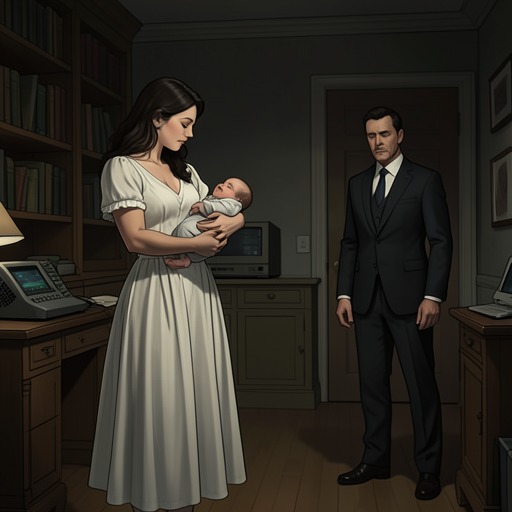
The Vampire Prince’s BrideThe Science Board's Demand for Fetal Research marks the moment when Shay's discovery of Gemma's pregnancy ceases to be a private medical and emotional revelation and becomes a public crisis for Stlozyn society. The pregnancy appears to offer a possible answer to the infertility disease ravaging Shay's people, but the Board's proposed solution would place Gemma and her unborn child under coercive scientific control. Shay must therefore choose between institutional advancement and the protection of his family, and his refusal turns him from a celebrated researcher into an opponent of the authority that once defined his future.
Causes and Scientific Stakes
Shay returned to Bronæl expecting the news of Gemma's pregnancy to be celebrated and broadcast through the information channels. He even imagined that it might lead to a human–Stlozyn breeding program. Instead, the Science Board ordered him to keep the pregnancy secret and reprimanded him. The reversal reveals how quickly wonder becomes containment when an institution encounters a biological possibility it cannot regulate.
The Board's interest is driven by the infertility disease devastating the Stlozyn population. Niqæsh, a bronze-scaled dragoness and member of the Board, tells Shay that his research may provide a cure, yet accuses him of refusing to take the necessary steps. Her charge is based on information supplied by Wynon, Shay's second, who proposed extracting DNA from the fetus developing inside Gemma. The Board considers fetal tissue especially valuable because DNA from a forming fetus would be more potent than material taken later. The language of research converts a developing child into a scarce resource, while the urgency of a population-wide crisis is used to justify removing the mother's power to refuse.
The Board's Demand
When Shay enters the Board's throne room, the members sit high above him in blue, the color of discipline. Niqæsh presses him to acknowledge that he knows exactly what she means: Wynon reported that he rejected the fetal-extraction proposal and threatened her. The Board treats his emotional response as professional misconduct, even though the conflict concerns his own child and the human woman he brought back to Bronæl.
Shay answers that the fetus is his child and insists on naming Gemma rather than allowing her to remain merely the human carrying a specimen. He argues that his findings on Earth already indicate that synthesized human DNA could be used to vaccinate uninfected Stlozyn against the disease. He further maintains that, after the child is born, DNA might be extracted without placing the baby at risk, and that continued research could eventually reverse the infertility crisis. His position does not reject science; it rejects the Board's demand that scientific usefulness outrank bodily safety and consent.
The Board rejects that distinction. Niqæsh concedes that fetal DNA would be more potent, then frames the refusal as a failure of duty. When Shay suggests a breeding program as an alternative way of addressing the population's need for children, she reveals that Wynon has formally requested custody of Gemma. The Board has agreed that giving the pregnant human to Wynon is in the best interests of Stlozyn society. Shay is told that he must comply or lose his position.
Consent, Power, and Defiance
The confrontation makes the medical ethics of the pregnancy explicit. Gemma is not consulted by the Board before custody is demanded, and the proposed research would expose both her body and the fetus to risks chosen by others. Wynon's description of her as a specimen, together with the Board's insistence that her pregnancy is the key to curing Stlozyn infertility, shows how technical vocabulary can obscure the person who bears the danger. The promised benefit belongs to an entire population, but the immediate physical risk is imposed on one human woman and one unborn child.
Shay's objection is grounded in informed consent. He argues that experimenting on a fetus unable to give meaningful consent violates the very ethics that science claims to uphold. Niqæsh answers that ethics have little use if Stlozyn people are dying childless. Her response turns demographic fear into a political weapon: because the crisis is collective, individual refusal is portrayed as selfishness. The Board's reasoning also exposes a hierarchy of personhood in which Gemma's status as an outsider makes her easier to seize and the child becomes valuable chiefly as a cure.
Shay refuses to surrender either of them. His anger is so intense that a flicker of flame escapes his mouth, and he struggles to prevent his dragon from taking control. Yet the scene presents his restraint as deliberate rather than weak. He does not answer institutional violence with an uncontrolled attack; he makes a decision. He will take Gemma away from Bronæl, keep her safe, continue his research, and seek a cure before the baby is born. The order therefore produces the opposite of its intended obedience: the Board's attempt to monopolize the pregnancy drives its most promising scientist beyond its authority.
Consequences and Narrative Significance
The immediate consequence is Shay's break with the official scientific structure. He is dismissed from the encounter under threat of losing his position, but his internal decision makes clear that professional status, his ship, and the prospect of a place on the Board are secondary to Gemma's safety. He intends to preserve the pregnancy and pursue the cure through methods that do not sacrifice the child. The event thus establishes the conflict that leads to the Science Board's later seizure of Gemma and its fetal-research program: the demand is not an isolated disagreement but the institutional premise for her abduction and experimentation.
The event also changes the meaning of Shay's discovery. At first, the pregnancy seems to promise celebration, public recognition, and perhaps a new reproductive future for two species. After the Board's intervention, the same pregnancy becomes a site of secrecy, surveillance, and threatened custody. Its scientific value increases the danger surrounding it. The child is simultaneously imagined as Shay's family, Gemma's pregnancy, and a possible biological instrument for saving an endangered people; the Board insists on the third definition, while Shay fights to preserve the first two.
Across the wider narrative, this confrontation echoes other scenes in which institutions regulate bodies through ritual, law, or custom. Cheryl is carried from the temple toward a royal future defined by reproductive duty before choosing a shared bond with Bjorn and Maskin. Kinai society restricts knowledge of Joining to preserve communal secrecy, while Harrod's transformation is witnessed as a den-wide rite of succession. Against those systems, the Science Board's order is notable for presenting coercion as rational administration. It claims to protect the species, yet its first practical act is to deny Gemma a choice.
The event's decisive value shift is from anticipated celebration to threatened captivity, and from scientific promise to moral resistance. Shay entered expecting recognition and left prepared to become a fugitive protector. The Board believes that the fetus may cure Stlozyn disease; Shay believes that a cure obtained by violating Gemma and the child would destroy the ethical foundation of the science meant to save them. His final resolve gives the pregnancy its larger significance: it is not merely evidence of cross-species fertility, but a test of whether a civilization facing extinction will preserve consent when survival appears to demand its abandonment.