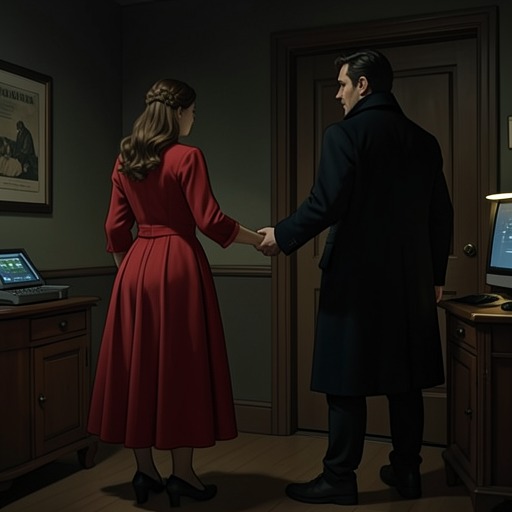
The marital relationship between Darius and Cleo
The Vampire Prince’s BrideDarius and Cleo’s marriage is both a dynastic arrangement and the emotional center of Darius’s transformation. He chooses Cleo as his human wife because the succession crisis requires a vampire leader with credible relations with humans, but the marriage soon exceeds its political purpose. What begins as a calculated union between an ambitious vampire colonel and a human woman seeking luxury, power, and queenship becomes a relationship in which both partners risk status, safety, and life for one another. Its decisive significance lies in the way public duty and private attachment gradually cease to be separable: Cleo helps make Darius a viable future king, while Darius ultimately abandons career security and political obedience to save her and their unborn child.
Political Foundation and Mutual Ambition
Darius marries Cleo after Iosif and Iosif’s human mate leave no doubt that the next vampire ruler must demonstrate good relations with humans. The marriage therefore answers a structural problem in vampire society rather than beginning as a spontaneous romantic choice. Humans are indispensable to vampire survival because vampires are born vampires, usually male, and cannot simply create new vampires by turning human partners. Humans who live among vampires and are regularly fed from may age slowly, become stronger and faster, and develop a taste for blood, but they remain human. Without human wives such as Cleo, the vampire population would become extinct within three generations. Cleo’s body and social position consequently carry dynastic importance from the moment she enters the marriage.
Cleo is not presented as a passive political instrument. Darius chooses her partly because she is beautiful, but more importantly because she openly wants a husband capable of giving her wealth, authority, and the position of queen. She wants queenship as intensely as Darius wants kingship, and she is prepared to do what is necessary to secure it. Her confidence, composure, intelligence, and resistance to purely emotional decision-making make her an unusually useful partner for a man pursuing advancement from outside the higher houses. Their ambitions initially align through calculation: Darius needs a human wife and a politically effective household, while Cleo wants access to the power and luxury that his rise can provide.
The marriage also establishes a contrast between military and diplomatic power. Darius thinks in terms of hunting Rebeluna and winning battles, whereas Cleo imagines an outreach program for vampire relations with the outliers and plans aid for regions damaged by flooding after the earthquakes. Her instinct is to use kindness to alter the direction of war, not merely to defeat an enemy. Darius recognizes this as a valuable form of alliance-building because humans are central to the continuing vampire–shifter conflict. Cleo’s political usefulness therefore extends beyond the symbolism of being human: she offers a different method of rule.
From Arrangement to Love
The relationship develops through a classic shift from strategic marriage to mutual attachment, but the change is gradual and initially resisted by both partners. Darius’s early attraction contains possessiveness; even after the wedding, he cannot tolerate the thought of another man touching Cleo. That impulse later becomes more complex. He still wants to protect her, but he also wants to give her everything she desires and see her honored as queen. His ambition becomes relational rather than exclusively personal: becoming king matters partly because it would make Cleo queen.
Cleo, meanwhile, guards herself against emotional dependence. When Darius tells her that he is glad to have chosen her and that they are going to have a child, she feels warmth but fears what loving him might demand. Her past includes poverty and abandonment, and she refuses to imagine herself surrendering ambition for a man. She therefore treats love as a danger to the independence she fought to obtain. The marriage’s emotional tension comes not from indifference but from the fact that both partners recognize attachment before either is willing to name it.
The pregnancy disclosure becomes the first major test of trust. Cleo is three months pregnant but has told no one, including Darius. She claims that his pursuit of Rebeluna has seemed more important and that she did not want to distract him. She also tries to conceal the pregnancy’s scent with extra fragrance and waits for a special moment to reveal it. Darius initially interprets her silence as a possible lack of trust and worries that she might have been considering termination without telling him. Cleo explains that she had wanted the announcement to be meaningful, not secretive. The misunderstanding resolves when he understands that the concealment arose from her wish to create a private, special moment.
Darius’s response marks a change in the marriage’s emotional terms. He tells Cleo that they may not have loved each other at the beginning, but the child is theirs and she is entitled to be happy about the pregnancy. His acceptance gives her permission to experience joy without treating it as weakness. The scene joins bodily intimacy, reproductive duty, and emotional recognition: the child is necessary to vampire continuity, yet Darius refuses to reduce the pregnancy to dynastic utility. Cleo’s happiness becomes a shared value rather than merely a successful outcome of their political arrangement.
The War and the Proof of Commitment
The marriage is tested when Cleo is taken hostage during the conflict with Rebeluna. Darius understands that rescuing her may cost him his life, destroy the career he has fought to build, and make him appear a traitor. He knows that he possesses coordinates that could help locate the shifters, yet he chooses not to use that advantage if doing so would endanger Cleo. He warns Gordon that he will go even if the shifters kill him, even if the king executes him, and even if the decision erases his military progress. His declaration that he cares only about Cleo and will not lose her turns the marriage from political partnership into an absolute personal commitment.
This choice reverses the original logic of the union. Darius first needs a human wife to satisfy the requirements of succession; during the hostage crisis, he risks succession, military honor, and royal favor for the woman herself. The marriage ceases to be a means toward power and becomes the reason he is willing to sacrifice power. His willingness to threaten even Gordon, his closest friend, shows that the decision is not symbolic. Cleo’s life has become more important to him than obedience, reputation, and survival.
Before confronting the Alpha, Darius tells Cleo that he is fighting for more than his opponent is fighting for: he is fighting for the woman he loves and the child she carries. Cleo asks whether he loves her, and he answers yes. She then admits that she loves him too, saying that she does not know when the feeling began but that it has become real. The confession arrives under mortal pressure, making explicit what both had previously treated as a dangerous distraction. Their love is not added to the marriage from outside; it is revealed as the truth that their shared ambition and repeated acts of protection had been concealing.
The confession also transforms their understanding of the lost time before the crisis. Darius wishes they had been brave enough to admit their feelings sooner and regrets not having been present through every stage of Cleo’s pregnancy. His questions about morning sickness and his touch on her swollen belly move the relationship from abstract declarations to domestic concern. Love is expressed not only through the willingness to fight but through attention to the ordinary bodily experiences that war and ambition had kept him from witnessing.
Family, Trust, and Royal Future
After the conflict, Darius and Cleo have a son, Tobar, and Darius becomes the king’s heir. These outcomes fulfill the public purposes that first brought them together, but the emotional meaning of the ending is more important than the political reward. Holding the infant, Darius says he is grateful for Cleo, their son, the peace, his position as heir, and, above all, having saved her. The order of his gratitude reveals the marriage’s final hierarchy: royal advancement remains valuable, but Cleo’s survival and their family matter more.
Their post-crisis relationship is organized around openness. Cleo says she is glad they have adopted a policy of sharing secrets because she discovers that there is much about her life she wants to tell him. The statement answers the earlier pregnancy concealment and converts secrecy from a source of fear into a lesson in mutual trust. The marriage does not become intimate because ambition disappears; rather, ambition can now coexist with disclosure, affection, parenthood, and peace.
Cleo’s final emotional position confirms that the marriage has given her more than the queenship she originally pursued. She has achieved what she fought for, yet she understands that she has gained something beyond wealth, rank, and political power: Darius’s love and the certainty of her own love for him. Even if every external possession were taken away, she believes that love would sustain her. The conclusion therefore reframes her ambition without denying it. Cleo does become a figure whose political aspirations matter, but the narrative treats her emotional bond with Darius as an additional form of fulfillment rather than a replacement for her agency.
Narrative Significance
Darius and Cleo’s marriage embodies the book’s recurring entanglement of reproduction, politics, species survival, and intimate choice. The vampire need for human wives makes their relationship socially consequential before it becomes personally meaningful. The marriage is initially a transaction shaped by succession, status, and reproductive necessity, while Cleo’s later outreach plans show how a human queen might influence relations between vampires, humans, and shifters through policy rather than force. Their relationship thus carries both institutional and emotional stakes.
At the same time, the marriage’s development exposes the limits of treating intimacy as a calculated alliance. Darius believes he has chosen Cleo because she fits his political needs, and Cleo believes she can enter the arrangement without allowing love to compromise her goals. Both are surprised by feelings that resist their original calculations. Their union becomes reciprocal through a sequence of disclosures, bodily vulnerability, shared pregnancy, danger, confession, and rescue. The relationship’s final form is not a rejection of ambition but a synthesis in which power, family, trust, and love reinforce one another.
The ending gives the marriage a distinctly affirmative resolution. Darius and Cleo survive the war, reconcile private feeling with royal duty, welcome Tobar, and move toward a peaceful future in which Darius is heir and Cleo is positioned to become queen. Their story begins with the practical need to preserve a species and ends with a family that understands survival as more than continued existence. For both partners, the marriage ultimately becomes the place where political destiny acquires personal meaning.