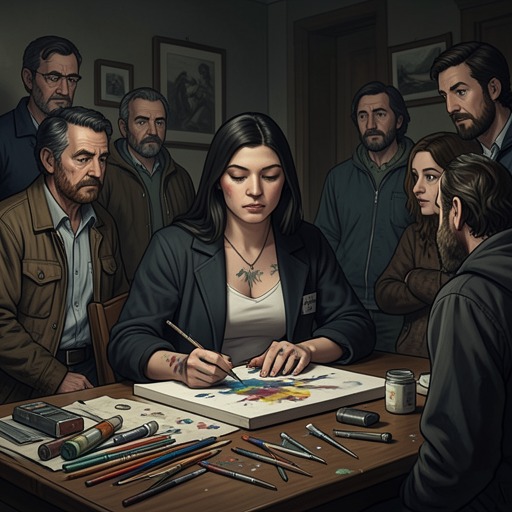
Thor Wragge
The Vampire Prince’s BrideThor Wragge functions as the most immediate human-scale antagonist in Piper Diamond’s story. A warlock and rival gallery owner, he represents the commercial logic that threatens Piper’s handmade art, her financially precarious business, and the independence she refuses to surrender. His menace is rarely presented through open violence; instead, it works through persistent acquisition attempts, calculated intrusion, sexualized appraisal, and the suspicion that he may be willing to exploit the gallery’s vulnerability.
Identity and Commercial Rivalry
Wragge owns a knockoff art souvenir shop directly across the street from Piper’s gallery, though he presents the business as another gallery. His basement operation uses magic to produce reproductions continuously, including replicas of famous works such as the Mona Lisa and kits designed to transform an entire room into something resembling the Sistine Chapel. The practice is technically legal because he does not falsely claim that the copies are originals, but its legality does not make it artistically honorable. His products are described as cheap, derivative, and lacking originality, placing him in direct opposition to Piper’s belief in the value of a real brush and an individual artist’s hand.
The rivalry is therefore more than a disagreement between neighboring businesses. Piper’s gallery survives only with difficulty. Even after her father gave her a house to help her get established, she quickly spent her savings opening the small gallery and has had to work merely to break even each month. Wragge sees that fragile enterprise as wasted potential that could be absorbed into his more profitable model. Piper sees his replicas as the cultural surrender of original art to convenient consumption. Their conflict joins a personal feud to a broader contrast between singular creation and magical mass production.
Pressure on Piper
Wragge repeatedly attempts to buy Piper out. His language presents the offer as generosity, but its underlying effect is coercive: he wants control of the space, the business, and what Piper has built there. When he enters the gallery, Piper immediately recognizes what she experiences as his greedy, slimy aura and tells him that an offer to buy her out will be rejected. Wragge responds by praising the shop as a place where he could do “wonders,” while also suggesting that Piper herself is part of the property’s unrealized potential. His attention turns the negotiation into a violation of personal boundaries.
Piper’s reaction makes clear that Wragge’s pressure is not confined to economics. He tends to ogle her, and she folds her arms across her chest when confronting him, both resisting his gaze and physically closing herself against it. His comments about her and the gallery combine commercial appropriation with sexual appraisal. When she tells him to leave, he smiles, smirks, and withdraws without conceding anything, preserving the sense that each encounter is only one round in a continuing campaign.
Wragge’s presence also activates Baxter’s protectiveness. Baxter, Piper’s attentive Werewolf mate, has previously faced off with Wragge and nearly attacked him. Piper is relieved that Baxter is absent during one confrontation because Baxter already struggles to find work simply because he is a Werewolf, and an assault charge could make his situation worse. Wragge thus becomes a pressure point in the couple’s life: he threatens Piper’s livelihood, provokes Baxter’s anger, and creates circumstances in which defending Piper could damage Baxter further.
Suspicion and Escalating Intrusions
The conflict sharpens when Piper’s gallery is targeted by vandals and burglars. The damage leaves shattered glass for her and Baxter to clear, while the heating system works overtime and threatens to produce an expensive bill. Piper has recently received ten thousand dollars and hopes the remaining money might cover repairs to the rattling car, but the gallery’s damage immediately converts that financial relief into another practical crisis.
When Wragge steps out of his convertible Corvette and approaches the damaged gallery, his expression appears deliberately innocent. Piper suspects that he may have had something to do with the previous night’s destruction. The evidence does not establish that he ordered or carried out the vandalism, but the timing and his conduct make him a plausible suspect in Piper’s eyes. He walks through the debris she has swept together and greets her as though the destruction were merely an unfortunate inconvenience, observing that she has had “some trouble last night.” His manner turns the ruined storefront into a taunt: he can inspect the consequences while avoiding responsibility.
Later, Wragge intrudes again while Piper is with Baxter and Patrick Giles. She is already struggling to determine whether she can accept Patrick’s request to join her and Baxter in a trois amour, a three-way mating group. A customer’s entrance briefly interrupts her attempt to ask what the three of them might become, but the newcomer is not a customer at all. Recognizing Wragge, Piper’s suppressed anger returns with force. She tears herself from Baxter’s arms and marches toward him, demanding to know what he is doing there. Wragge again hides behind the language of commerce, claiming that perhaps he is interested in buying something.
Public Performance and Narrative Role
Wragge’s later appearance at a social gathering extends the rivalry beyond the gallery. Piper is discussing her abstract paintings when she sees him across the room. Her hand tightens around her champagne glass, her eyes narrow, and her lip curls before the narration even needs to describe an exchange. Wragge is visibly ill at ease in the fashionable crowd, and his suit does not compare well with the clothing around him, yet he has entered the same social sphere as Piper and her allies. His presence contaminates what might otherwise have been a celebratory or intimate occasion.
This scene reveals the limits of his power as well as its persistence. Wragge can threaten Piper’s business and unsettle her private life, but he does not fully belong in the social world she is entering. His commercial confidence weakens in a setting where taste, attraction, and reputation cannot be manufactured as easily as his basement reproductions. Even so, his appearance demonstrates that he is not content to remain across the street. He follows Piper into spaces where his business leverage is less direct, keeping the conflict alive through sheer intrusion.
Wragge can be read as a distorted threshold guardian in Piper’s plot. He stands at the boundary between the life she has built through difficult creative labor and the easier, more profitable surrender represented by his shop. Unlike a guardian who tests a hero openly, he disguises pressure as opportunity. His repeated offers ask Piper to abandon not only a building but also a principle: that original work deserves protection even when imitation is cheaper, easier, and legally defensible.
Characterization and Significance
The available episodes do not give Wragge a redemptive turn, a revealed vulnerability, or a final defeat. Instead, they establish him through recurrence. He appears whenever Piper’s economic anxiety, artistic frustration, or romantic uncertainty is most exposed. His greed is visible in his shop, his magical reproduction system, his attempts to purchase the gallery, and his appraisal of Piper herself. His possible connection to the vandalism remains a suspicion rather than a confirmed fact, preserving an element of uncertainty around the damage without proving more than the evidence supports.
His most important function is to make Piper’s choice concrete. Piper must decide what she wants from life while her gallery faces financial trouble, vandalism, burglary, and the prospect of being converted into a distribution point for cheap reproductions. Wragge gives that decision a face and a voice. He is not simply an unpleasant neighbor; he embodies the future Piper rejects: a future in which art becomes a product of magical repetition, creative labor becomes an asset for acquisition, and personal boundaries are treated as negotiable. Against him, preserving the gallery becomes an act of artistic and personal self-definition.