Tom
The Vampire Prince’s BrideTom is a T'shav warrior whose story links martial inheritance, interstellar rescue, destined partnership, and the lost history of humanity. Introduced as a formidable traveler with little patience for delay, he is eventually revealed not only as Zon’s agent and son, but also as Lisa’s brother—the scientist whose work on faster-than-light travel becomes part of the civilization that outlives him. His plot trajectory therefore moves in two directions at once: forward, through his bond with Sara and his effort to save humans in stasis, and backward, through Lisa’s discovery that Tom helped make humanity’s migration from Earth possible.
Identity and Background
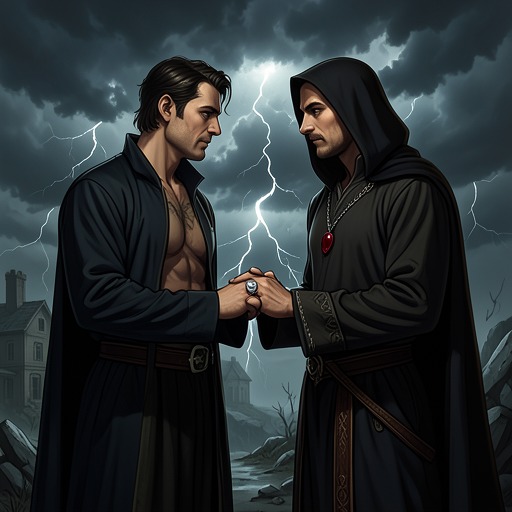
Tom’s T'shav identity shapes how strangers respond to him. At the power station, other customers assume that a T'shav is waiting for the smallest excuse to disembowel someone, and they clear a path rather than risk provoking him. Tom is accustomed to that fear and uses it practically, but the narrative also establishes that his reputation is backed by real martial ability. He is the son of Zon, the warlord protector of the Rouge Systems, and describes himself as the child of a T'shav warlord who trained him to be a warrior. His broadsword and daggers are not ornamental possessions: they are the tools through which he understands danger, competition, and protection.
That warrior identity is complicated by his family role and covert work. Tom is operating as one of Zon's agents when he encounters Sara, and he is pursuing a mission to retrieve a ship carrying humans in stasis. His assignment is not to exploit those humans but to bring them to a planet where they can awaken and establish a human sanctuary. Because he needs a Corps officer to pass security checkpoints, his attraction to Sara is accompanied by a concrete operational objective. The combination makes him neither a simple romantic hero nor merely a soldier: his personal destiny and political responsibility become inseparable.
The Starmate Revelation and the Festival
Tom’s decisive transformation begins when an advertisement projects the image of Sara, a blue-skinned United Species Corps officer chosen to serve as the Goddess of the Fifth Cycle Festival. He recognizes her before knowing her name. The sight produces an immediate bodily response—his heart skips, his attention narrows to her face, and the desire to claim and protect her overwhelms everything else in the advertisement. The emotional intensity is not presented as a gradual courtship. Tom understands it through the T'shav belief that souls are born in the stars and can be separated into two mortal bodies. He has searched for the other half of his soul since childhood and identifies Sara as his Starmate at once.
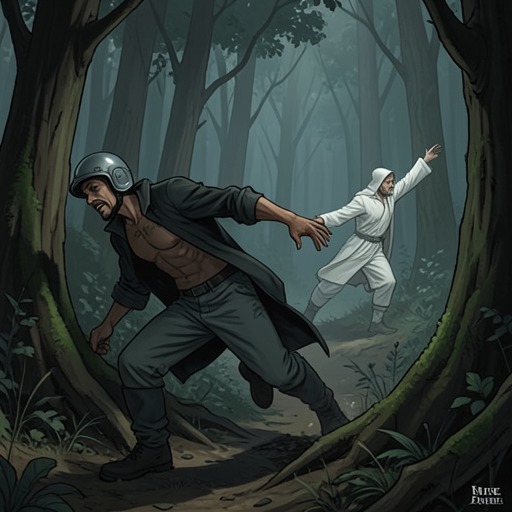
The festival turns that recognition into a public and violent contest. Men of different species enter a fighting enclosure marked by silver disks, and Tom pays the required two helix quarks to join them. He treats the caged battle as an advantage because it will keep the competitors contained while he eliminates them. As the fight progresses, bodies cover the ground and the dirt becomes red mud. Tom kills opponents who attack him, then faces the last remaining T'shav warrior with his broadsword drawn.
The older warrior offers him a chance to surrender, but Tom refuses because the woman selected as the festival’s Goddess is his Starmate. He declares that he would put an entire planet in its grave before surrendering her. The statement exposes both the grandeur and danger of his early response: Tom sees the contest as a legitimate route to Sara because the festival’s social order has made her a prize. Sara, watching from the platform, appears angry rather than receptive, and the narrative preserves the difference between Tom’s certainty and her unwillingness to be treated as property.
The elder T'shav finally reveals that he once met his own Starmate on the day she died and was hired by the Ruziers Corporation to claim her. His warning gives Tom’s quest a larger threat. Sara is not endangered only by the festival competitors; corporate interests will continue pursuing her, and Tom is told to remain vigilant. Tom wins the immediate struggle, but the encounter reframes victory as the beginning of responsibility rather than the end of a tournament.
Bond, Mission, and Rescue
After the festival, Tom identifies himself to Sara as Bond, a name that prompts her comparison to 007. The alias emphasizes his covert role while also allowing him to approach her outside the public spectacle of the contest. Their first physical encounter is charged by the Starmate bond: he pulls her close and pins her against a wall, while Sara experiences an attraction she does not fully trust and recognizes that she has reason to resist him. Tom moves away before the encounter becomes more consequential, giving the scene a boundary that matters to the later relationship.
Tom eventually tells Sara that he believes she is his Starmate. She responds with alarm rather than romantic acceptance, and he acknowledges that destiny alone offers no logical reason for her to remain with him. He therefore explains his other reason for seeking her: he is trying to retrieve a ship filled with humans held in stasis and needs a Corps officer to help him pass security checkpoints. His mission is directed toward settlement and survival. The humans are meant to awaken on a planet that can serve as their sanctuary, making Tom’s private pursuit part of a broader rescue of an endangered or displaced population.
The conflict with the United Species Corps forces Tom to disclose the political dimension of his identity. When Sara learns that he is one of Zon’s agents, she initially has reason to suspect that he may be working for the corporation involved in the human cargo. Tom insists that his purpose is different, and his actions support that claim. During the escape, Sara removes one of her bionic eyes and uses it as a stun grenade, leaving an empty socket temporarily visible while she helps secure the opposing patrol. Tom is astonished by the weaponized prosthesis, but he also recognizes her effectiveness; her technology and initiative make her an active partner in the rescue rather than a passenger waiting to be saved.
Tom then uses his family name as a strategic weapon. From his ship, he hails the United Species vessel, identifies himself as the son of Zon, and warns that half of his father’s fleet is approaching. The opposing colonel’s ship withdraws almost immediately. Tom activates the anchors on the cargo ship, secures the human vessel with a net, and sets a course away from the danger. The rescue confirms that his claim to be helping the humans was genuine, while his connection to Zon supplies the force necessary to complete it.
Family, Pregnancy, and the Human Legacy
Tom’s relationship with Sara becomes a family bond as well as a Starmate bond when she tells him that she is pregnant with his child. She expects that he may reject both her and the pregnancy, but Tom responds with wonder rather than withdrawal. The disclosure confirms that their relationship has moved beyond the coercive circumstances of the festival and the uncertainty of their first encounters. It also joins Tom’s personal future to the human sanctuary he is trying to establish.
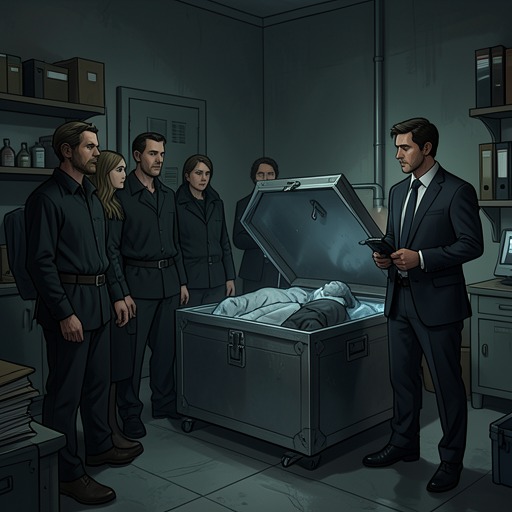
Tom’s connection to Lisa is revealed from another chronological and emotional angle. Lisa, abducted from Earth and placed in cryostatus, hears references to hadron particles, quarks, and light-speed travel during an alien auction. Those terms recall her research into geo-nuclear radiation and her brother’s work as an astrophysicist and engineer. She remembers that Tom had promised to solve the temporal distortion associated with faster-than-light travel before her thirtieth birthday, though she does not know how much time has passed since her abduction.
The revelation becomes undeniable when Lisa finds a projection of Tom in a position of honor. The image reproduces his appearance, including his hair, eyes, posture, hands in his pockets, and slightly sheepish expression. The accompanying account credits an unnamed man with correctly theorizing how to avoid temporal distortions in faster-than-light travel, allowing his descendants to leave Earth without suffering the effects that harmed earlier travelers. Lisa identifies the man as her brother and addresses him as Tommy, recognizing that he continued his work and left behind a legacy long after her disappearance.
This memorial scene changes Tom’s place in the larger history. To the societies that preserve the projection, he is an unnamed scientific pioneer; to Lisa, he is the brother who moved with her through foster families after their parents died. His legacy is therefore both civilizational and intimate. The same person associated with a theoretical breakthrough is remembered by Lisa through his posture, his promise, and the relief of knowing that he did not give up. Her farewell confirms that Tom’s influence survives not merely as technological progress but as the condition that made humanity’s escape from Earth possible.
Narrative Significance
Tom’s arc combines the quest, rescue, discovery, and love patterns without reducing any of them to a single function. He begins by treating the Starmate revelation as a command to fight, yet the plot gradually tests that instinct against Sara’s anger, skepticism, professional autonomy, and ability to act under pressure. His progress is measured less by abandoning strength than by redirecting it: the same warrior who enters a blood-soaked contest later uses his inheritance, his agency, and his military connections to protect Sara and the humans in stasis.
The character also embodies a posthuman redefinition of family. Tom’s story crosses T'shav culture, United Species technology, bionic anatomy, cryostatus, faster-than-light travel, and cross-species reproduction. Sara’s bionic eye becomes a weapon, Tom’s Starmate bond is experienced through the body before it is accepted intellectually, and their child links separate biological and social worlds. The narrative treats identity as something made through bodies, machines, ancestry, and chosen responsibility rather than through a pure or isolated human origin.
Finally, Tom’s apparent disappearance from Lisa’s life does not end his narrative presence. Lisa’s grief at the memorial is paired with pride and renewed strength: knowing that Tom continued his life gives her the courage to continue hers. His ending is thus a form of historical afterlife. Tom is simultaneously a living warrior in Sara’s plot, a brother preserved in Lisa’s memory, a father whose child is on the way, and the unnamed theorist whose solution to temporal distortion helped shape the future of humanity.