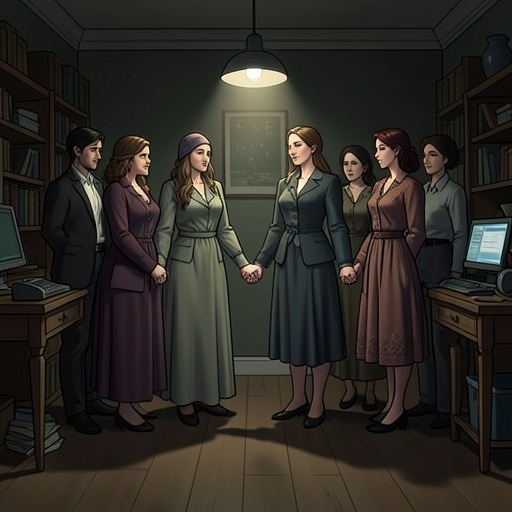
Transformation of Matheus's harem into a school
The Vampire Prince’s BrideTransformation of Matheus's harem into a school is the reform through which Alice repurposes Matheus's former harem as a place of education, magical practice, and collective defense. What had been associated with service and confinement becomes a school in which the girls can learn to read, write, and use magic, gaining a chance to become something more than servants while helping protect Alice's family.
Causes and New Purpose
The transformation takes place after Matheus has begun reshaping his political order. Over the following months, he removes nobles who will not bend to his rules and replaces them with people willing to obey, while relations with neighboring nations gradually improve. Against that backdrop of institutional change, Alice undertakes a parallel reform inside the household. Her project does not merely alter the function of a room or repurpose a building; it changes what the girls are expected to be and what resources they are allowed to possess.
Alice turns the former harem into a school because she has grown attached to the girls and wants them to have an opportunity beyond domestic service. Education becomes both an act of affection and a practical strategy. By teaching the students, she creates a new form of guard capable of helping keep her family safe. The school therefore joins two aims that might otherwise seem separate: personal advancement for the girls and collective security for the household.
Classes and Magical Instruction
Alice teaches literacy alongside magic. The curriculum includes reading and writing, but the classroom scene shows that magical instruction is already concrete and practical rather than merely theoretical. Alice explains that love potions vary in potency and react differently according to their ingredients. Bachelor's Buttons can influence love and help reveal whether a relationship is meant to be, whereas cinnamon acts as an aphrodisiac, producing lust rather than love. Her lesson distinguishes emotional attachment from physical desire and treats magical knowledge as something that must be understood carefully.
The warning also establishes the risks of careless practice. Alice tells the students to remember their book on love potions and jokes that she will not be responsible if they accidentally make their true loves turn purple. The humor softens the lesson, but the underlying point is serious: magic has differentiated effects, and misunderstanding those effects can produce visible and potentially disruptive consequences.
The students are not passive recipients of symbolic empowerment; they are learning specific techniques. Alice reports that Lindsey has already mastered basic fire spells, although her first attempt nearly set her hair on fire. That near accident shows both the promise and danger of the new education. The girls are acquiring abilities that can make them useful defenders, but their training also requires supervision, repetition, and a teacher willing to tolerate early mistakes.
Care, Authority, and Daily Practice
The school operates within Alice's domestic life rather than outside it. During the lesson, Alice balances her barely month-old daughter, Emma, in the crook of her arm while moving between the desks. The image places instruction, motherhood, and institutional reform in the same physical space. Alice is not represented as abandoning care in order to pursue authority; she exercises authority while caring for her child and while remaining closely involved with the students.
When Emma becomes fussy, Alice dismisses the class and reminds the girls to finish reading their book by the end of the week. Afterward, she settles behind her desk to feed the baby. The classroom thus remains a lived household environment, with its schedule shaped by the needs of an infant as well as by the demands of study. The interruption does not cancel Alice's role as teacher. Instead, it reveals a model of leadership in which care is part of the institution's ordinary operation.
Alice's conduct as Emma's mother reinforces that principle. Although many people are available to watch the child, she insists on being the primary caretaker because she does not want Emma to remember being raised by a group of nannies. Her decision parallels the school reform: in both cases, Alice resists impersonal arrangements and chooses direct, sustained responsibility. Her work with the girls and her care for her daughter are presented as connected forms of protection and attachment.
Consequences and Continuing Reform
The immediate result is a functioning school whose classes are progressing without major mistakes. Alice acknowledges that some of the girls still struggle to remember which ingredient or spell produces which effect, but she is proud of their development and especially of Lindsey's progress. The girls' advancement gives substance to the promise that they can become more than servants, while their magical training supplies the beginnings of the protective force Alice intended to create.
The reform also changes the emotional atmosphere of the former harem. Alice has taken the girls under her wing, and their education is described as a chance to become something more. The space is no longer defined solely by its former institutional role; it now holds desks, lessons, books, spells, and the possibility of self-development. Its transformation is consequently social as well as architectural, replacing dependence with knowledge and treating the former occupants as students with futures.
The event's domestic aftermath is deliberately quiet. Matheus enters after class, asks how the lesson went, and helps Alice to her feet after Emma finishes feeding. He then leads her into the hallway and suggests dinner once the baby is asleep. Alice agrees and considers asking Matheus's mother to watch Emma so that they can have a night to themselves. This closing movement places the school's reform within a continuing family life: political change, magical education, infant care, and intimacy coexist rather than appearing as isolated storylines.
Narrative Significance
The transformation is a constructive counterpart to Matheus's political purge. He consolidates power by removing nobles who refuse his rules, while Alice builds loyalty and safety by teaching people who had previously been confined to service. Their methods differ, but both reshape inherited structures. The contrast gives the event its larger significance: authority can be secured through obedience imposed from above, yet a more durable community may also be built through education, affection, and participation.
The school therefore embodies a shift from possession to cultivation. The girls are not simply reassigned within the same hierarchy; they are given literacy, magical knowledge, and a role in defending the family. Alice's classroom joke about turning true loves purple captures the reform's tone—warm, playful, and domestic—while the fire-spell accident and the need to distinguish lust from love preserve an awareness of danger. The former harem becomes a place where knowledge can create both freedom and responsibility, making Alice's reform one of the clearest local expressions of the book's movement toward a changed social order.