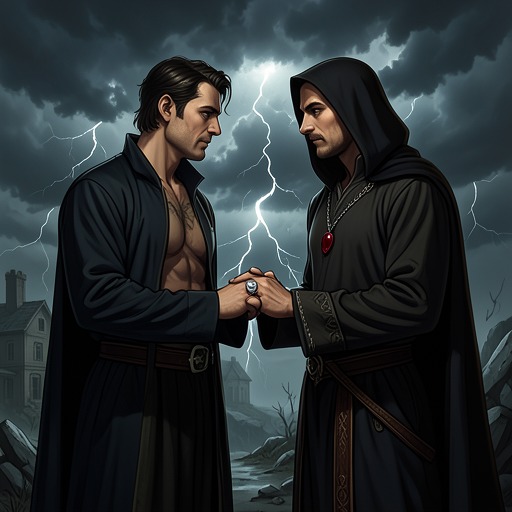
True mate bond
The Vampire Prince’s BrideThe True mate bond is the novel’s most consequential form of intimate attachment: a connection recognized through instinct, altered bodily response, supernatural signs, and, in some species, reproductive law. It is not simply attraction or parenthood. The text distinguishes the bond from ordinary dating, sex, and even the existence of a shared child, presenting true mating as a commitment that becomes effectively unbreakable once the pair accepts it. The bond can protect a life, redirect a succession, expose a hidden identity, or turn a relationship into a struggle over autonomy and possession.
Definition and Recognition
The bond is often recognized before the characters can explain it. In the Drakonaar storyline, Prince Darilth’s inner dragon, Mekarth, identifies Ella as his true mate, while the Draco’s Eye confirms the recognition through a physical reaction. The silver band containing the Eye glows blue; Darilth feels constriction in his chest and a tug at his heart, an intensity he has never experienced before. The recognition is therefore simultaneously emotional, bodily, and technological-magical. It is not established by courtship or rational compatibility, but by an external sign that makes an otherwise uncertain relationship appear destined.
Darilth had already been warned that his true mate would come from another world and would be different even among her own kind. After leaving Earth, he cannot stop thinking about Ella, remembers her scent and the taste of her lips, and watches her sleep in a capsule while wondering whether she will accept marriage when she awakens. His certainty arrives before her consent or understanding. When he finally explains the bond, he tells Ella that he is the heir to the Rothgar throne and that she is his mate, then places the silver band on her wrist. The band contracts to fit her, and its blue stone shines brightly, turning an inward conviction into visible proof.
The Draco’s Eye also gives the bond a dynastic function. Darilth explains that the stone contains the magic and part of the soul of the Dragon Queen, transferred before her death, and that it was later set into the silver band by her successor. The Eye can be awakened only by a woman who is a true mate to the crown prince of the Rothgar throne. The relationship is thus not merely private: Ella’s ability to awaken the Eye validates Darilth’s royal lineage and links personal union to the survival and legitimacy of the Royal Drakonaar bloodline.
Biological and Emotional Force
The bond operates through the body before it becomes a spoken declaration. Its signs include scent, desire, heart sensations, involuntary attention, and an instinctive refusal to cause harm. When Erdal tells Natalie that she is his true mate, he links recognition directly to his inability to kill her. He says that their race can impregnate only the woman destined to be a true mate, a belief dismissed by many as an ancient myth but preserved in the memory of the elders. The bond therefore governs both emotional attachment and reproduction, making Natalie’s safety inseparable from Erdal’s understanding of his own nature.
Erdal’s relationship with Natalie also shows that true mating can clarify a feeling distorted by resemblance and memory. When Natalie asks why he tried to save her despite believing that she hated him, he explains that she reminds him of another woman. He then corrects the comparison: the earlier woman was not his mate, while Natalie is. He insists that his love for Natalie is directed toward her as an individual rather than toward an image of the past. Recognition does not merely intensify desire; it forces him to separate inherited grief and remembered love from the relationship that the bond identifies as real.
The werewolf narrative gives the bond a related but distinct form. Roland and Melissa understand that duty and sexual activity have not made them mates. They have been trying to produce children for a year because the pack requires an heir, yet neither feels the connection associated with true mating. Roland’s father described mating as something that occurs when the partners meet and becomes solidified when they have sex for the first time, almost like a holy sacrament. Love is therefore not ornamental in this system. It is the condition that makes the mating genuine and, according to the pack’s belief, improves the chance of pregnancy.
When Roland carries Claire into the guesthouse, his response is immediate and physical. Her warmth and scent make him want to howl, while his wolf demands that he claim her and acknowledges her as his mate. His earlier refusal to turn a human woman into a werewolf merely to produce children contrasts with this later recognition. Claire is not selected because she is useful to the pack; the wolf’s response identifies her before the reproductive obligation can be imposed. The contrast exposes the difference between a mate bond and a social breeding duty, even though the pack repeatedly attempts to make the two serve the same institutional purpose.
Difference from Ordinary Mating and Parenthood
The shifter account explicitly separates the bond from ordinary romance. When Betty assumes that Jace must be Amanda’s mate because he may be Logan’s father, the response rejects the equation between producing a child and becoming mates. Shifter mating is described as broadly resembling human love at first: partners date, experiment with sex, choose wrongly, and suffer heartbreak. The decisive difference comes when a pair commits. At that point, a bond forms that cannot be broken, and there is no later falling out of love.
The novel gives this permanence a physiological explanation. Exposure to a mate’s sight, sound, or scent causes the shifter brain to release bonding chemicals not found in human brains. The bond is therefore represented as more than a romantic metaphor, although it still passes through recognizable human experiences of attraction, uncertainty, and sexual experimentation. The text preserves a space for choice and error before commitment, then marks true mating as a threshold after which ordinary romantic reversibility no longer applies.
This distinction also complicates the language of belonging. A true mate is someone recognized as uniquely destined, but the recognition does not automatically settle how the relationship should be lived. Clarissa confronts Amanda and Jace by insisting that they are still in love and belong together, urging Amanda to admit her love and Jace to end his relationship with Clarissa. Her intervention treats the mate bond as an ethical claim that existing commitments cannot indefinitely conceal. At the same time, the scene shows that recognition can be delayed by fear, secrecy, and social arrangements even when the emotional connection remains visible to others.
Consent, Possession, and Social Order
The bond carries a persistent tension between mutual attachment and unilateral claim. Darilth’s inner dragon urges him to claim Ella immediately after the Draco’s Eye awakens, and Darilth’s months of watching her sleep show how certainty on one side can precede comprehension on the other. His declaration that Ella is his mate establishes a supernatural fact within the story, but it does not itself demonstrate that Ella has chosen the relationship. The bond can identify a partner; it cannot erase the narrative problem of consent.
That tension becomes especially visible when mate language is connected to bodies and reproduction. Erdal’s statement that his species can impregnate only a true mate reassures Natalie that he will not harm her, yet it also places her body inside a species-level reproductive rule. Roland’s pack similarly treats mating as the route to an heir and the protection of the pack during the three nights of the full moon, when its wolves become bloodthirsty monsters. In both cases, the bond may offer recognition and protection while simultaneously drawing the woman into dynastic or communal expectations.
The novel also presents an alternative in which relationship structure is negotiated rather than dictated by a single bond. Cheryl chooses both Bjorn and Maskin, declaring that if one has her, the other does as well, and that neither will be alone with her. She requires them to remain together and threatens to reject both if they fight again. This arrangement does not erase the language of chosen partnership, but it resists the assumption that a legitimate mate relationship must be exclusive or controlled by one claimant. Her decision makes relational rules explicit and places the terms of the bond, or of bonds, under her authority.
Narrative Function and Significance
The True mate bond repeatedly converts private feeling into public consequence. For Darilth, Ella’s recognition awakens the Draco’s Eye and supports a royal succession. For Erdal and Natalie, it explains why violence gives way to protection and ties love to the possibility of pregnancy. For Roland and Claire, it disrupts an arranged reproductive duty and creates the basis for a new pack future. For Amanda and Jace, it becomes the truth that other relationships and years of avoidance cannot permanently suppress.
The bond also supplies the novel with a recurring contrast between imposed roles and embodied recognition. Characters are pressured to produce heirs, preserve bloodlines, obey pack duties, or fit dynastic traditions, yet the bond is described through scent, heart, desire, instinct, and the refusal to kill. It can reinforce institutions, as with the Rothgar throne and werewolf succession, but it can also expose the inadequacy of institutions that treat reproduction as a duty without love. Its force lies in this double movement: it naturalizes destiny while forcing characters to negotiate what destiny should mean in practice.
Across the different species narratives, true mating is therefore neither a simple guarantee of happiness nor a purely coercive mechanism. It may be experienced as recognition, fear, reassurance, obsession, responsibility, or political necessity. The story repeatedly asks whether an apparently unbreakable connection creates freedom through certainty or limits freedom by naming a person’s future in advance. Its answer remains relational rather than abstract: the bond matters most when characters turn recognition into care, distinguish the beloved from a substitute or memory, and establish conditions under which belonging does not become domination.