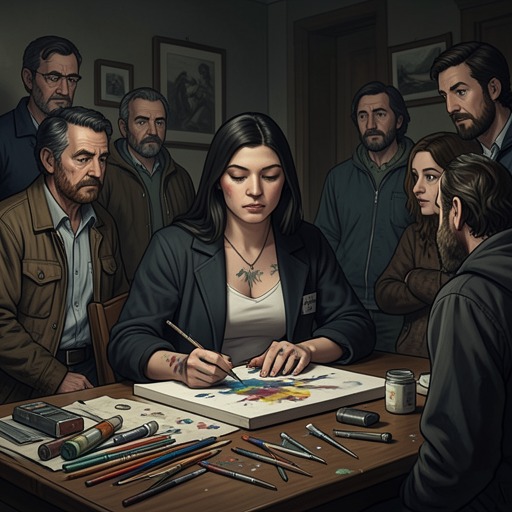
Uphoria Gallery Destruction
The Vampire Prince’s BrideUphoria Gallery Destruction is the destruction of Piper Diamond’s gallery and the financial catastrophe that follows. More than a property crime, it is a reversal of Piper’s professional hopes: the gallery’s physical ruin becomes an economic and emotional ruin when the security system appears not to have been activated and the insurer refuses to pay.
Causes and Immediate Discovery
Piper encounters the gallery after the damage has already been done. Glass crunches beneath her feet, while the beating of her heart becomes almost the only other sound she can register. Her first response is disbelief; the scene feels to her like an intolerable nightmare rather than an event that can belong to ordinary waking life. That reaction establishes the destruction as both a visible crime scene and a psychological shock.
The damage is comprehensive rather than localized. Every gallery window has been smashed, as have the display cases. Ceramics have been thrown onto the floor and kicked to pieces. Paintings have been slashed, leaving ribbons of canvas hanging from their frames, while stone sculptures have been cracked in half. Metal sculptures have been blasted by magic and reduced to twisted heaps. The different materials and artistic forms are all brought to the same condition: broken objects that can no longer serve as works of art or sources of income.
The police provide the first explanation that turns the disaster into a crisis of responsibility. Their investigation finds that the new security system was not engaged and shows no sign of magical tampering. The absence of magical interference matters because the gallery has suffered magical destruction, yet the mechanism that might have protected it appears simply to have been left off. Piper insists that she set the system before locking up the previous day, an action she describes as something she would never forget. The apparent contradiction between her certainty and the official evidence leaves the event unresolved at the level of cause while making her responsible in the eyes of institutions and creditors.
Financial and Professional Collapse
Piper initially tries to hold on to the belief that the gallery is insured. She closes her eyes against the sound of glass underfoot and repeats that assurance to herself, but the insurance office converts hope into a second reversal. The broker cites the police report, which clearly states that the security system was not engaged, and tells her that nothing can be done. The refusal is not presented as a negotiation but as an administrative conclusion: the condition that would have allowed the policy to protect her has apparently not been met.
The loss is especially severe because much of the art was held on commission rather than owned outright by Piper. Tens of thousands of dollars’ worth of work has disappeared or been destroyed, yet the artists who trusted her still demand the money they would have received had their pieces sold. Piper therefore owes people for art that can no longer generate revenue. The gallery’s ruin creates obligations in both directions: artists seek payment, while the landlord demands compensation for the damage to the property because the security system failed to do its job.
Piper’s professional identity offers no easy escape. Her art degree is described as useless for obtaining a job in Uphoria, and the debts appear large enough to consume the rest of her life. The gallery had carried all her hopes, so its destruction removes not only inventory and premises but also the future she had built around them. Her statement that she has lost everything is given concrete economic meaning through the unpaid commissions, repair demands, denied insurance claim, and absence of a viable alternative career.
Piper’s Response and Narrative Function
Piper’s anger briefly turns toward the insurance broker. She wants to hex him, but she restrains herself because adding jail time to the existing disaster would make her situation worse. That moment shows the pressure placed on her by the destruction: magical retaliation is available as an impulse, yet practical survival requires her to suppress it. She leaves the insurance office without a meltdown and walks through the frozen streets until her face and hands become numb, a physical image that parallels the emotional numbness produced by the loss.
The event is structured as a chain of failed protections. The gallery’s windows, cases, artworks, and sculptures are physically unable to withstand the attack. The security system, which should have provided a second layer of defense, is inactive. Insurance, which should have absorbed the financial consequences, is rendered unavailable by that inactivity. Finally, Piper’s education and professional network cannot rescue her from the resulting debt. Each expected safeguard fails in sequence, turning a single night of vandalism into a total collapse of security, livelihood, and confidence.
The destruction also gives material form to the vulnerability of art as both culture and commerce. The works are not damaged abstractly: canvas hangs in ribbons, ceramics become fragments, stone splits, and metal twists under magic. Once broken, the pieces expose their material fragility and their dependence on systems of display, protection, ownership, and payment. The gallery’s devastation therefore affects the art’s physical presence and the network of trust that allowed Piper to exhibit it.
Consequences and Unresolved Questions
The immediate consequence is that Piper is ruined financially and socially accountable for losses she cannot meet. The artists who entrusted her with their work are angry, the landlord seeks payment for property damage, and the insurer refuses coverage. Because the security failure appears to be her responsibility, the event burdens her with costs extending far beyond the value of her own business assets.
Yet Piper’s certainty that she activated the security system prevents the destruction from settling into a simple account of negligence. The official findings say the system was not engaged and found no magical tampering, while Piper’s memory says the opposite. That tension leaves open the possibility of an unseen action or manipulation without proving one. Within the narrative, the gallery’s ruin is thus both an accomplished fact and an unresolved mystery: the damage is undeniable, but the explanation remains trapped between institutional evidence and Piper’s repeated recollection.
The event’s decisive significance lies in its conversion of physical wreckage into a lasting life crisis. Piper begins with a gallery full of commissioned art and a future anchored in her degree and business; she ends the episode facing unpaid artists, property claims, denied insurance, and debts she expects to carry for life. The destruction is consequently not merely an attack on a building. It is the point at which the material collapse of Uphoria’s gallery threatens to determine Piper’s entire future.