Valdez Farm
The Vampire Prince’s BrideValdez Farm is Danita Valdez’s newly inherited agricultural property and the material center of her effort to establish an independent life. More than a piece of land, it represents ownership, self-sufficiency, and the possibility of building a future through her own labor. Its significance is established immediately through a collision between hope and decay: Danita presents the farm as the beginning of her dream, while the farm’s failing structures and inherited financial obligations expose how precarious that dream is.
Property and Setting
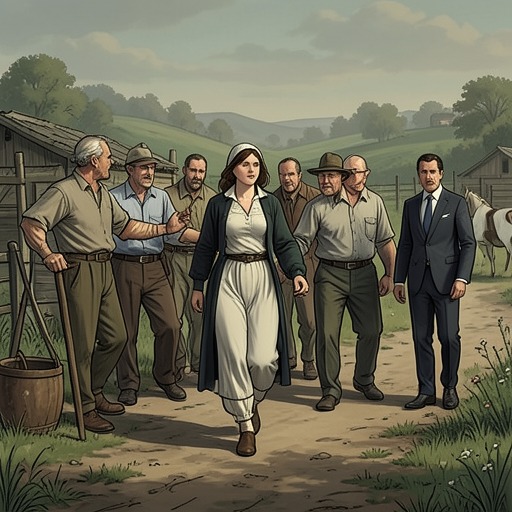
Valdez Farm initially appears as a working farm in need of extensive repair. When Danita pushes open the door of the brand-new barn, the door falls off its hinges, revealing rusty hardware and a frame that may need rebuilding. The supposedly new structure therefore carries the visual marks of neglect. Danita refuses to treat this deterioration as defeat. She reduces the damage to a practical list of repairs—new hinges, screws, and perhaps a rebuilt frame—and insists that elbow grease will make the place functional.
The farm’s planned layout reflects Danita’s specific agricultural ambitions rather than a vague desire to own rural property. She intends to use the barn for equipment and hay storage and to establish an alpaca pasture directly beside it. The pasture will cover three acres, enough to support a small beginning herd while leaving room for expansion. Danita already owns an alpaca named Maria and expects to add more animals, placing males and females together so the herd can grow. The plan is therefore both immediate and long-term: repair the infrastructure, protect the livestock, and gradually turn a single animal into a viable herd.
The surrounding environment is beautiful but carries real risks. Nearby farmers warn Danita that bears and cougars may threaten the animals at night, a danger made plausible by the great forest around the farm. Danita responds by planning to train the alpacas to return indoors after dark. She also recognizes that alpacas may be aggressive toward canids, but she does not mistake that defensive capacity for complete security. The farm’s relationship with the wilderness is consequently practical rather than purely pastoral: the forest supplies the setting’s beauty while also requiring vigilance.
Debt and Threatened Ownership
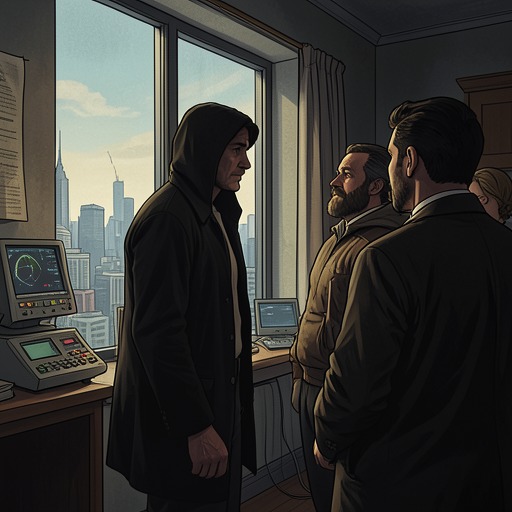
The farm’s promise is undermined when Dean McGrath arrives with a financial claim against it. Danita has inherited the property from her uncle, who died by suicide, and she believes careful review with a lawyer has confirmed her position. McGrath counters that her uncle owed him approximately five hundred thousand dollars and asserts that the land technically belongs to him because of that debt. His claim transforms the farm from an inheritance into contested property and places Danita’s independence under immediate pressure.
McGrath’s threat is not presented as an ordinary legal dispute. He discourages Danita from involving lawyers and smiles while revealing distinctive fangs, making the farm a point where financial coercion and supernatural danger meet. The land that Danita sees as the foundation of her future is, in his eyes, an asset available for seizure. Her ownership is therefore challenged not only economically but also through intimidation and the power imbalance between a vulnerable new farmer and a predatory creditor.
Danita nevertheless refuses to surrender the farm’s meaning. She tells Amelia that it is her place and that she will get it running herself, rejecting both outside labor and a loan even when Amelia offers help from her two Alphas and their Wolves. This insistence is not ignorance of the farm’s needs; Danita openly acknowledges that several major repairs must be completed before she can obtain a herd. Her position is that accepting assistance should not mean abandoning authorship of the project. The farm becomes an arena in which independence is tested as a daily practice rather than declared as an abstract ideal.
Labor, Courtship, and Community
For several days, Killian Flanagan and Ryan Higgins work nearly nonstop on Valdez Farm while Danita keeps busy with the same project. Their presence changes the farm’s social atmosphere. At first, Danita fears that they may demand her body as payment for their assistance, a fear shaped by the vulnerability created by McGrath’s debt threat. Their behavior gradually contradicts that expectation. Although they make no effort to conceal their attraction, their courtship takes the form of soft caresses, foot rubs, cooked meals, and other ordinary gestures rather than threats or intimidation.
The farm thus becomes a testing ground for a different exchange of value. Work, care, desire, and trust develop together, but Danita is not forced to treat her body as currency. Her growing comfort with Killian and Ryan is reflected in her nighttime cravings to leave her room and wake them in the living room, even as she remains uncertain about whether acting on her desire would be wise. The property’s repair is accompanied by an emotional repair: a place initially associated with debt and coercion begins to host patience, mutual attention, and the possibility of chosen intimacy.
Danita’s uncertainty is sharpened by the contrast between her imagination and her experience. She has the mind of an erotica writer but remains a virgin, so the farm’s physical labor and the men’s gentle seduction bring fantasy into a reality that frightens her. Valdez Farm is therefore not merely the backdrop for a romance. It is the protected, imperfect space in which Danita must learn to distinguish desire freely offered from exploitation demanded.
Recovery and Agricultural Future
After McGrath is gone, the farm’s financial position improves decisively. Danita obtains the mortgage she had wanted, gaining enough money to repay Amelia, survive the winter, and purchase supplies for spring shearing. The mortgage does more than solve an immediate cash problem. It converts the farm from a threatened inheritance into an economically sustained enterprise, allowing Danita to continue planning for the alpaca herd on her own terms.
The winter setting emphasizes both hardship and renewal. Frost covers the branches, dead grass, fences, and windows, while the cold air carries the smell of snow. Danita loves winter because she finds it romantic, but the season also measures the farm’s survival. Inside the barn, the alpacas huddle together in their section, their woolly bodies pressed close as Danita anticipates a good harvest the following year. The animals’ safety and the coming shearing season provide concrete evidence that the farm has moved beyond mere aspiration toward a functioning agricultural cycle.
Danita’s morning routine with Maria and the other alpacas gives the property its settled domestic rhythm. She pats Maria’s head, checks on the animals, and prepares hay and mineral supplements. The barn door opens as she cuts the twine from a hay bale, and Killian and Ryan enter, still associated with the farm’s labor and with the new community forming around it. The scene places livestock care, seasonal work, repaired finances, and intimate partnership within the same space. Valdez Farm ends this portion of the story not as a flawless estate, but as a hard-won beginning whose future is now materially possible.
Narrative Significance
Valdez Farm externalizes Danita’s struggle for control over her own life. Its broken barn door and uncertain ownership embody the forces that threaten her—neglect, inherited debt, and predatory authority—while its planned pasture and expanding herd embody deliberate construction. Every improvement depends on labor, yet the farm’s survival also depends on relationships that do not reproduce the coercion McGrath represents.
The location’s strongest contrast is between land treated as property to be claimed and land experienced as a life to be built. McGrath sees a five-hundred-thousand-dollar debt and a technical right to possession. Danita sees equipment storage, hay, three acres of pasture, Maria, future breeding, spring shearing, and animals that must be protected from the forest at night. The difference is the difference between extraction and stewardship. By the winter scenes, the farm has become evidence that Danita’s independence can survive pressure when it is supported by her own persistence and by assistance offered without force.