Vampire reproductive crisis
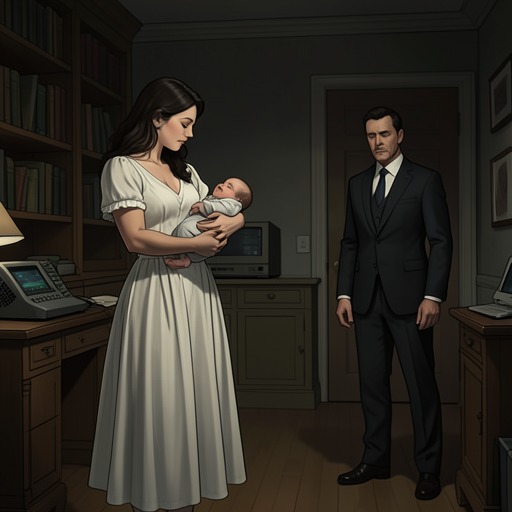
The Vampire Prince’s BrideThe vampire reproductive crisis is the central demographic emergency shaping relations between vampires and humans. It turns marriage, blood, pregnancy, and political alliance into matters of species survival: vampires may possess superior strength and longevity, but their future depends on human women and on the institutions built around that dependence.
Biological Basis and Demographic Stakes
The crisis rests on a distinction that many characters misunderstand. Humans who live among vampires and are regularly fed from can develop vampiric traits: their aging slows dramatically, they become stronger and faster, and they acquire a taste for blood. They do not, however, become vampires. Vampires are born vampires, and they are usually male. The result is a population that cannot reproduce itself without human wives. The narrative states the consequence in stark terms: without women such as Cleo, vampires would become extinct within three generations.
This dependence makes human beings valuable to vampires for reasons beyond blood supply. Human blood sustains individual vampires, but human women sustain the species biologically. The distinction separates ordinary vampiric feeding from reproductive reliance and explains why human–vampire marriage is treated as a political institution rather than merely a private romance. Human partners become essential participants in the continuation of vampire society, even when that society remains structurally dominated by vampires.
Marriage, Alliance, and Political Policy
Cleo’s position illustrates the crisis’s constructive political possibility. While Darius thinks in terms of war, battles, and conquest, Cleo considers an outreach program for vampire relations with outliers and plans increased aid for communities affected by earthquake flooding. Darius recognizes that her kindness could change the direction of wars and regards her as a valuable ally. Her role therefore extends beyond that of a reproductive partner: as a human wife, she can mediate between populations whose conflict threatens the survival of both.
The same scene connects the crisis to the wider vampire–shifter war. Humans are described as key figures in the conflict because vampires require them not only to live but also to reproduce. Cleo’s humanitarian diplomacy offers an alternative to conquest, suggesting that the very population vampires need could become a bridge toward peace. The reproductive emergency thus creates vulnerability as well as leverage: vampire power depends on maintaining relationships with humans, while human participation can redirect those relationships toward cooperation.
Reproduction as Duty and Transaction
The crisis also produces coercive forms of exchange. In the Demante succession system, Cheryl is escorted from the Queen’s Temple to a royal ceremony and is told that her future consists of giving her king beautiful, dark-blue children. Her public transfer from the temple to the palace turns reproduction into an overt obligation attached to queenship. The hovering platform, the chanting crowd, and the palace reception frame her body as part of a public succession ritual rather than an exclusively private matter.
Other storylines expose the same pressure in more personal and transactional terms. Killian refuses Ryan’s suggestion that they kill the man holding Danita’s debt, explaining that they would have to pay double her ransom and that he has instead agreed to buy her from him. The arrangement treats a woman’s freedom and future as debt secured through money, revealing how reproductive and sexual vulnerability can be converted into financial obligation. In another case, Sheridan tells Maribel that he was drawn to her from the moment she entered his palace because he had been searching for a woman to bear his child. His direct objective makes the reproductive imperative explicit, but Maribel’s alarm shows the human cost of being approached as a solution to a demographic problem.
The crisis can also be expressed through a gift that appears more intimate than economic. Maskin gives Cheryl a grass necklace he made himself, and her response creates a moment of genuine tenderness between them. Yet Cheryl must ultimately confront the reproductive and political rivalry surrounding her. After Bjorn and Maskin have been injured, she declares that if one of them is with her, the other must be as well, and that neither man may be alone with her. Her decision converts a contest over access to the queen into a condition she sets herself. Reproduction remains central, but Cheryl refuses to let the crisis determine the terms without her consent.
Cross-Species Bodies and Reproductive Knowledge
The book repeatedly places reproduction at the intersection of biology, technology, and species identity. Lisa’s pregnancy is examined with advanced medical equipment that presses scanning nodules against her abdomen and constructs a three-dimensional holographic image of her uterus. The embryo initially resembles a mixture of a tadpole and a dinosaur rather than a human baby, and Zon wants confirmation that Lisa is pregnant rather than carrying a parasite. The scan makes the unfamiliarity of cross-species pregnancy visible while confirming that the developing child will become a baby.
Shay explains a related history to Gemma by revealing that Stlozyn ancestors were humans taken from Earth centuries earlier. Their descendants were genetically altered so that certain genes became more pronounced, while additional DNA enabled them to shift shapes. The result is a species that remains genetically connected to humanity while possessing visible scales and transformative abilities. This account complicates the boundary between human and vampire or between human and alien species: reproduction is not simply the production of identical members of a race, but a process through which bodies, ancestry, and engineered or inherited traits are combined.
The narrative’s interest in the crisis therefore extends beyond population numbers. The vampire need for human wives belongs to a larger pattern in which pregnancy becomes the site where species boundaries, political succession, and technological intervention meet. The reproductive body can be examined, exchanged, claimed, transformed, or used to secure a dynasty, but it can also expose the instability of categories that societies treat as fixed.
Narrative Significance
The vampire reproductive crisis gives the vampire–human relationship an underlying contradiction. Vampires are powerful enough to dominate humans, yet dependent enough that domination threatens the cooperation on which their future rests. Their apparent superiority is therefore inseparable from demographic fragility. Human longevity among vampires may imitate aspects of vampiric existence, but it cannot replace human women’s reproductive role; feeding and reproduction remain distinct forms of dependence.
The crisis also explains why romantic and political plots repeatedly converge around marriage, pregnancy, and claims of destiny. Darius remembers knowing immediately that Cleo was the woman who would become his bride, while Darilth presents Ella with the Draco’s Eye and explains that the heirloom identified her as his destined mate. Such language can elevate partnership into fate, but it also operates within societies that need human or cross-species bodies to secure succession. The result is an unresolved tension between intimacy as chosen connection and reproduction as collective necessity.
Ultimately, the crisis is not only a threat of extinction but a test of how a society responds to dependence. Cleo’s humanitarian approach, Cheryl’s insistence on setting the terms of her relationship, Lisa’s technologically mediated pregnancy, and Maribel’s shock at being selected to bear a child show different possible responses to the same pressure. The vampire future depends on human participation, but the book’s conflicts ask whether that participation will be obtained through coercion and ownership or through recognition, negotiation, and mutual alliance.