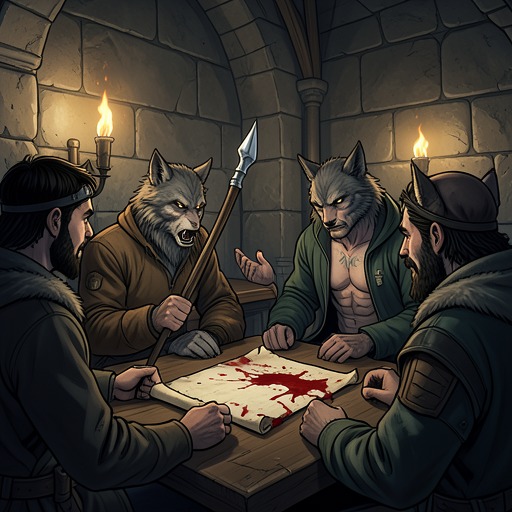
Werewolf Alpha Succession Obligation
The Vampire Prince’s BrideWerewolf Alpha Succession Obligation is the rule that binds a werewolf Alpha’s authority to the continuation of the pack. The Alpha is expected to take a mate, produce an heir, and prepare a successor capable of protecting the pack and governing it when the werewolves’ transformations make ordinary control most difficult. In Roland Davis’s story, this obligation is not a ceremonial expectation: it is the political condition of his rule, the source of pressure from his Beta, and the reason Melissa Clarkson’s death threatens the pack’s future.
Definition and Political Function
The obligation joins two responsibilities that might otherwise be separate: reproduction and leadership. Roland is described as an Alpha whose chief duties include taking a mate and producing an heir who can lead the werewolves after him. The future child is therefore imagined not merely as Roland’s descendant but as the person who will eventually assume the Alpha position, protect the pack, and keep its members in line when their wolves take control.
The rule becomes especially urgent because Roland’s pack is unusually vulnerable. Roland and Adam Buchan are the only two werewolves in the pack who were born werewolves. When the full moon rises, the pack transforms into bloodthirsty monsters for three nights. Adam, serving as Beta, has better control than the others, but he still cannot completely resist the moon. The required heir would consequently serve as more than a family successor: the child represents institutional continuity during the recurring period when the pack’s animal nature overwhelms ordinary restraint.
Melissa Clarkson and the Succession Crisis
Melissa Clarkson was the only female werewolf remaining in the pack after Roland’s mother died. That scarcity made her central to the operation of the rule. Roland and Melissa were not true mates and did not love each other, but both understood the duty imposed on them. They had been attempting to produce children for a year, treating reproduction as a responsibility to the pack rather than as the natural result of romantic attachment.
The arrangement had already produced profound grief. Melissa suffered three miscarriages and eventually decided that she could not endure another loss. She and Roland agreed to pause their attempts until she felt strong enough to face the possibility of losing more children. Roland had not expected the arrangement to end permanently, yet he privately doubted whether he could withstand further heartbreak either. The rule thus creates a cruel contrast: the pack requires a child, while the people tasked with producing one carry the emotional damage of repeated failure.
Melissa’s murder converts that private sorrow into an immediate political emergency. Roland finds her body in his bed with a knife still in her chest, and the scene confirms that she will never have the chance to become a mother or resume the attempt to conceive. Her death removes the pack’s only available female werewolf and appears to remove Roland’s last practical route to fulfilling the succession obligation. The reproductive requirement therefore magnifies the crime’s consequences: the victim is simultaneously a woman, a prospective mother, and the pack’s only remaining female reproductive partner.
Enforcement Through Pack Pressure
Adam articulates the rule as a political warning rather than a consolation. While Melissa’s body is still in Roland’s bed, Adam asks how Roland will find a mate now that she is gone. He then reminds Roland that an heir is needed soon because the pack is becoming restless during the moon. Without young children, Adam fears that members of the pack will begin challenging Roland, especially Brian.
This exchange shows that succession is enforced through the pack’s expectations and its willingness to contest authority. Roland’s position depends not only on his personal strength or title but also on visible proof that the pack will continue after him. The absence of an heir creates an opening for challenges, and the full-moon transformations intensify that instability. Reproductive failure is therefore treated as a leadership vulnerability, while the prospect of an heir functions as a promise that Roland’s rule has a future.
Adam’s timing also exposes the emotional violence built into the obligation. Roland asks for respect because Melissa’s body is still in his bed, but Adam’s concern remains focused on succession. The scene places mourning and governance in direct collision: Roland is confronted with the death of a woman who shared his reproductive duty, while the Beta immediately calculates the effect of her death on pack discipline. The rule leaves little room for grief before political necessity demands another solution.
Broader Reproductive and Cross-Species Contexts
The obligation belongs to a wider world in which reproduction repeatedly becomes a political instrument. Darilth explains that the Draco’s Eye identified Ella as his destined mate and links the object’s authority to the Rothgar succession. Maskin gives Cheryl a grass necklace and hopes for a relationship based on mutual feeling rather than fear, even though warrior-slaves have had little experience with human women. These contrasts distinguish imposed reproductive roles from bonds that seek recognition and affection.
The same tension appears in the human and nonhuman bodies surrounding the rule. Sara uses bionic eyes that can be removed and deployed as stun grenades, turning an implanted body part into concealed technology and a weapon. Lisa’s pregnancy is verified through a medical scan that constructs a three-dimensional holographic image of her uterus and embryo; the embryo initially resembles a disturbing mixture of a tadpole and a dinosaur, yet it is recognized as developing into a baby. Shay explains that Stlozyn ancestors were humans taken from Earth and genetically altered, with added DNA that permits shape-shifting. These examples place reproduction within a continuum of altered bodies, cross-species inheritance, and technological intervention rather than within a simple human-versus-animal division.
Other reproductive claims are more explicitly coercive. Sheridan tells Maribel that he recognized her as the woman he had been seeking because he wants her to bear him a child. Unlike the werewolf succession obligation, which is presented as a pack duty affecting the Alpha’s legitimacy, Sheridan’s demand is expressed as a direct claim on Maribel’s body. Together, these examples show how the book repeatedly makes pregnancy and inheritance sites where personal desire, social survival, and institutional power overlap.
Narrative Significance
Werewolf Alpha Succession Obligation gives Roland’s plot its governing contradiction. He is expected to preserve the pack through an heir, yet the only woman who could help fulfill that expectation has died after three miscarriages and a period of deliberate recovery. The rule promises continuity while producing pressure, grief, and the possibility of rebellion. It also explains why Roland’s relationship with Claire Doyle becomes consequential: Claire enters a crisis created not simply by a murder but by the collapse of the reproductive foundation on which Alpha authority rests.
The obligation ultimately reveals that the pack’s political order is biological without being purely natural. Full-moon transformation, inherited werewolf status, mating, pregnancy, and succession are treated as interconnected systems, but each is organized through social expectations and threats of challenge. Roland must therefore manage both the wolf within the pack and the institution built around it. The rule’s decisive significance lies in that fusion: an Alpha is not secure merely because he commands the present. He must also produce the future that will keep the pack alive and governable.