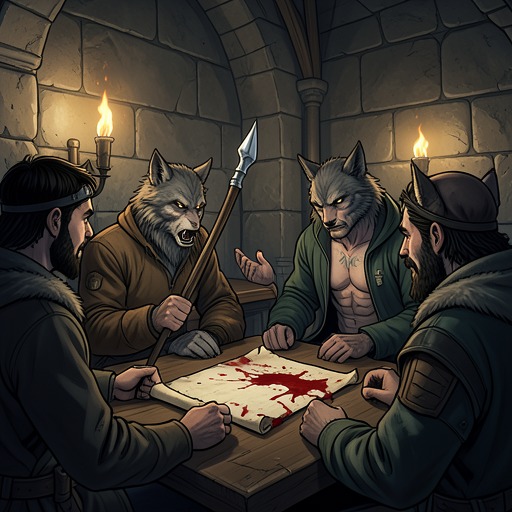
Werewolf Pack Alpha Rule
The Vampire Prince’s BrideWerewolf Pack Alpha Rule is the governing structure that makes the Alpha responsible for both the authority and survival of a werewolf pack. Its power is practical rather than merely symbolic: the Alpha must control the pack when the full moon turns its members into dangerous creatures, preserve order during those periods, secure an heir, and defend the succession against rivals. Leadership therefore joins command, biological continuity, and collective protection in a single office.
Authority and Pack Protection
Werewolf Pack Alpha Rule is most clearly embodied by Roland Davis. As Alpha, Roland keeps watch over his people when the full moon rises and the pack transforms into bloodthirsty monsters. Even Adam, his Beta, possesses better control than the others but cannot fully resist the moon. The Alpha’s authority consequently carries a disciplinary function: Roland is expected to keep the transformed wolves from destroying one another or the wider community during the three nights when their animal nature takes over. His position is a form of guardianship enforced through rank and physical dominance, but it is also a responsibility that exposes the Alpha to the consequences of every failure.
The rule extends beyond the wolves’ supernatural condition into the pack’s everyday hierarchy. Adam speaks to Roland as a subordinate who may raise urgent concerns, yet he ultimately bows his head and steps back when Roland’s anger asserts itself. That gesture makes the hierarchy visible without requiring a formal challenge. Roland’s growl, clenched fists, and refusal to tolerate an insult toward Claire establish that Alpha authority is exercised through both command and the expectation of submission. The pack members observe these exchanges closely, and their reactions show that internal conflict is never purely private: an Alpha’s emotional or relational decisions can affect the stability of the entire group.
Reproduction and Succession
The Alpha’s rule is inseparable from the demand for continuity. Roland and Adam are the only two born werewolves left in the pack, and Roland is expected to take a mate capable of bearing children. The purpose is not simply personal parenthood. The pack requires an heir who can eventually replace Roland as Alpha, protect the group, and maintain control when the wolves’ transformations make them dangerous. Reproduction is therefore treated as a political duty and a condition of legitimate leadership.
This obligation becomes acute after Melissa Clarkson is found dead in Roland’s bed with a knife still in her chest. Melissa had been the pack’s only female and the last one remaining after Roland’s mother died. She and Roland had not loved each other or experienced a mate connection, but they had accepted their duty and spent a year attempting to produce young. Three miscarriages had already made the effort a source of profound heartbreak. They had agreed to pause until Melissa could face the possibility of another loss, making her death both a murder and the destruction of the pack’s reproductive plan.
Adam immediately recognizes the political danger. He asks how Roland can find a mate now that Melissa is gone and warns that the pack is becoming restless during the moon. Without young soon, he says, members may begin challenging Roland, particularly Brian. The Alpha’s authority thus depends on more than present strength: it is measured against the pack’s confidence that leadership will continue after him. A dead or absent reproductive future threatens to become a succession crisis, and the prospect of a challenge turns grief into an institutional emergency.
Mate Choice and Internal Conflict
The rule pressures Roland toward a relationship that cannot be reduced to strategy. Adam notices that Roland is attracted to Claire Doyle and claims that he can smell the wolf on Roland whenever she is near, suggesting that Roland’s wolf may have identified her as a mate. His advice treats the matter as both a possible biological bond and a practical solution: Roland should court Claire, reveal the truth, and determine whether she is truly meant to remain beside him.
Roland resists that reasoning because Claire is human rather than a werewolf. He rejects the idea of transforming her merely so she can bear his children, explicitly refusing to treat her body as a reproductive instrument for pack policy. His anger at Adam’s suggestion that Claire might be suitable only for a one-night stand further distinguishes personal attachment from institutional necessity. Roland’s response shows the Alpha rule straining against an ethic of consent and recognition: the pack needs an heir, but Roland will not accept that need as permission to convert or use a woman.
Adam’s later submission does not resolve the question; it confirms the limits of his authority. He repeats that Roland’s wolf may want Claire as a mate, while Roland denies that this can happen. The exchange reveals a central tension within Alpha leadership. The Alpha is expected to obey the pack’s reproductive logic, yet he must also decide whether that logic can govern intimate choice. Roland’s refusal to make Claire serve succession preserves her autonomy, but it leaves the pack’s political problem unresolved and increases the pressure surrounding his future.
Wider Systems of Exceptional Rule
Other cultures in the book provide stark contrasts to the werewolf model. At the Queen’s Temple, Priest Quincy turns a queen and two Kings Presumptive into instruments of a fertility test: they are sent to the Shrine of Nethja until the alignment of the four moons, and the man who fathers the queen’s child will become king, while failure results in both candidates’ deaths. The system presents reproduction as a direct mechanism of political selection, with the queen’s body placed under sacred and royal control.
The Fifth Cycle Festival offers an even more violent version of reproductive and sexual sovereignty. A woman is chosen to embody the Goddess while men fight to the death until one remains; the victor becomes the God and may do what he wants with her. The United Species banned the tradition because the Goddess was often killed and eaten by the victor. These examples clarify what distinguishes Roland’s conflict from more openly coercive institutions. Werewolf Pack Alpha Rule still makes fertility a political obligation, but Roland’s refusal to force Claire into transformation or reduce her to childbirth marks a contested boundary within the system rather than an uncomplicated acceptance of it.
Ethical and Narrative Significance
Werewolf Pack Alpha Rule gives supernatural hierarchy a material cost. It explains why Roland cannot treat leadership as private prestige, why Melissa’s death destabilizes the pack, why Adam fears a challenge from Brian, and why the possibility of a mate becomes a matter of collective survival. The Alpha is powerful because he must command the pack, yet vulnerable because the pack can judge him through its hunger for continuity and its fear of the full moon.
The rule also makes the body the principal political arena. Transformation governs discipline; pregnancy governs succession; the scarcity of born werewolves governs the future; and the question of whether Claire may remain human tests whether duty can coexist with consent. In that sense, Alpha authority is maintained through a mixture of force, biological expectation, and communal dependence. Its deepest contradiction is that the leader must preserve the pack’s future without allowing the pack’s survival imperative to erase the personhood of those expected to secure it.