Witch Gene Succession
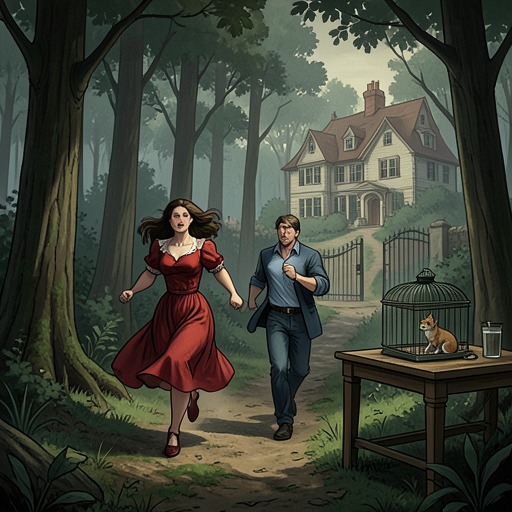
The Vampire Prince’s BrideWitch Gene Succession is the hereditary pattern by which magical ability passes through a family unevenly rather than appearing in every generation. The text presents witchcraft as a family inheritance that can skip one generation: a child may receive the witch gene while the parent does not, and the non-witchy generation may instead develop the ability to predict the future. This succession rule is not merely biological background. It determines how relatives understand one another, how they value different forms of magic, and how an uncertain prophecy can shape an entire family’s emotional life.
Definition and Inheritance
Witch Gene Succession is explained most directly through Lola’s account of her family. The witchy genes, or whatever force permits magic, skip one generation, so Lola became a witch while her mother did not. Her mother nevertheless inherited prophetic abilities. The two women therefore possess different branches of the same family legacy: Lola has active witchcraft, while her mother can look toward the future. The inheritance is cyclical rather than linear, and the text gives no indication that either form of power is simply superior. The distinction instead produces a painful contrast between the daughter who has magic and the mother who has prophecy.
The succession pattern also explains why Lola’s mother treats the family inheritance as a source of injury. Lola believes her mother resents her because she received witchcraft, while the mother did not. At the same time, the mother’s prophetic gift has helped make her successful. Her public life includes work as an actor, a former top model, a philanthropist, a member of New York’s elite, and the trophy wife of a business tycoon. Yet she refuses to acknowledge the prophetic ability as openly as Lola acknowledges witchcraft. The inherited system thus produces two kinds of power, but social prestige does not erase the private rivalry between them.
Family Consequences
The rule becomes most damaging in the relationship between Lola and Mayumi May. Lola grows up in her mother’s shadow, physically compared with her and repeatedly excluded from her mother’s glamorous world. Her parents largely leave her upbringing to a live-in nanny, while her mother keeps her away from parties and from the celebrities who visit the family home. The difference in magical inheritance becomes another instrument of alienation: Lola has the identity her mother lacks, but she does not receive the affection or recognition that might have made that inheritance feel like a gift.
Lola’s grandmother complicates this interpretation without dismissing its consequences. She tells Lola that Mayumi May may not hate her exactly, but may be unable to love her in the way Lola wants. The grandmother confirms that Mayumi May has prophetic abilities, then recounts the moment when Mayumi May performed a tarot reading after Lola’s birth. Whatever the cards showed, Mayumi May immediately pushed them back into the deck and never explained the result. After that reading, something in her changed and she withdrew from Lola. Witch Gene Succession therefore links inherited power to a second, less visible inheritance: the burden of knowing—or believing that one knows—what a child’s future contains.
Prophecy and Uncertainty
The prophecy attached to the succession pattern remains deliberately ambiguous. Lola fears that the tarot reading means she is doomed, but her grandmother rejects that conclusion. Predicting the future is not presented as a precise art. A sign such as “stroke” might mean heatstroke, a medical stroke, a stroke of good luck, or the birth of a baby. The same word can support radically different futures, so the danger lies not only in the vision itself but in the interpretation placed upon it.
This uncertainty explains why Mayumi May’s reaction matters even though the contents of the reading remain undisclosed. The text never confirms that the prophecy was genuinely disastrous. It confirms only that Mayumi May believed the reading was bad enough to alter her behavior. Her silence turns an unknown future into a permanent present fact: Lola grows up sensing rejection without knowing whether the rejection began in jealousy, fear, prophetic guilt, or some combination of all three. Witch Gene Succession consequently operates through withheld knowledge as much as through inherited power.
Institutional and Social Function
The wider supernatural community treats witches as valuable members of its social order. In the Fort, the Wicce is described as a witch who has been present since the beginning of the community. Long-life potions can slow aging but cannot stop it, and the Wicce is becoming old. She can heal wounds caused by sunlight, sits on the Council, and is considered nearly as important as the Head of the Fort. Her knowledge is therefore an institutional resource, not a private curiosity.
The Fort’s crisis shows what happens when succession fails to produce a ready replacement. The Wicce has no other witch among the community to whom she can pass her knowledge, and the Head warns that losing her without finding a successor would be a serious loss. A reward is offered to anyone who can find a replacement. This concern confirms that magical inheritance is treated as a continuity problem: power must be embodied, taught, and transferred before an aging practitioner disappears. The rule’s importance is therefore both familial and administrative, governing the survival of magical expertise within a larger society.
Narrative Significance
Witch Gene Succession gives the book a structure in which inheritance never arrives as a simple blessing. Lola receives witchcraft but also inherits exclusion, comparison, and a mother’s unexplained fear. Mayumi May receives prophecy, gains worldly success through it, and yet remains trapped by what she saw in a tarot spread. The Fort’s Wicce possesses indispensable knowledge, but age threatens to sever the chain by which that knowledge is preserved. Across these cases, succession creates continuity and instability at the same time.
The concept also connects supernatural power with ordinary systems of exchange and obligation. Witchcraft, prophecy, healing, knowledge, and even the possibility of a future child are treated as things that affect status and impose duties. A mother’s gift is concealed, a daughter’s gift is resented, and an institution searches for a successor before its most important specialist dies. Witch Gene Succession thus functions as a rule of world-building and as an emotional engine: it explains who possesses magic, but more importantly, it shows how inherited difference can become resentment, secrecy, fear, and the unresolved hope that the future has been misunderstood.