Aleksander Purchases Esmeralda
The Vampire's Pet: Romantasy at its darkest (Blood and Kisses Chronicles : A Dark, Gothic Romance Series)Aleksander Purchases Esmeralda is the turning-point action that brings Esmeralda out of a cage and into Aleksander’s possession, while revealing the violence, commerce, and moral contradictions of the vampire pet system. Aleksander enters the store expecting to identify a suitable human, yet the encounter becomes more than a transaction: Esmeralda’s defiance distinguishes her from the other captives, the seller’s treatment of her provokes Aleksander’s anger, and the act of purchase establishes the unequal bond from which their later attachment and conflict develop.
Institutional Setting and Purpose
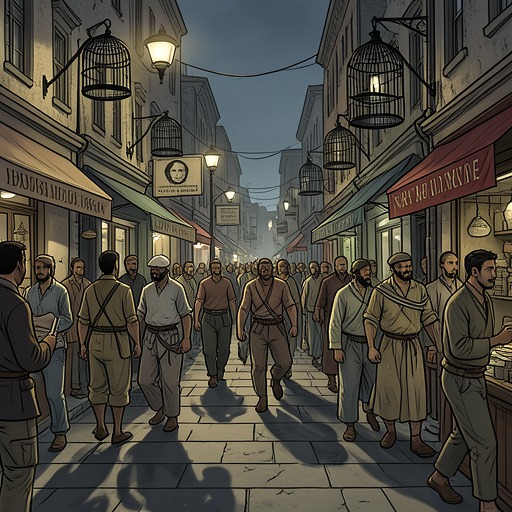
The purchase takes place within a society where humans are openly sold as vampire pets. Aleksander reaches the store after deciding that he needs a human, and the visit is part of the ordinary operation of a system that treats living people as merchandise. The store itself had once sold goods for humans; its conversion into a business that sold humans gives the setting an especially stark irony. The repurposed shop makes social change visible in its walls: humans have moved from customers to commodities, and the commercial language of the former business now encloses cages rather than merchandise.
Inside, the dimly lit store smells of urine. Cages line the walls, each containing a human, straw, a bowl of water, and food scraps. Some captives sleep, while others cling to the bars in panic. The arrangement reduces people to managed bodies requiring minimal maintenance, and the combination of confinement, bodily waste, and scraps of food makes the store’s degradation impossible to mistake for a respectable household. The seller further explains that the adults in the cages were caught in the city, whereas humans produced on a breeding farm are only babies. The distinction reveals two supply routes within the institution: capture in the city and planned production on human breeding farms.
The seller presents this arrangement without apparent shame. He welcomes Aleksander as Lord Dumoulin and treats the visit as a conventional retail exchange. Aleksander, however, reacts with silent judgment, finding the conditions filthy. His response does not amount to a rejection of the system itself, since he has come to buy a human, but it creates an early tension between participation and disgust. He accepts the position of buyer while refusing, at least in this moment, to accept every form of cruelty that the system permits.
Esmeralda’s Selection
Aleksander does not know precisely what he is seeking. He believes that recognition will come when the right captive appears, and the scene therefore gives the purchase an instinctive rather than purely practical logic. He rejects a pot-bellied man whose greasy hair and smell repel him, then passes two beautiful women, a redhead and a blonde, who fail to appeal to him. He pauses longer over a young man with long curly brown hair, blue eyes, and freckles, but continues inspecting the cages in case something better can be found.
Esmeralda is in a cage at the back of the store. Her long black hair and large brown eyes, marked by open defiance, immediately set her apart. Aleksander describes himself as able to read prey by a single glance after centuries of craving fresh blood, but the language of prey does not fully contain what he encounters in her. She is not passive, and her gaze carries resistance rather than the fear or docility expected by the store’s logic. Her torn dirty rags also expose the seller’s treatment of his merchandise, producing in Aleksander not only attraction but disgust at the condition in which she has been kept.
Aleksander asks her name directly. The seller objects, insisting that he need not address the humans personally, a remark that attempts to preserve the captives’ status as objects rather than persons. Esmeralda answers nevertheless, giving her name in a frightened whisper after the seller threatens her. Aleksander repeats the name and declares that he likes it and will take her. In the immediate mechanics of the scene, her identity is supplied by her own voice, but the purchase simultaneously converts that identity into part of a transaction: the name that distinguishes her also becomes attached to the ownership decision.
Violence at the Cage
The transaction changes when Esmeralda resists the seller. She spits at his feet, and he reaches for a whip. When she sees it, she gasps. He warns her to know her place or suffer the consequences, then opens the cage door and raises his arm. Aleksander grabs the vampire’s wrist before the blow can land. This is the first decisive intervention in the purchase: Aleksander does not merely choose Esmeralda; he physically interrupts the seller’s violence.
The confrontation exposes a divide between two vampire attitudes toward humans. The seller argues that humans are merely a food source and that their wounds do not matter. Aleksander recognizes him as part of an older mentality and refuses to change his mind, but he nevertheless draws a boundary around the human he wants. He sternly tells the seller not to hurt the pet in whom he is interested. The wording is protective and possessive at once. Esmeralda is spared the immediate strike, yet the protection is granted within the vocabulary of ownership rather than freedom.
That contradiction governs the scene’s emotional charge. Aleksander objects to beating humans, but he does not challenge the right to cage, buy, collar, or remove them. His anger therefore produces a limited correction rather than a rejection of the institution. The seller lowers the whip because Aleksander has greater standing and because the threatened human has become Aleksander’s chosen property. The immediate value shift is from imminent bodily harm to temporary safety, but the larger condition remains coercive: Esmeralda is no longer under the seller’s control only because she is about to pass into Aleksander’s.
The Purchase and Its Implements
After Esmeralda gives her name, she cries out against the decision to take her. Aleksander answers by contrasting the store with the alternative of remaining in a cage that reeks of urine. The choice offered to her is therefore deliberately narrow: submission to a new owner is presented as preferable to continued confinement under the seller. Esmeralda freezes and shakes her head, but the refusal does not cancel the transaction. Her fear registers the absence of meaningful consent even as the purchase proceeds.
The commercial character of the exchange becomes explicit when the seller asks whether Aleksander needs accessories. His shelves contain collars, leashes, toys, clothes, and other items. Aleksander selects a black collar adorned with pearls and lace and fitted with a large black gemstone, along with a long black leather leash. The objects transform ownership into a visible and portable arrangement. The collar marks Esmeralda’s status, while the leash gives that status a mechanism of physical control; the decorative details soften neither function. The black gemstone becomes the conspicuous emblem of a system that makes domination ornamental.
Aleksander returns to Esmeralda’s cage and tells her to put on the collar. When she does not comply, he moves closer and holds her fiery stare. He tells her, “Whether you like it or not, you’re mine! Now obey and put this collar on.” The statement makes the central contradiction unmistakable: his intervention against the seller’s abuse has not made Esmeralda free, but has shifted the authority over her body. She finally slips the leather around her neck, and Aleksander judges that the gemstone suits her. He praises her as “a good girl,” a phrase that frames forced compliance as successful taming.
The leash completes the transition from captive to escorted possession. Aleksander attaches it to the collar and pulls, but Esmeralda does not move. He orders her to come because he does not intend to remain in the store all day. She objects that she does not even know his name and asks why she should follow him. Her objection preserves a small but important assertion of personhood: she identifies the absence of any reciprocal introduction even while being commanded to obey. Aleksander responds with a growl and closes the distance until she shrinks back, offering to walk her rather than drag her. The apparent alternative remains coercive, but the moment shows the purchase becoming a negotiation of immediate bodily control rather than a completed, frictionless sale.
Protection and Possession
The purchase also establishes the possessive logic that will govern Aleksander’s later conduct. His resistance to the seller’s violence is not an abstract defense of human rights; it is attached to the particular human he has selected. That limitation becomes unmistakable when another vampire later threatens Esmeralda and Aleksander responds with the declaration, “Nobody touches what’s mine.” The phrase extends the store encounter’s ownership language into a personal code: Esmeralda’s safety matters to him, but he initially articulates that concern as control over his property. His protection is therefore both genuine in its immediate effect and compromised by the structure through which he understands it.
The scene nonetheless marks a boundary between Aleksander and the older vampire mentality represented by the seller. Aleksander accepts humans as a food source and purchases Esmeralda as a pet, yet he refuses to regard physical abuse as acceptable treatment. His anger when the whip is raised, his intervention at the cage door, and his insistence that the seller not injure the human he wants all show a selective ethic operating inside an oppressive institution. The distinction is not enough to free Esmeralda, but it prevents the purchase from being morally identical to the seller’s casual cruelty.
The First Exit from the Store
Aleksander’s warning about the surrounding vampires clarifies why Esmeralda eventually moves toward him. He points out that, without the collar and leash, the vampires outside would devour her. From her widened eyes, he infers that she may not be from Ichoryllia. The observation introduces uncertainty about her origin while also making the social order outside the store part of the immediate threat. The collar is presented as a mark of subordination, but within the scene it also functions as a sign that may deter other vampires from treating Esmeralda as available prey.
When Esmeralda comes close enough for Aleksander to feel the warmth of her body against his coldness, the relation changes from a commercial inspection to a charged physical encounter. He senses the blood moving through her veins, and its scent enthralls him; he is certain that she would be delicious. This response keeps the purchase anchored in the central vampire economy of blood. His attraction to her defiance does not replace predatory desire but exists beside it, binding protection, appetite, possession, and fascination together from their first meeting.
Immediate Consequences and Narrative Significance
Aleksander leaves the store with Esmeralda not as an equal companion but as a collared and leashed human whose movement depends on his command. The purchase removes her from the seller’s immediate reach and from the cage, yet it transfers her into another form of captivity. That double movement is the action’s decisive consequence: physical rescue and social subordination occur at the same time. Esmeralda’s first step toward Aleksander is thus neither a simple escape nor a freely chosen attachment, but a forced passage between owners within the vampire pet system.
The action also places private feeling against public law. The kingdom has changed its official religion from the portraits of Hecate, mother of vampires, to those of Alastor, demon and spirit of vengeance, and opposition to the Queen’s regime can be punishable by death. Against this atmosphere of enforced conformity, Aleksander’s personal judgment appears limited but significant. He recognizes that the store’s treatment of humans is filthy and cruel, even though he participates in the institution that makes such treatment possible. His purchase becomes an early example of resistance that does not yet become revolution: he changes Esmeralda’s immediate circumstances while leaving the larger order intact.
The event’s lasting importance lies in the contradiction it plants at the center of their relationship. Esmeralda is chosen because she is visibly unwilling to submit, yet Aleksander’s first response to that resistance is to demand obedience and fasten a black gemstone collar around her neck. He interrupts a whip, but replaces the raised hand with his own authority; he notices her name, but claims her body; he offers protection from devouring vampires, but makes protection conditional upon visible ownership. Later, when Esmeralda is endangered, his violent defense of her and her reunion with him confirm how deeply the initial possession has developed into attachment. The purchase is therefore the foundational reversal of their story: the act begins as a transaction governed by appetite and hierarchy, but becomes the first encounter through which Aleksander comes to treat Esmeralda as singular, irreplaceable, and worth defending at any cost.