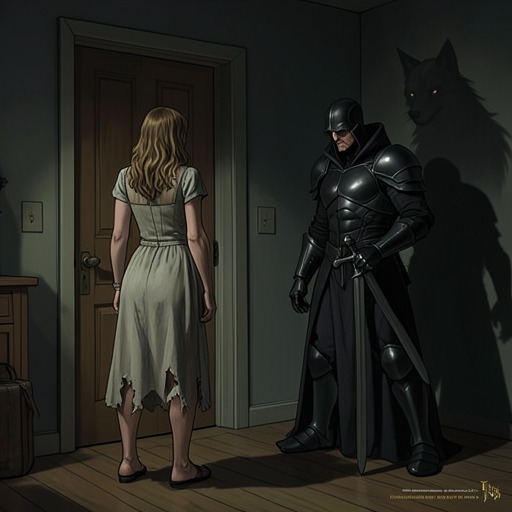
Alyson
The Vampire's Pet: Romantasy at its darkest (Blood and Kisses Chronicles : A Dark, Gothic Romance Series)Alyson is the Luna of Esmeralda’s werewolf-witch pack and a decisive mediator in the confrontation between the pack, Esmeralda, and Aleksander Dumoulin. As both a parent and a holder of pack authority, she stands between family obligation, the Alpha’s violence, and the supernatural rule of the fated-mate bond. Her intervention prevents Aleksander’s death, exposes Esmeralda’s position as the Alpha and Luna’s daughter, and allows Esmeralda to choose love over succession.
Identity and Position
Alyson is introduced through her resemblance to Esmeralda and through the authority she exercises as Luna. When she catches up with Esmeralda in the forest, she is described as older, with graying hair, but recognizably similar to her daughter. The resemblance is not merely familial decoration: it enables Aleksander to understand at once that the woman confronting the pack is Esmeralda’s mother. Her appearance is paired with composure and command. Although the Alpha is more than a head taller than her, Alyson approaches him without intimidation and questions his conduct as an equal authority within the pack.
Her title, Luna, places her within the pack’s governing structure rather than reducing her to a maternal role. When the Alpha challenges her decision to stop the attack, she asks when he began questioning his Luna’s choices. The exchange establishes that Alyson possesses recognized authority, even while the Alpha’s physical power and temper threaten to overwhelm the situation. Her power is therefore both institutional and personal: she commands as Luna, but she also acts from her knowledge of Esmeralda’s character and her responsibility as a mother.
Intervention in the Forest Confrontation
Alyson enters at the moment when the conflict is closest to becoming irreversible. The Alpha has driven his claws into Aleksander’s back and is preparing to let the pack finish him. Esmeralda is being held among her people, and the wolves are waiting for their leader’s signal. Alyson’s pursuit of Esmeralda, followed by her command to stop, interrupts the violence before Aleksander is killed. The branches cracking around her arrival and her forceful pursuit of the younger woman give the scene the abrupt quality of an intervention rather than a gradual negotiation.
Her first concern is Esmeralda’s life. When the Alpha objects that the decision is endangering their daughter, Alyson explains that Esmeralda has said Aleksander saved her life and treated her well. This testimony shifts the terms of the confrontation. Aleksander is no longer simply an enemy vampire or an alleged captor; he becomes the person Esmeralda identifies as her protector. Alyson listens to that account even though it conflicts with the pack’s hostility toward vampires and with the assumption that Esmeralda must be recovered by force.
Alyson also recognizes that the family’s stake in Esmeralda is unusually high. Esmeralda is not only her daughter but the daughter of the Alpha and Luna, and therefore the pack’s next leader. Her recovery is presented as essential because she is probably the most valuable member of the pack after her parents. Alyson’s intervention thus operates within several overlapping duties: preserving her daughter’s life, defending pack order, and determining whether the vampire relationship is coercion or a legitimate bond.
Recognition of the Fated-Mate Bond
The central judgment Alyson makes is that the fated-mate bond overrides the racial boundary separating vampires from werewolf witches. The Alpha rejects the possibility that the Moon Goddess could mate a vampire with one of their kind, but Alyson answers that the Moon Goddess does not concern herself with races and acts according to her own will. For Alyson, the bond is purer and more important than the pack’s inherited hostility toward vampires. Her position directly challenges the Alpha’s attempt to treat species identity as an absolute barrier.
This judgment gives supernatural law precedence over both prejudice and paternal possession. The Alpha insists that Esmeralda is his daughter and must return to the pack, while Alyson acknowledges that the revelation of the bond changes everything. She does not deny Esmeralda’s place in the family; instead, she refuses to let biological parentage cancel the claim of the fated relationship. In the conflict among royal vampire law, werewolf-witch custom, parental authority, and the Moon Goddess’s decree, Alyson becomes the character most willing to recognize a higher rule when it threatens her own expectations.
Her later question to Aleksander confirms that her acceptance is not casual. She asks whether he truly is Esmeralda’s fated mate, the one given by the Moon Goddess. Aleksander nods, and Alyson concludes that, if that is the case, he is the one Esmeralda should be with. The conditional form of her judgment matters: Alyson seeks confirmation before granting approval, but once the claim is established, she does not retreat merely because Aleksander is a vampire or because the choice damages the pack’s succession.
Motherhood, Authority, and Esmeralda’s Choice
Alyson’s relationship with Esmeralda is defined by protection without total possession. She arrives with the pack to retrieve her daughter, yet she is also the parent who listens when Esmeralda says that Aleksander saved her and treated her well. After Alyson releases her, Esmeralda runs into Aleksander’s arms, and Alyson allows the reunion to occur rather than forcibly separating them again. The physical release marks a change in the family’s response: Esmeralda is no longer treated only as a missing member to be returned, but as someone whose own attachment must be considered.
The final decision becomes harder when Esmeralda declares that she loves Aleksander. Alyson warns her that there will be no going back and explains the practical consequence: if Esmeralda becomes a vampire, she will not be able to lead the pack. This warning is neither a threat nor an attempt to disguise the cost. Alyson makes the loss of succession explicit so that Esmeralda’s choice is informed. Esmeralda accepts that consequence, saying that her brother has always wanted to lead the pack anyway, and Alyson then softens rather than escalating the dispute.
Alyson’s acceptance is emotionally difficult. She admits that the decision breaks her heart, but she also says that she must accept the Moon Goddess’s decision. Her motherhood therefore appears as a form of relinquishment. She cannot preserve both Esmeralda’s relationship with Aleksander and Esmeralda’s future as pack leader, so she recognizes the choice instead of forcing her daughter back into the role prepared for her. This makes Alyson a counterpoint to the Alpha, whose paternal claim remains expressed through anger and compulsion.
Aftermath and Narrative Significance
After the Alpha rejects the bond and leaves in fury, Alyson remains behind to settle the immediate aftermath. She tells Esmeralda not to worry about her father’s stubbornness and says that she will change his mind. The statement preserves the family relationship even after the pack’s authority has fractured. Alyson does not pretend that the Alpha has been persuaded, but she assumes responsibility for continuing the work of reconciliation rather than allowing his rage to define the ending.
She also accepts Aleksander into the family’s future. Alyson takes his hand and places it over Esmeralda’s, asking him to take good care of her and promising to visit them in Ichoryllia. The gesture transforms her earlier legal and supernatural judgment into a personal obligation. Aleksander is no longer merely the vampire whom she has permitted to live; he becomes the person entrusted with Esmeralda’s care. Her promise to visit also resists the werewolf pack’s customary distance from vampires, opening a continuing connection between the two communities.
Alyson’s significance lies in the way she negotiates competing systems of belonging. Esmeralda was born into a werewolf-witch pack despite lacking both a wolf and magic, and she stands at the boundary between inherited identity and chosen relationship. In the wider setting, vampires have restored old laws, humans have been subordinated, and public resistance has been repressed with violence or death. Against that background of rigid hierarchy, Alyson’s decision is strikingly flexible: she recognizes that neither race, pack rank, nor parental ownership can simply erase a bond that Esmeralda and Aleksander both accept. Her intervention changes the forest confrontation from an execution into a contested but survivable reordering of family, authority, and identity.