Old Vampire Laws
The Vampire's Pet: Romantasy at its darkest (Blood and Kisses Chronicles : A Dark, Gothic Romance Series)Old Vampire Laws are the legal and ideological foundation of the Queen’s new regime in Ichoryllia. Their restoration ends the previous, more equal treatment of Humans, establishes Human Breeding Farms, and permits a society in which Humans can be captured, confined, sold, and consumed. The laws therefore function not merely as background policy but as the mechanism that converts a political reversal into a material system of ownership, blood extraction, and sanctioned predation.
Restoration and Political Order
Old Vampire Laws are reinstated by the Queen during a sudden transformation of the kingdom. The city’s former Human presence, especially among workers in blood banks, disappears as the streets fill with Vampires and the social landscape falls into disarray. Human Breeding Farms open on the same day as the legal restoration, a speed that leads Aleksander Dumoulin to suspect that the change was prepared in advance and connected to corruption within the ruling power.
The regime maintains itself through overt repression. Some Vampires are horrified by the new laws because hybrid families have been torn apart, and protesters take to the streets. The Queen answers those protests with violence or death, cutting short any attempted revolution. Opposition is therefore not treated as a legitimate political position; resistance itself becomes punishable, allowing the restored order to present coercion as the means of preserving stability.
The laws also reverse the kingdom’s official religious symbolism. In the royal palace, portraits of Hecate, described as the mother of Vampires, are replaced by images of Alastor, a demon and spirit of vengeance. Servants repaint rooms and alter the palace furnishings while the Queen changes the kingdom’s official religion. Even Aleksander, who is not religious, recognizes the replacement as wrong, yet concludes that speaking openly is dangerous because opposition can bring death. Legal restoration thus reaches beyond feeding practices into public memory, sacred authority, and the visible architecture of power.
Humans as a Governed Resource
The central effect of Old Vampire Laws is the reclassification of Humans from social equals into a managed source of bodies and blood. Aleksander explicitly approves of seeing Humans returned to what he considers their proper place on the food chain. He frames this hierarchy as natural rather than hateful, but the institutions surrounding it reveal that the arrangement is constructed and administered: farms produce Humans, shops sell them, cages confine them, and Vampires decide how their bodies will be used.
The Human Breeding Farms expose the regime’s reproductive logic. The farms do not yet provide mature Humans; their earliest products are still babies and will not reach maturity for another twenty years. That delay creates a temporary market for adults captured in the city, linking state reproduction policy to private commerce. The Human Pet Store becomes the immediate retail outlet for this supply, while the farms promise a future in which the production of Humans is more directly controlled.
The store makes the law’s abstraction brutally concrete. Its former business had specialized in merchandise for Humans; under the new order, it sells Humans themselves. Cages line the dim interior, each holding a Human with straw, water, and food scraps. Some occupants sleep, while others cling to the bars in panic. The owner explains that the adults were captured in the city, distinguishing them from the immature Humans produced by the farms. The distinction between captive and farm-produced bodies is administrative, but both categories are contained within the same system of commodification.
Aleksander Dumoulin and the Law’s Everyday Operation
Aleksander Dumoulin’s response shows how Old Vampire Laws work through consent as well as force. He does not simply obey the Queen’s order; he welcomes the return of predatory hierarchy, saying that it awakens an ancient vampiric instinct and makes him feel alive. His acceptance is shaped by family teaching. His mother preferred Blood Wine and reminded him that Vampires had become civilized after the Dark Times, when the Human population was nearly destroyed. Yet the restored laws make the older practice desirable to him, and his hunger for fresh blood gradually overwhelms the restraint associated with his upbringing.
The legal environment makes his desire actionable. After seeing Jason, a mature Human pet at the castle, Aleksander develops an obsessive conviction that he should acquire a pet. Two days later he visits the Human Pet Store, where the law has already created a market designed to satisfy that impulse. His choice is presented through the language of selection and ownership: he examines the caged Humans, rejects several, and hesitates over Esmeralda before deciding that she is the one he wants.
The objects sold alongside the Humans complete the system’s domestic form. Aleksander selects a black collar decorated with pearls and lace and bearing a large black gemstone, together with a long black leather leash. When Esmeralda hesitates to put on the collar, he asserts ownership and orders her to obey. The collar is not only an accessory; it is a visible legal and social sign that translates the restored hierarchy into a relationship between master and pet. His later declaration, “Nobody touches what’s mine,” continues the same property vocabulary even when he acts to protect her from another Vampire.
Conflict with Other Normative Orders
Old Vampire Laws do not govern the entire world without challenge. Esmeralda comes from a secluded pack of Werewolf Witches far to the northwest, although she was born without either a wolf or magic. Her lack of supernatural traits leaves her unfamiliar with Vampire customs, while her pack identity places her within a different social and moral order. The law of the Vampire kingdom can classify her as a purchasable pet, but it cannot erase the claims made on her by her birth family.
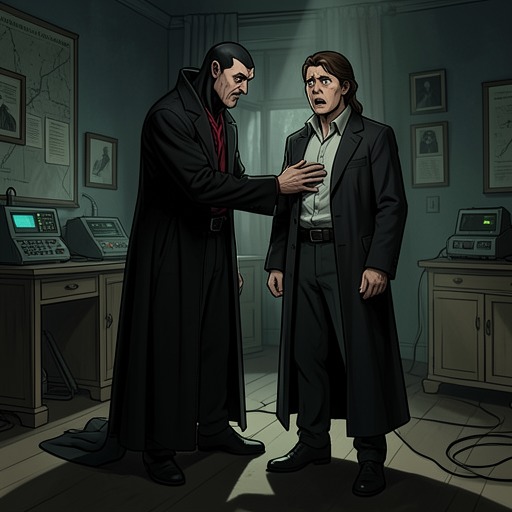
That conflict becomes explicit when Esmeralda’s parents arrive to reclaim her. Her mother, Alyson, speaks as the pack’s Luna and questions the Alpha’s opposition to her choice with authority. Thomas, Esmeralda’s father and the Alpha, insists that his daughter’s life is at stake. Their competing claims show that family rank and pack governance can confront the Vampire system’s ownership claim directly.
The strongest counterrule is the bond of fated mates. When Aleksander identifies himself as Esmeralda’s fated mate, Alyson states that the Moon Goddess does not restrict such bonds by race and that no bond is purer or more important. She ultimately tells Aleksander that, if his claim is true, he is the one Esmeralda should be with. Esmeralda then returns to his arms by her own choice. This does not undo the coercive circumstances of her purchase or the collar, but it changes the immediate relation that the law had created: a status imposed as property becomes entangled with a supernatural bond and with Esmeralda’s expressed decision to remain.
Consequences and Significance
The restoration of Old Vampire Laws produces a society organized around exclusion, hierarchy, and controlled life. It separates hybrid families, suppresses dissent, replaces a former religious order, and turns Human reproduction into a state-linked resource. Its violence is both spectacular, in the Queen’s treatment of protesters, and ordinary, in the cages, collars, leashes, and bodily vulnerability of Humans in the marketplace.
At the same time, the laws reveal their own instability. Aleksander’s suspicion that the legal change was prepared before its public announcement suggests that the regime’s claim to natural order conceals deliberate political construction. The law calls the hierarchy inevitable, yet it requires farms, shops, guards, religious replacement, and lethal repression to make that hierarchy appear permanent. Its supposed return to tradition is therefore also an active program of institutional manufacture.
The law’s limits become clearest in the confrontation over Esmeralda. Vampire sovereignty can purchase and mark her, while the Werewolf Witches’ family authority can demand her return, and the Moon Goddess’s fated-mate rule can override racial boundaries recognized by political custom. Old Vampire Laws remain powerful because they shape the city and enable the entire pet system, but they are not the only rules in the world. The resulting collision makes the laws central to the story’s moral tension: they transform predation into legality, while personal attachment, kinship, and sacred bond continue to contest what legality claims to define.