Queen Reinstates Old Vampire Law and Establishes Human Breeding Farms
The Vampire's Pet: Romantasy at its darkest (Blood and Kisses Chronicles : A Dark, Gothic Romance Series)Queen Reinstates Old Vampire Law and Establishes Human Breeding Farms is the decisive political event that transforms Ichoryllia from a society in which Humans had been treated as near-equals into one organized around explicit vampire dominance. The Queen’s restoration of the old order is presented not as an isolated legal adjustment but as a coordinated regime change: Human breeding farms open immediately, public dissent is crushed, religious symbols are replaced, and Humans become legally and materially available as food and property.
Causes and Political Background
The event follows the Queen’s accession and the collapse of the previous royal order. Aleksander Dumoulin regards the old king as weak because he had introduced nothing new and merely preserved the policies inherited from his parents. By contrast, the Queen’s laws are extreme enough to awaken Aleksander’s ancient predatory instinct. Their speed also makes him suspicious. Human breeding farms appear on the same day the old vampire laws are reinstated, a coincidence he considers impossible without prior preparation and evidence that corruption has reached the highest levels of power.
The restored laws reverse an earlier social arrangement in which Humans moved openly through the city and many worked in blood banks. After the change, the streets contain mostly Vampires, while the Human population is removed from ordinary civic visibility. The transformation is therefore both legal and spatial: a change in status becomes visible in who may walk freely, who is confined, and whose bodies supply the kingdom.
Enforcement and Social Reordering
The Queen’s regime does not tolerate opposition. Some Vampires are horrified by the new laws, particularly because hybrid families are torn apart, and protesters take to the streets. The Queen responds with violence and death, cutting short any attempt at revolution. Aleksander expects the population eventually to settle, not because the laws are accepted through open deliberation, but because coercion makes resistance dangerous and temporary.
The event also establishes a sharper classification between Vampires and Humans. Aleksander does not describe himself as hating Humans; instead, he accepts their subordination as the natural order and believes they must return to their supposed place on the food chain. His response reveals how the regime’s hierarchy is normalized through the language of nature. A political decision is recast as biological inevitability, allowing domination to appear less like a new construction than a recovery of an ancient truth.
Breeding Farms and the Human Pet Market
The breeding farms are the institutional foundation of the restored system. At the Human pet store, the proprietor explains that the adults for sale were captured in the city, while Humans produced on the farms are still only babies. This distinction shows that the new order has two complementary channels of supply: seizure removes existing Humans from public life, while controlled reproduction creates a continuing population for vampire consumption and ownership.
The pet store makes the regime’s ideology concrete. Its building had once sold merchandise for Humans; under the new laws, it sells Humans themselves. The irony exposes the transformation of a commercial space into an apparatus of commodification. Inside, cages line the walls, and each contains a Human, straw, water, and food scraps. Some prisoners sleep, while others cling to the bars in panic. Their confinement turns legal dispossession into a visible material condition: Humans are no longer treated as members of the city but as inventory.
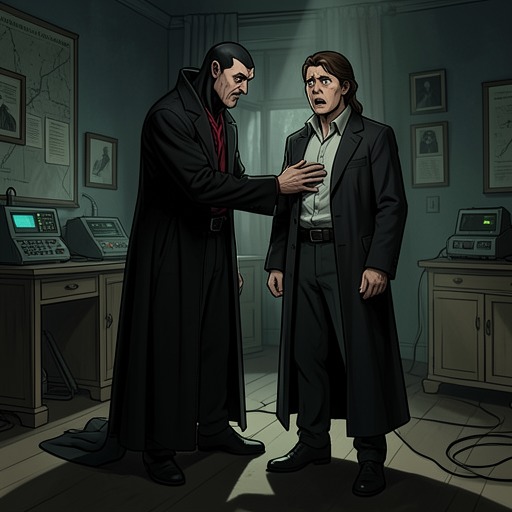
Aleksander participates directly in this market. He selects a black gemstone collar and gives it to Esmeralda, ordering her to put it on and declaring that she belongs to him. The purchase and collar enact the restored law at the level of a single body, translating royal policy into ownership, restraint, and obedience. Yet Esmeralda’s rebellious gaze and refusal to comply prevent the scene from becoming a simple confirmation of the system’s power. Her resistance remains present even while the institution attempts to define her as a pet.
Religious and Ideological Transformation
The Queen’s program extends beyond blood and property into official belief. When Aleksander returns to Ichoryllia Royal Castle, portraits of Hecate, the goddess and mother of Vampires, have been replaced by images of Alastor, demon and spirit of vengeance. Servants are repainting rooms and replacing curtains and chandeliers, making the political revolution visible in the castle’s altered interiors.
Aleksander is not religious, but he recognizes the replacement as wrong. The change demonstrates that the regime is attempting to control the symbolic history of the kingdom as well as its population. The old religious imagery associated with vampire origins gives way to a figure of vengeance, matching a government that enforces restored hierarchy through punishment. Because opposition to the Queen is punishable by death, private judgment becomes the only safe form of dissent; even a powerful nobleman must conceal what he thinks while continuing his work for the castle.
Consequences and Narrative Significance
The reinstated laws create the conditions for Aleksander’s personal descent into the pet system. His family had traditionally preferred Blood Wine and regarded that practice as civilized, remembering the Dark Times when Humans were nearly driven to extinction. He initially tries to respect that inherited restraint, but the sight of the new order and the availability of Humans awaken an appetite that Blood Wine can no longer satisfy. His decision to visit the pet store two days later connects state policy to private desire: the Queen’s law does not merely permit predation; it makes predatory intimacy purchasable.
That connection produces the central contradiction of the event. The regime seeks to make Humans controllable through farms, cages, collars, and a rigid racial hierarchy, but Esmeralda’s relationship with Aleksander exceeds those categories. Her origin in a distant pack of Werewolf Witches, her lack of wolf and magic, and the later recognition of the fated-mate bond all introduce rules that compete with the Queen’s law. Esmeralda’s mother, Alyson, insists that the Moon Goddess does not respect racial boundaries and that the bond between fated mates is more important than ordinary divisions between species. The supernatural principle therefore challenges the state’s claim that race determines rightful status.
The event’s effects continue into the conflict between Aleksander and Esmeralda’s family. When the pack attacks Dumoulin Mansion and Aleksander calls Esmeralda his mate, the possessive language echoes the ownership system created by the Queen, but the later confrontation complicates it: Esmeralda chooses to return to him, and Alyson accepts that choice once the fated bond is acknowledged. Even Aleksander’s proposal to turn Esmeralda into a Vampire so that she can live as long as he does becomes a dispute between competing authorities—his species’ power, her family’s protection, and the Moon Goddess’s supposedly higher law.
As a result, Queen Reinstates Old Vampire Law and Establishes Human Breeding Farms functions as both political background and moral pressure. It reorganizes the kingdom through coercion, turns reproduction and blood into state-managed resources, and gives institutional legitimacy to the treatment of Humans as prey. At the same time, its attempt to make hierarchy absolute generates the conditions for its own limits, because blood desire, family loyalty, and the fated-mate bond continue to cross the boundaries that the restored order tries to enforce.