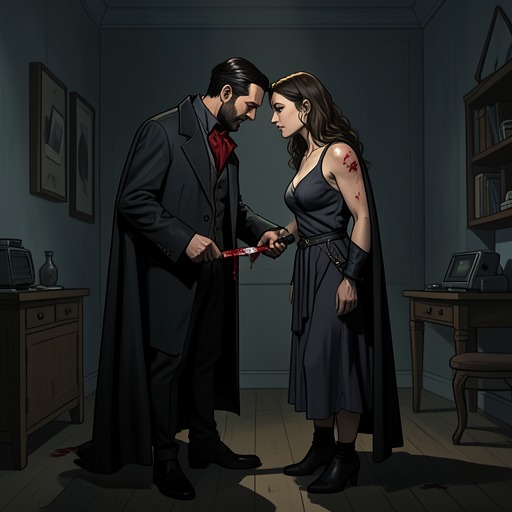
Werewolves Attack Dumoulin Mansion
The Vampire's Pet: Romantasy at its darkest (Blood and Kisses Chronicles : A Dark, Gothic Romance Series)Werewolves Attack Dumoulin Mansion is the decisive assault that shatters the fragile domestic order of Dumoulin Mansion, leaves Aleksander Dumoulin’s butler dead, and carries Esmeralda away. More than an act of physical destruction, the raid exposes the hidden importance of Esmeralda’s identity and precipitates Aleksander’s recognition that the human pet he had acquired is also his fated mate.
Causes and Background
The attack takes place against a kingdom already destabilized by the Queen’s reinstatement of the old vampire laws. Human breeding farms have opened across the same political transformation, and the city has been thrown into disarray. Protests by vampires opposed to the laws have been suppressed through violence or death, while hybrid families have been torn apart. This atmosphere matters because the mansion is not an isolated refuge from public power: it belongs to a vampire lord in a society that has restored a predatory hierarchy and made the control of other bodies newly legitimate.
Esmeralda’s presence in the mansion is especially vulnerable because she was born into a pack of werewolf witches far to the northwest, although she herself possesses neither a wolf nor magic. Her separation from that pack had concealed the significance of her position. The werewolf communities and the vampires are formally at peace, but mutual hostility keeps most packs away from Ichoryllia and limits contact between the two peoples. Esmeralda’s unfamiliarity with vampires had already suggested that her pack was unusually reclusive; the later attack reveals that its distance did not mean indifference toward her.
The immediate cause is the pack’s decision to recover Esmeralda. The servants later explain that the werewolves came to destroy the mansion because they believed she was being held prisoner against her will and treated badly. Their judgment is not wholly mistaken: when Esmeralda first arrived, she had indeed been a prisoner, even if her relationship with Aleksander had changed by the time of the raid. The attack therefore grows from a conflict between two competing accounts of captivity and protection—Aleksander’s belief that Esmeralda has chosen to remain with him and her family’s belief that she must be rescued from him.
Destruction of the Mansion
The assault is discovered when Aleksander returns with a magnificent bouquet of red and white flowers, ranging from rosé to crimson. The promise of an ordinary, celebratory day collapses as Dumoulin Mansion comes into view. Its windows are shattered, stained-glass fragments cover the floor, and the front door hangs open and off its hinges, marked by claw scratches. The bouquet tightens in his grasp as panic overtakes him; he runs toward the ruined house so urgently that petals escape into the wind.
Inside, the violence has erased the mansion’s familiar order. Armchairs have been torn apart, their fabric peeling away, while the walls bear the scars of battle and dust still hangs in the air. The wreckage functions as a visible record of an invasion that has reached into the private spaces of Aleksander’s life. The home is not merely damaged; it has been rendered unreadable, its furniture and walls transformed from signs of stability into evidence of sudden predation.
Crying leads Aleksander to the kitchen, where Judith and other servants are gathered on the floor beside the body of his butler. The man has been decimated by scratches and bites and lies in a pool of blood. Although vampires possess healing powers, the injuries make survival seem unlikely. Aleksander kneels at the butler’s feet and remembers that the servant had been present throughout his life, always there when needed. He takes the man’s arm and waits, but the limb is already cold and rigid, and there is no pulse. The attack thus produces its first irreversible consequence before Aleksander even learns Esmeralda’s fate: the death of the household’s oldest personal witness.
Abduction and Recognition
Judith’s account supplies the missing explanation. Between sobs, she identifies the attackers as werewolves and says that the servants had tried to protect Esmeralda. She then confirms that the werewolves took her despite her screams and her attempts to make them let her go. The report converts the ruined mansion into the site of an abduction rather than a simple raid. Esmeralda was not lost in the confusion; she was the assault’s specific objective.
Aleksander’s response joins grief, guilt, and possessive attachment. He realizes that the attackers have taken the one person who had driven away his emptiness, first naming Esmeralda as his pet and then, with greater force, as his mate. The recognition arrives only after violence has removed her from him. He understands that the distress he felt when she first escaped, his rage when another vampire attacked her, and the intensity of his reaction to her disappearance had all been expressions of a bond he had refused to consider because she was human.
The attack therefore changes the meaning of earlier events without undoing them. Aleksander had purchased Esmeralda within the vampire pet system, and his original relationship to her was shaped by ownership and confinement. Yet the mansion’s destruction forces him to distinguish that initial status from the attachment that developed afterward. His discovery of the fated-mate bond does not erase his earlier guilt; instead, it makes the moral uncertainty of his conduct more acute, particularly because Esmeralda’s family has attacked the mansion while acting on the conviction that she needs protection.
Pursuit and Immediate Consequences
The destruction does not leave Aleksander in a posture of mourning. After telling the servants to rest, he promises that the mansion will be repaired and that the dead butler will receive a proper burial when he returns with Esmeralda. He apologizes for leaving them in their moment of need, but the need to recover her has become a compulsion rather than a considered plan. The attack has therefore transferred the mansion’s surviving inhabitants from a household under his protection into witnesses awaiting restoration, while sending Aleksander away from the wreckage and toward the people who caused it.
He leaves Dumoulin Mansion in haste, following Esmeralda’s faint lilac scent. The trail confirms that the attackers departed recently and leads west out of Ichoryllia into the forest. As the scent grows stronger, his heightened senses register the panting of wolves, cracking branches, and the sounds of someone struggling. Esmeralda’s cry that she should be released provides the final confirmation that the pursuit has not arrived too late. The raid consequently opens directly into a rescue confrontation: the ruined house is only the first stage of the event, while the forest becomes the place where captivity, kinship, and choice will be tested.
Family Authority and the Hidden Stakes
The confrontation reveals why the werewolves were unwilling to abandon Esmeralda. Aleksander recognizes in a woman’s gaze the same look Esmeralda had possessed when he first saw her and realizes that the woman is her mother, Alyson. Alyson approaches the Alpha while holding Esmeralda, and her authority is immediately evident in the way she challenges his questioning of the Luna’s choices. The exchange establishes that the pack is governed not only by the Alpha’s command but also by the Luna’s recognized power to decide matters affecting the family and the group.
The Alpha’s protest identifies the personal stakes beneath the attack: Esmeralda is his daughter. Aleksander then understands that she is the child of both the Alpha and the Luna and the next leader of the pack, likely the most valuable member after her parents. Her abduction from Dumoulin Mansion was therefore not a random act of retaliation or a generalized assault against vampires. It was a recovery mission directed at the heir of a werewolf-witch pack, undertaken by parents who believed that the vampire pet system had made their daughter a prisoner.
The competing authorities surrounding Esmeralda are consequently laid bare. The Queen’s restored vampire laws authorize a hierarchy in which humans can be captured and placed within breeding farms or kept as pets. The werewolf pack answers to its own familial and communal order, while Alyson invokes the Moon Goddess when the family’s claims reach their limit. None of these systems is merely abstract: each attempts to determine where Esmeralda belongs, who may protect her, and whether her future is governed by law, pack duty, or a sacred bond.
Choice, Transformation, and Resolution
Alyson acknowledges that she and the pack believed Esmeralda was a prisoner against her will and badly treated. Aleksander cannot dismiss the charge because Esmeralda had in fact been a prisoner when she first arrived at the mansion. What has changed is that she now chooses to remain with him. The attack thus exposes a temporal contradiction at the heart of the relationship: the family’s rescue is based on a condition that was once true, while Aleksander’s defense rests on a later change that the family could not see from outside the mansion.
When Alyson asks whether Aleksander is Esmeralda’s fated mate, the question shifts the dispute from ordinary possession to a supernatural rule recognized by the pack. Aleksander confirms the bond, and Alyson concludes that, if he is truly the one chosen for Esmeralda, he is the person with whom she should be. Her response does not erase the mansion’s destruction or the butler’s death, but it changes the status of the abduction: the family’s intervention gives way to recognition of Esmeralda’s own decision.
That decision carries a permanent cost. Alyson warns Esmeralda that becoming a vampire will prevent her from leading the pack. Esmeralda accepts the consequence, saying that her brother has always wanted the leadership anyway, and declares her love for Aleksander. Her choice places the fated-mate bond above the succession awaiting her as the Alpha and Luna’s daughter. Alyson, though heartbroken, accepts what she calls the decision of the Moon Goddess. The attack therefore ends not with the restoration of the old family arrangement but with Esmeralda choosing a different species, household, and future.
Narrative Significance
Werewolves Attack Dumoulin Mansion is both a violent reversal and a revelation scene. It begins with Aleksander returning to celebrate an apparently ordinary day and ends by forcing him to pursue Esmeralda through the forest, confront the family from which she came, and recognize the bond he had overlooked. The broken windows, claw-marked door, torn armchairs, and dead butler make the consequences physical before the deeper truth becomes legible: Esmeralda is not an incidental human captive but the daughter of the pack’s ruling couple and its intended successor.
The event also places private love inside a conflict among rival orders. The Queen’s laws have normalized the capture and subordination of humans, while the werewolf-witch pack treats Esmeralda as family and heir, and the Moon Goddess’s decree authorizes the fated-mate relationship that ultimately settles the dispute. The raid is thus produced by a world in which several forms of law claim the same body. Its resolution depends not on the vampire regime or the pack’s initial command alone, but on Esmeralda’s expressed choice and the willingness of Alyson to accept its consequences.
Finally, the attack transforms Aleksander’s understanding of himself. His first response is shaped by the possessive language of the vampire pet system, but his recognition of Esmeralda as his mate exposes an attachment deeper than ownership. That recognition is inseparable from guilt: he remembers that she once was a prisoner and knows that the werewolves’ suspicion was not baseless. The mansion can be repaired and the butler buried, but the assault permanently alters the meaning of the household. It becomes the place where Aleksander’s emptiness was interrupted, the place whose destruction disclosed Esmeralda’s origins, and the point from which both characters move toward a future chosen at the cost of her inheritance.