Aleksander Dumoulin
The Vampire's Pet: Romantasy at its darkest (Blood and Kisses Chronicles : A Dark, Gothic Romance Series)Aleksander Dumoulin is a centuries-old vampire noble and skilled piano maker whose life is shaped by a void that wealth, pleasure, and inherited purpose cannot fill. His early support for the Queen’s restored vampire laws makes that private dissatisfaction part of a wider moral contradiction: the man who longs for something beyond possession initially welcomes a regime that treats humans as possessions.
Identity and Background
For hundreds of years, Aleksander has walked the streets of Ichoryllia with the same persistent feeling: something is missing. Money can buy whatever he desires, but the objects that fill his mansion remain empty substitutes. Sexual pleasure with women and men offers no lasting answer either; beneath it, a nagging desire keeps him in a state of dissatisfaction. The narration introduces his inner life not as a single recent crisis but as a condition that has endured across centuries.
That weariness reaches back to his youth. Although he describes his childhood as good and his upbringing as sound, his parents could not kindle an interest in anything. They called for a doctor, who found no remedy and advised private lessons in the hope that Aleksander might discover a passion. Singing, dancing, and painting all failed to engage him. His days passed in the same desolate indifference, establishing that neither privilege nor parental care could explain away the emptiness he carries into adulthood.
His family’s place in society rests on a practical craft rather than a calling he chose. The Dumoulins had been piano makers and repairers for generations, and their work earned them a noble title. Aleksander’s father urged him to take pride in that status, but the title meant little to him. As an only child, he is nevertheless responsible for continuing the family name after his father’s death. He learned piano work from his father, sees few alternatives, and notes that no one else in the kingdom works in the piano trade and that the business pays well. The craft gives him a role to occupy, not a passion capable of filling the void.
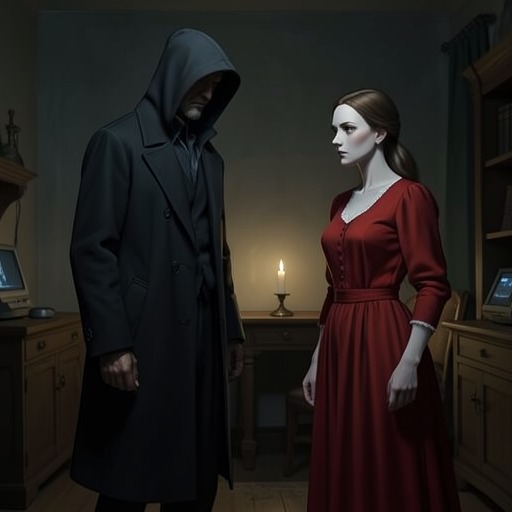
A royal letter addressed to him by his full name breaks through the ordinary form of address: most people call him by his title, while the royal household remembers him from his frequent childhood visits to the castle. The letter’s royal seal points to his family’s generations of service to royalty. Before responding to that summons, he checks his appearance in the mirror, pushes back the collar of his long black trench coat, studies his piercing blue eyes, shaves, and ties his dark hair in a bun. This controlled preparation contrasts with the inward dissatisfaction that no outward presentation can resolve.
The city around him has changed under the Queen’s restored vampire laws. Humans who once walked the streets and worked in blood banks have largely disappeared from public life, while human breeding farms have opened. Aleksander recognizes that such establishments could not have appeared so quickly without warning and suspects corruption at the heart of the change. Yet he intends to conceal that suspicion while working for the castle. His awareness of political corruption does not make him an opponent of the new order: he welcomes the laws because, in his view, humans had been treated as equals for too long and should return to a lower place on the food chain. As protests are met with violence or death and hybrid families are torn apart, his approval reveals the cruelty embedded in the hierarchy he accepts.
Human Pets and Possessive Violence
At the castle, Aleksander catches the scent of prey and notices a human looking at guitars in the corner. Although he is not hungry, the man looks tempting, and his presence there surprises him. When Aleksander asks what a human is doing in the castle, Lysander identifies him as Jason, the Queen’s new pet. The encounter places Aleksander’s private appetite within a public system of ownership: he recognizes the human first as prey, then as someone assigned to the Queen.
At the pet store, a frightened woman gives her name as Esmeralda. Aleksander repeats it as though it belongs to him, approves of it, and announces that he will take her. The owner claps at his choice, while Esmeralda screams in protest. His decision is immediate and possessive; at this point, the evidence shows him claiming her as a pet, not recognizing her as a partner or understanding what she means to him.
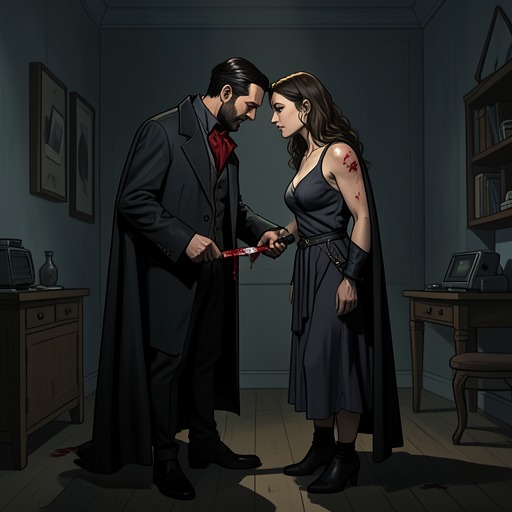
That possessiveness turns violent when another vampire steps over Esmeralda. Aleksander kicks him in the stomach; the vampire lunges with a knife and drives it into Aleksander’s shoulder. Despite the pain, Aleksander holds on to the attacker’s hand, keeps him close, and beats him repeatedly. He pauses only when the vampire has gone still and his own rush of adrenaline ebbs, then bares his fangs and lengthens his nails as a warning that the beating can resume. His declaration, “Nobody touches what’s mine.”, makes the logic of his intervention explicit: he protects Esmeralda, but frames that protection as a defense of ownership.
Recognition and Pursuit
When Werewolves abduct Esmeralda from the vampire city, Aleksander’s response exposes how completely she has altered the meaning of his long-standing emptiness. He first thinks of her as the pet they have taken, but the pain of losing her forces a different word into view: mate. He freezes at the recognition, since he had not considered that a human could be his mate, then reinterprets what had seemed like separate reactions. Her distress when she ran from him, his rage when another vampire attacked her, and the force of his first response to seeing her in the store now form a pattern. What began as possession has become an attachment he understands as a bond, and he declares, “I’m going to get my mate back!”
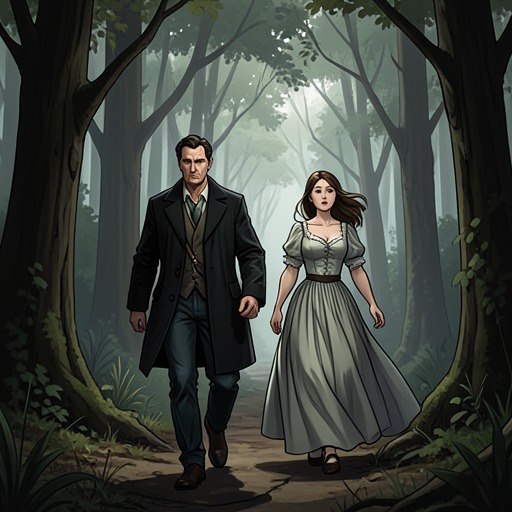
The realization gives his pursuit a personal urgency distinct from his earlier claim of ownership. In the forest, wounded and losing strength, Aleksander sees Esmeralda being chased by an older woman whose graying hair and resemblance to the young woman suggest a family connection. As the Werewolves prepare to pounce, he roars, “Give me back my mate!” The word escapes before he can consider it, but he insists on making his claim known to the pack. His appeal does not immediately free him: the Alpha withdraws his claws only after the woman holding Esmeralda shouts for everyone to wait. Blood running from his back, Aleksander forces himself to his knees and suppresses a wave of pain. The scene leaves the bond newly acknowledged but the confrontation unresolved, with Esmeralda’s intervention halting the attack for the moment.
Narrative Role and Contradictions
Aleksander’s arc is organized around a tension between inherited roles and an attachment he cannot initially name. Piano making gives him a trade learned from his father and a family duty to continue, but neither that work nor the nobility it secured supplies the passion his parents hoped he would find. His response to the human-pet system exposes a deeper contradiction: he can notice corruption in the Queen’s sudden political changes while approving the hierarchy those changes impose. He is not merely an outsider observing a brutal order; he accepts its premise that humans belong beneath vampires, and first approaches Esmeralda through that same language of ownership.
The successive names he gives her mark a change in his understanding, without erasing the possessiveness that preceded it. He begins by choosing her as a pet, then recognizes her as his mate only when the Werewolves take her away. At the forest confrontation, he makes that new bond public even as he describes her as his. The shift therefore brings emotional recognition, not a settled resolution of the inequalities shaping their relationship. Aleksander’s importance lies in this unresolved collision: the man whose abundance could not relieve his emptiness discovers an attachment powerful enough to drive him into danger, while still expressing it in the terms of possession he already knows.