Esmeralda Escapes the Mansion
The Vampire's Pet: Romantasy at its darkest (Blood and Kisses Chronicles : A Dark, Gothic Romance Series)Esmeralda Escapes the Mansion marks the moment when Esmeralda rejects the protected captivity of Dumoulin Mansion and enters the city alone, only to confront the violence that makes escape perilous. Her flight turns the question of ownership and confinement into a life-threatening contest over whether she can remain free.
Causes and Background
Aleksander had learned that Esmeralda came from a werewolf pack, a group he understood to be protective of its own. He expected the pack’s Alpha to send members searching for her once her disappearance became known. Because Esmeralda was believed to have gone to Mytvathyr, the elven city, Aleksander hoped the werewolves would not find her quickly; he estimated that several days might pass before they discovered she was not there. This expectation made her concealment seem temporarily secure, but it also reveals how precarious her position was: her safety depended on misinformation, distance, and the continued functioning of the mansion’s confinement.
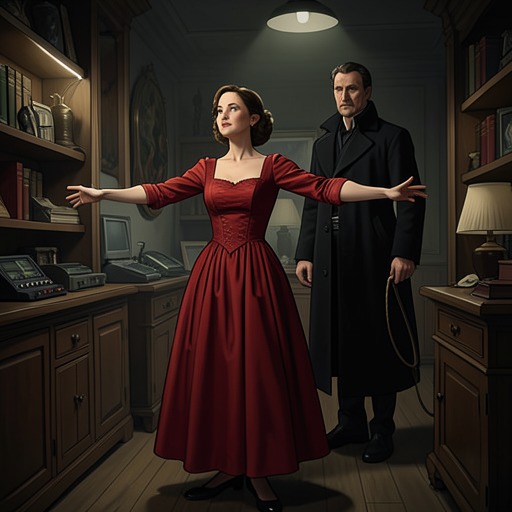
Before the escape was discovered, Aleksander withdrew into a book beside the fireplace, using the quiet of the living room to drive away the emptiness that had long accompanied his existence. The domestic scene is sharply undercut after midnight, when Judith entered in a panic and called for her master. Her alarm transformed the mansion from a controlled interior into the starting point of an emergency.
The Discovery of the Escape
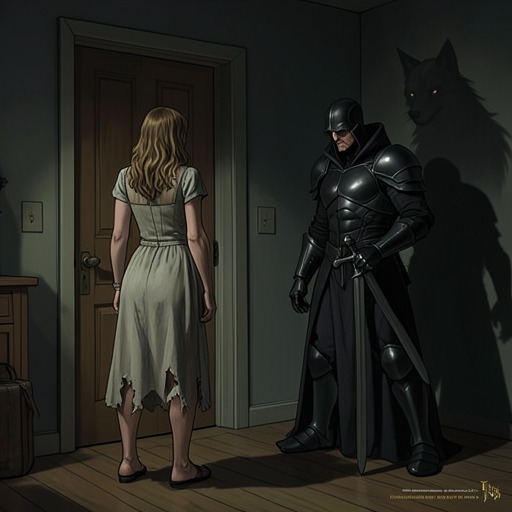
Judith reported that Esmeralda was no longer in her room. The most visible sign of the breach was the black gemstone collar lying on the bed, while the window stood open. The abandoned collar is more than a missing object: it shows that Esmeralda left behind the physical emblem of her status as a vampire pet rather than carrying it into the city.
Aleksander immediately questioned whether the windows had been locked. Judith confirmed that they had been, but explained that Esmeralda had used the curtain rod to force the lock open. The detail gives the escape a practical, improvised character. Esmeralda did not possess institutional power or a prepared route; she used an object from the room itself to overcome the barrier that held her there. Her ingenuity made the flight possible, but the forced window also exposed how little protection the mansion could offer once she decided to leave.
Flight into the City
Aleksander left the mansion without delay, took flight, and tried to calculate how much time had passed between Esmeralda’s going to bed and the discovery of her absence. He suspected that she could not have gone far. She did not know the city, and the presence of so many vampires made the city’s outer edge the likeliest direction for someone seeking distance from the mansion.
The pursuit is therefore shaped by a paradox. The unfamiliar city limits Esmeralda’s ability to escape, yet those same limits make her movement predictable to Aleksander. Her freedom begins as a sudden break from confinement, but it unfolds within a hostile urban geography whose streets she does not understand. Aleksander’s knowledge of the city allows him to convert her uncertainty into a search pattern.
Immediate Consequences
The escape carries Esmeralda toward a danger that confirms the threat beyond the mansion. As Aleksander flew over a street near the new breeding farm, he heard a woman scream and caught the scent of lilac on the wind. He followed the sensory clues and found Esmeralda lying on the stone, with a blond vampire standing over her.
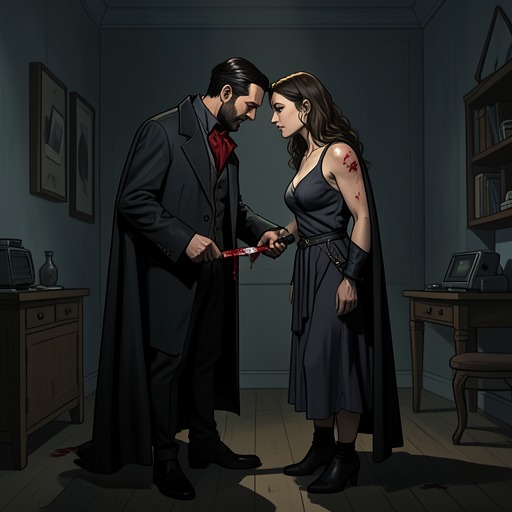
The vampire had pressed a knife against Esmeralda’s throat, torn the top of her dress to expose her breasts, and inflicted a deep gash across her arm. Dark blood was oozing from the wound, while his lowered fangs showed that he was preparing to feed. Thus the escape’s immediate value shift is from confinement toward apparent freedom, then from freedom toward acute physical danger. Esmeralda has escaped Aleksander’s mansion, but the city’s vampire society offers no protection simply because she has left his control.
The scene also gives the escape a structural consequence: Esmeralda’s disappearance summons Aleksander into a rescue pursuit. What begins as an act of self-liberation becomes the event that places her in the path of another vampire and brings Aleksander directly to her. The open window is consequently both an image of release and the entrance through which the next threat arrives.