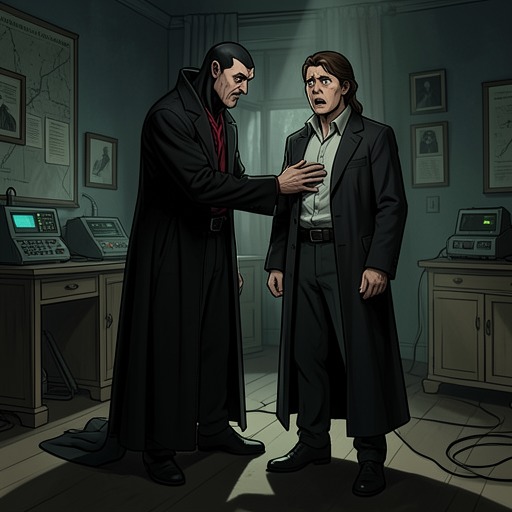
Esmeralda Escapes the Mansion and Is Attacked by a Vampire
The Vampire's Pet: Romantasy at its darkest (Blood and Kisses Chronicles : A Dark, Gothic Romance Series)Esmeralda Escapes the Mansion and Is Attacked by a Vampire is the decisive crisis that follows Esmeralda’s purchase as Aleksander Dumoulin’s human pet. Her flight briefly breaks the imposed order of Dumoulin Mansion, but the city’s danger turns escape into survival. By the time Aleksander finds her, she has been assaulted by another vampire, and his rescue binds protection, ownership, bodily violence, and desire into a single confrontation.
Causes and Background
The event grows directly out of the system that has already reduced humans to merchandise. In the human pet store, humans are kept in cages with straw, water, and scraps of food, while collars, leashes, clothing, and toys are sold as accessories. Aleksander selected a black collar decorated with pearls and lace and marked by a large black gemstone, then compelled Esmeralda to put it on after telling her that she was his. The collar therefore functioned not merely as clothing but as a visible sign of captivity and possession. When Esmeralda later removes it, leaving it on her bed, her escape rejects the object that had been used to define her place in Aleksander’s household.
The immediate alarm comes shortly after midnight. Judith enters in a panic and reports that Esmeralda is no longer in her room, that the collar has been left on the bed, and that the window stands open. The locked window has not simply been forgotten: Esmeralda used the curtain rod to force the lock. Her escape is consequently deliberate and resourceful, not an accidental disappearance. Aleksander leaves the mansion at once, calculating the interval since she went to bed and assuming that she cannot yet have gone far because she does not know the city. He also reasons that the concentration of vampires will probably drive her toward the outer edge of the city.
The Flight and Attack
Aleksander takes flight over the streets in search of Esmeralda. Near the new breeding farm, he hears a woman scream, and the wind carries him the scent of lilac. The two signals lead him to a scene that sharply contrasts with the commercial captivity of the pet store: Esmeralda is no longer enclosed in a cage, but outside the mansion she is exposed to predation by another member of the same dominant species.
A blond vampire stands over Esmeralda with a knife pressed to her throat. He has torn the top of her dress open, exposing her breasts, and a deep cut crosses her arm as dark blood runs from it. His fangs are lowered as he prepares to feed. The attack combines physical injury, sexualized exposure, and the extraction of blood, making Esmeralda’s body the contested ground of vampire power. Her escape has carried her from one form of human commodification into an immediate threat of consumption.
Aleksander intervenes before the attacker can bite. He orders the vampire away and uses a wave of vampiric power to startle and throw him off balance. When the attacker asks who he is and calls Esmeralda his prey, Aleksander answers that she is his pet and threatens to tear the vampire apart if he touches her. The language is morally unstable: Aleksander opposes the assault, yet he does so through the same ownership vocabulary that helped imprison Esmeralda in the first place. His claim protects her from one predator while reaffirming his own possession of her.
The attacker questions why Aleksander’s pet is alone, but Aleksander refuses to explain. When the blond vampire steps over Esmeralda, Aleksander kicks him in the stomach and sends him backward. The vampire lunges with the knife and drives it deeply into Aleksander’s shoulder. Rather than retreat, Aleksander grips the attacker’s hand, keeps him close, and answers the wound with repeated blows to his face. The fight shifts the immediate value of the scene from Esmeralda’s vulnerability toward the attacker’s defeat, while Aleksander’s injury makes the rescue costly rather than effortless.
Aleksander’s violence culminates in the assertion, “Nobody touches what’s mine.” The sentence exposes the central contradiction of the event. It is a declaration of defense, but it is also an unmistakable statement of ownership. Esmeralda is saved because Aleksander refuses to permit another vampire to claim access to her body; the same logic leaves her positioned as an object whose rightful possessor is Aleksander. The rescue therefore does not abolish the pet system. It intensifies the personal force with which Aleksander enforces it.
The attacker’s face becomes unrecognizable from the beating, with swollen eyes and blood pouring from his mouth. Aleksander displays his fangs and lengthened nails, making clear that he is prepared to continue. The blond vampire finally abandons the fight, declaring, “This is not worth it. I’m out of here!” His retreat ends the immediate danger, but it also leaves the encounter defined by asymmetrical power: Esmeralda survives because Aleksander is strong enough to overpower a fellow vampire, while Aleksander himself has been stabbed and must carry the wound back to the mansion.
Rescue and Return
After the attacker flees, Esmeralda moves toward the wall, breathing raggedly and trying to cover her exposed breasts with one arm. She apologizes while still searching for the vampire who had threatened her. Aleksander is furious at her disobedience because the escape could have ended in her death, yet he postpones punishment and tells her that the matter will be dealt with later. His first practical response is to examine the wound on her arm and determine that the gash is superficial and should heal quickly with proper care.
Aleksander then removes the knife from his own shoulder. The act makes his injury visible to Esmeralda, who flinches at the sight of his blood, and it changes the rescue from a simple act of dominance into a shared aftermath of bodily harm. They are close enough to Dumoulin Mansion for him to fly back despite the wound. Carrying Esmeralda in his arms, he feels the scent of her blood and struggles against the instinct to feed: his fangs grow, and he hisses through clenched teeth, but the urgent priority is returning her to safety and treating both injuries.
Judith and several servants wait at the mansion entrance. Judith rushes toward Esmeralda and Aleksander, but Aleksander immediately assigns her care of Esmeralda, ordering that the girl be changed and kept in her room so that she cannot leave again. Esmeralda says nothing and obeys. The final command is that her collar be put back on, restoring the visible emblem she had removed and reasserting the domestic order broken by her flight. The event thus ends not with freedom, but with enforced return, renewed surveillance, and the reinstallation of the object associated with her status as a pet.
Blood, Desire, and Reclassified Intimacy
The rescue also prepares a deeper shift in the relationship. Soon afterward, Esmeralda agrees to let Aleksander drink from her, and he sinks his fangs into her neck while she grips his arm. Her blood overwhelms him; he experiences it as unlike any human blood he has tasted and recognizes that he will not be able to do without her. Feeding becomes more than routine consumption. As he drinks slowly, their heartbeats move together, and he perceives her private memories and emotions, including her fear of being caught by vampires and the desire arising in the moment itself.
This blood exchange gives the earlier attack a lasting consequence. The vampire who assaulted Esmeralda treated her blood as prey and access as entitlement; Aleksander’s later feeding is presented as mutually accepted, but it remains rooted in the same unequal vampire-human structure that makes her body available for consumption. The difference lies in consent and emotional connection, not in the disappearance of the power imbalance. Their connection therefore transforms the meaning of blood without freeing it from the economy of possession, appetite, and danger.
From Possession to the Fated-Mate Claim
The event’s language of ownership later acquires a more complicated meaning when Aleksander confronts Esmeralda’s werewolf pack. As the wolves prepare to attack him, his strength is failing, yet he demands that they give back his mate. The word emerges before he consciously chooses it, and he wants the entire pack to know that Esmeralda is his. The claim echoes his earlier insistence that nobody may touch what belongs to him, but it also marks a movement beyond the purchased identity of a human pet. The collar names a social possession imposed by vampire custom; mate names a bond recognized in the conflict between species.
The werewolf Alpha rejects the prospect of Aleksander’s survival with Esmeralda, saying that the Moon Goddess chose poorly and that, after her death, Aleksander would have to live alone for hundreds of years in mourning. Aleksander answers that he will turn Esmeralda into a vampire so that she can live as long as he does, while the Alpha rejects the proposal and Esmeralda affirms it. Although this later confrontation is not part of the escape itself, it reveals why the attack matters within the larger arc: the flight exposes Esmeralda to danger, the rescue deepens Aleksander’s attachment, and the resulting bond eventually becomes an argument over whether her future belongs to her pack, to Aleksander, or to her own stated choice.
Consequences and Narrative Significance
The escape produces no immediate liberation, but it does alter the emotional and narrative balance. Esmeralda proves that the restrictions surrounding her can be challenged: she forces open a locked window with a curtain rod, removes the collar, and reaches the city without being detected until the attack. At the same time, the city demonstrates that flight from the mansion does not place her outside violence. She encounters a vampire who is willing to expose, wound, and consume her, and her survival depends on another vampire’s intervention.
For Aleksander, the episode turns abstract possession into active protection. He leaves the mansion without delay, searches through the night, accepts a knife wound while fighting, carries Esmeralda home, resists feeding from her blood while she is injured, and orders the servants to treat her. Those actions make his attachment physically costly and behaviorally concrete. Yet the same sequence preserves coercion: he calls her his pet, orders her confinement, and requires the collar’s return. The event’s decisive tension is therefore not between ownership and freedom as cleanly opposed states, but between rival forms of control, with protection functioning as both care and justification for continued possession.
As a plot structure, the episode combines escape, pursuit, rescue, and temptation. Its value reversal is rapid: Esmeralda moves from confinement to apparent freedom, from freedom to mortal peril, and from peril to guarded safety that remains another form of confinement. The open window promises an exit, while the restored collar closes the movement symbolically. The later blood bond and fated-mate claim keep that contradiction alive, allowing a violent rescue to become the threshold through which captivity is recast as intimacy and personal ownership begins to resemble, without fully becoming, reciprocal belonging.