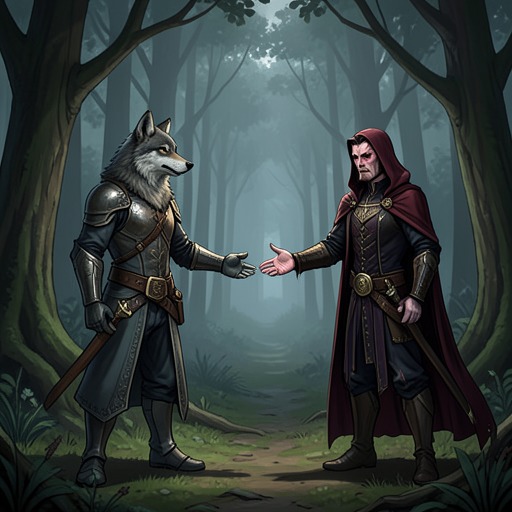
Werewolves
The Vampire's Pet: Romantasy at its darkest (Blood and Kisses Chronicles : A Dark, Gothic Romance Series)Werewolves are a supernatural people defined by pack belonging, bodily transformation, and collective loyalty. Their role in the story is deliberately double: they are treated by vampires as dangerous outsiders, yet they are also the family and community that comes to reclaim Esmeralda when they believe she has been imprisoned. Through their conflict with Aleksander Dumoulin, the narrative reveals that Esmeralda is the daughter of the pack’s Alpha and Luna and is expected to inherit its leadership, while her connection to a vampire challenges the boundaries separating the two peoples.
Identity and Social Boundaries
Werewolves live in organized packs, and at least some packs are connected to witchcraft. Esmeralda explains that she grew up in a pack of werewolf witches far to the northwest, although she was born without either a wolf form or magic. Her lack of those abilities makes her unusual within the group, but not detached from it: the pack remains her home, and its customs shape her understanding of the wider supernatural world.
The relationship between Werewolves and vampires is formally peaceful but emotionally hostile. Werewolves generally avoid Ichoryllia, while those that do enter the city maintain only minimal contact with its vampire population; Aleksander therefore suspects that Esmeralda’s pack is among the more reclusive groups. The boundary is also perceptual and bodily. Aleksander initially cannot smell wolf in Esmeralda, and her unfamiliarity with vampire customs marks her as someone raised outside Ichoryllia. Her identity consequently cannot be reduced to physical traits: she belongs to the werewolf community by family and social origin even though she lacks the characteristic transformation and magic.
Pack Structure and Family Authority
The pack is governed through a clear hierarchy. Its Alpha is a physically imposing man who leads the confrontation with Aleksander, while the Luna, Alyson, exercises a distinct authority of her own. When the Alpha angrily challenges the pack’s pause in the attack, Alyson answers by asking when he began questioning his Luna’s choices. Her intervention demonstrates that pack power is not held by the Alpha alone; the Luna can halt violence and compel the group to reconsider its actions.
The werewolves’ response to Esmeralda’s disappearance is rooted in both kinship and collective obligation. After the attack on Dumoulin Mansion, Judith explains that the Werewolves destroyed everything because the household was trying to protect Esmeralda. Aleksander realizes that the assault was far larger than an ordinary rescue: the pack has entered a vampire city in broad daylight to retrieve one of its own. The scale and risk of the operation show that Esmeralda’s value is not merely emotional. She is the daughter of the Alpha and Luna and therefore the pack’s next leader, probably its most important member after her parents.
Transformation and Conflict with Aleksander
The confrontation in the forest presents Werewolves through their most visibly threatening characteristic: transformation. A tall, muscular man with short black hair and a scruff approaches Aleksander with the pack surrounding him. After declaring that Aleksander will die as a bloodsucker, the man drops onto all fours; his face lengthens into a snout, his muscles swell, his clothes tear, a tail extends, and hair spreads across his body. Within seconds, he becomes a huge wolf. His greater size compared with the other transformed members identifies him as the Alpha.
At the Alpha’s signal, the entire pack attacks. Teeth sink into Aleksander’s flesh and claws tear his skin from every side, while the struggle leaves blood and saliva across the ground. One attacker returns to human form and lies naked nearby, but Aleksander has no time to determine whether the figure is dead. Though outnumbered and increasingly exhausted, he uses vampiric strength, throws one wolf down, scratches others with his nails, and bites a wolf that attempts to attack his face. The violence is sustained by his determination to reach Esmeralda, who is close but hidden from view.
The battle also exposes a limit to the pack’s violence. When Alyson orders the attack to stop, the Alpha reacts as though her command were an act of defiance. His anger is not simply hostility toward Aleksander; it is fear for his daughter’s life. The family’s internal conflict interrupts the external one, allowing Esmeralda’s testimony that Aleksander saved her and treated her well to be heard.
Esmeralda, Belonging, and the Fated Bond
The pack initially assumes that Esmeralda must be rescued from captivity. Its judgment is understandable within the circumstances: Aleksander purchased her from the human pet store, brought her into a vampire household, and at first treated her according to the coercive pet system. The wider vampire order reduces humans to commodities and prey, while the new regime has reopened human breeding farms and violently suppressed opposition. Against that background, the Werewolves’ fear that Esmeralda is being held against her will is not baseless.
Yet the forest encounter changes the meaning of the rescue. Esmeralda tells her mother that Aleksander saved her life and treated her well, and she insists that her life is not in danger. Alyson accepts that the situation has changed after Aleksander identifies himself as Esmeralda’s fated mate. She asks whether he is the mate given by the Moon Goddess and concludes that, if his claim is true, he is the one Esmeralda should be with. The pack’s family authority therefore yields to a higher sacred rule: the fated-mate bond is presented as more important than racial hostility or the parents’ immediate judgment.
Alyson explicitly rejects the Alpha’s belief that the Moon Goddess would never join a werewolf with a vampire. She maintains that the goddess does not care about species and acts according to her own will. This principle overturns the pack’s racial boundary without denying the seriousness of its traditions. Esmeralda remains the Alpha and Luna’s daughter, but her recognized future no longer lies wholly within the pack.
Consequences and Narrative Significance
Esmeralda’s choice has direct political consequences. Alyson warns that if her daughter becomes a vampire, she will no longer be able to lead the pack. Esmeralda accepts the loss of succession because she loves Aleksander, adding that her brother has always wanted to lead the pack anyway. Her decision does not erase her werewolf heritage; instead, it separates biological and familial belonging from formal leadership. The pack can remain her origin even as another person assumes the position she was expected to inherit.
The Werewolves thus function as both antagonistic force and corrective community. Their attack destroys the mansion and kills or injures members of its household, but their intervention also exposes the truth that Aleksander had not understood: Esmeralda is not an ordinary human pet but a politically significant daughter and heir. Their arrival forces the vampire protagonist to confront the coercive beginnings of his relationship with her and to recognize that her continued presence must become a choice rather than mere possession.
Their presence also tests the vampire kingdom’s official order. The Queen’s restored vampire laws classify humans beneath vampires and have already torn hybrid families apart, while the kingdom’s changed religion punishes dissent. Against this state-backed hierarchy, the Werewolves preserve a competing legal and moral structure based on pack authority, parental protection, and the Moon Goddess’s decree. The forest confrontation becomes the point at which those systems collide: vampire law, pack custom, family command, and sacred fate all claim authority over Esmeralda. The resolution does not come from military victory. It comes when Esmeralda speaks, Alyson listens, and the pack acknowledges a bond that crosses the species boundary it had defended with violence.