Blood Wine
The Vampire's Pet: Romantasy at its darkest (Blood and Kisses Chronicles : A Dark, Gothic Romance Series)Blood Wine is synthesized from donated blood and serves as the principal civilized alternative to feeding directly on Humans. Its importance is practical, social, and symbolic: it permits adult Vampires to survive without sacrificing Humans, while also marking the distance between the restrained society Aleksander Dumoulin inherited and the predatory instincts revived by the Queen’s restored vampire-law regime. The drink never fully replaces fresh blood, and that failure becomes one of the pressures leading Aleksander toward Esmeralda.
Definition and Social Function
Blood Wine is made from donated blood, but the process diminishes its purity. Aleksander explains that it allows Vampires to survive in adulthood without sacrificing Humans, making it a technological and cultural compromise between vampiric appetite and the moral memory of earlier catastrophes. His mother treated the drink as evidence that their people had become civilized and had moved beyond the Dark Times, when the Human population had been reduced almost to extinction. Within his family, drinking Blood Wine therefore represented more than taste: it was a discipline connected to restraint, historical memory, and a refusal to repeat the destruction caused by uncontrolled feeding.
That ideal exists uneasily beside the political transformation of Ichoryllia. After the Queen reinstated the old vampire laws, Human breeding farms opened and Humans were forced back into a subordinate place. Aleksander accepted the new hierarchy and felt the return of his ancient predatory instinct, even while he recognized the corruption and violence surrounding the Queen’s rule. Blood Wine consequently stands as a remnant of a more regulated social order at the moment when the kingdom is turning toward openly institutionalized predation.
Use in Aleksander Dumoulin’s Household
Aleksander’s family preferred Blood Wine, and he initially tried to respect the values his mother had taught him. Nevertheless, the sight of Jason at the castle awakened an appetite for fresh blood that would not disappear. The craving became an obsession, and two days later Aleksander went to the Ichoryllia Human Pet Store to acquire a Human pet. The decision shows that Blood Wine has ceased to satisfy him: the civilized substitute remains available, but it no longer answers the bodily desire intensified by the restored social permission to treat Humans as prey.
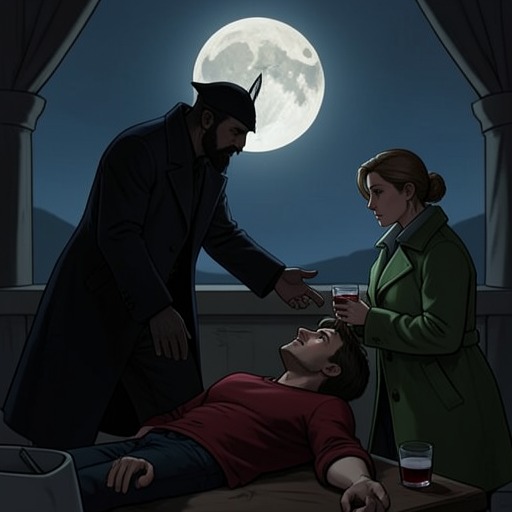
At dinner, Aleksander lazily swirls Blood Wine in a glass while waiting for Esmeralda to enter. The crimson liquid occupies the same scene as her body, her lilac scent, and the stone set into her collar, creating a sharp contrast between the prepared beverage and the living source of blood beside him. The drink is present as a controlled ritual, but Esmeralda’s proximity makes restraint increasingly difficult. Its visible color recalls what it contains while its processed form cannot compete with the immediacy of a Human body.
The inadequacy becomes explicit when Esmeralda eats at the long wooden table. Aleksander finds the meal acceptable but judges the Blood Wine disappointing, because having his new pet nearby intensifies the urge to sink his teeth into her. He does not feed immediately; instead, he tells her that he wants her to desire the act, reasoning that willing blood tastes better and that a traumatized pet would not be enjoyable. Blood Wine thus helps frame the difference between passive nourishment and the charged intimacy Aleksander seeks from fresh blood.
Biological Limits
Aleksander later gives Esmeralda a direct account of Blood Wine’s limits. Fresh Human blood is the main vital source for Vampires, whereas Blood Wine, because it is synthesized from donated blood, loses purity. The substitute is sufficient for adult survival, but fresh blood increases vampiric powers tenfold, including healing. This distinction explains why Blood Wine can sustain a population while still leaving powerful Vampires physically and instinctively unsatisfied.
The explanation also changes the meaning of Aleksander’s appetite. His desire is not merely a rejection of his mother’s ethics or a preference for a stronger flavor. Fresh blood has measurable effects on vampiric strength and healing, and it carries a sensory and emotional immediacy that processed blood lacks. When Esmeralda offers herself, Aleksander’s response crosses the boundary his family’s Blood Wine tradition was designed to maintain.
Contrast with Fresh Blood
Aleksander’s first feeding from Esmeralda confirms the superiority he had sensed. She permits him to bite her neck, and the exchange produces an intense physical and psychic connection: he tastes her blood as uniquely delicious, perceives her fear and desire, and experiences their emotions as intertwined. Blood Wine has none of this reciprocal, invasive intimacy. It can preserve life, but it cannot reveal another person’s memories or bind two bodies through shared sensation.
The contrast is reinforced by the broader imagery of the narrative. The Human pet store reeks of urine and contains Humans in cages, while Esmeralda’s blood is associated with her warmth, heartbeat, scent, and eventual emotional surrender. Blood Wine belongs to the managed economy of donation, storage, and civilized consumption; fresh blood belongs to the unstable zone where appetite, violence, desire, and attachment overlap. Aleksander’s movement from one to the other mirrors his movement from inherited restraint toward possession and then toward a bond he recognizes as fated.
Narrative Significance
Blood Wine makes the vampire society’s claim to civilization materially visible, but the story repeatedly reveals how fragile that claim is. Aleksander’s mother invokes it against the memory of near-extinction, while the Queen’s regime normalizes Human capture and revives predatory privilege. The beverage therefore carries an argument about progress: it offers a way for Vampires to live without killing, yet the political order can preserve the product while abandoning the ethical principle behind it.
For Aleksander, Blood Wine is both habit and failed boundary. He can pour it over ice, drink it at dinner, and use it to remain alive, but it cannot quiet the hunger awakened by Esmeralda’s presence. After Esmeralda is attacked by another Vampire, Aleksander pours himself whiskey and stares into the fireplace, but the scene follows his fear that he might have lost her rather than any satisfaction supplied by Blood Wine. Its recurring presence consequently marks the distance between subsistence and desire, between a society that calls itself civilized and the predatory force it continues to organize, regulate, and sometimes celebrate.