Esmeralda’s werewolf-witch pack
The Vampire's Pet: Romantasy at its darkest (Blood and Kisses Chronicles : A Dark, Gothic Romance Series)Esmeralda’s werewolf-witch pack is the secluded community in which Esmeralda was raised and the force that comes to reclaim her from Aleksander Dumoulin’s household. Although the pack initially appears through the hostile logic of a werewolf-vampire conflict, its intervention reveals a more complicated structure of kinship, protection, leadership, and supernatural law: Esmeralda is not merely a vulnerable human without wolf or magic, but the daughter of the pack’s Alpha and Luna and the next prospective leader. Its most consequential act is therefore both a rescue mission and a struggle over who has the authority to define Esmeralda’s belonging.
Nature and Social Position
Esmeralda’s werewolf-witch pack lies far to the northwest, away from Ichoryllia and from the ordinary contact maintained between some werewolf groups and vampires. Esmeralda explains that she was raised in a pack of werewolf witches despite being born without either a wolf or magic. Her lack of supernatural abilities makes her an unusual member when judged by powers alone, but the pack remains her home and the source of the identity she presents when questioned about her past.
The pack is described as reclusive and as strongly committed to mutual protection. Aleksander Dumoulin understands that werewolves protect their own and expects that an Alpha would send members to search for a missing pack member. His expectation initially rests on incomplete knowledge: he hopes the pack will not find Esmeralda quickly because he believes her intended journey to Mytvathyr may delay discovery. The pack’s eventual response proves that its obligations are deeper and more organized than he had assumed.
The pack also exists within a tense interspecies order. Werewolves and vampires are technically at peace, but neither side is fond of the other, and most werewolf packs avoid Ichoryllia or maintain only minimal contact with it. The pack’s decision to enter a vampire city is consequently not routine travel. It is a deliberate breach of distance and danger, made necessary by Esmeralda’s disappearance and by the belief that a vampire has taken one of their own.
Leadership and Kinship
The pack is governed by an Alpha and a Luna, Thomas and Alyson, whose authority is both political and familial. Thomas leads the armed recovery of Esmeralda and speaks as the guardian of the pack’s collective honor. Alyson exercises a different but equally formal authority: when Thomas challenges her decision, she asks, “Since when do you question your Luna’s choices?” Her words establish that the pack’s leadership is not represented by the Alpha alone and that the Luna can direct the interpretation of the crisis.
The recovery party’s importance becomes clear when Alyson is seen holding Esmeralda and Thomas identifies her as their daughter. Esmeralda is the next leader of the pack, probably its most valuable member after her parents. Her absence therefore threatens more than a single family. It removes a future successor and places a central piece of the pack’s continuity in the hands of a vampire under the institution of the vampire pet system.
Thomas interprets that situation as an intolerable insult. He condemns Aleksander for taking one of the pack and making her a pet, and he rejects the idea that a vampire could be connected to a member of their kind. His reaction combines paternal fear, political responsibility, and species hostility. Alyson, by contrast, recognizes that Esmeralda’s testimony changes the meaning of the encounter: Esmeralda says that Aleksander saved her life and treated her well, so the supposed captivity cannot be assessed solely from the pack’s initial assumptions.
The Rescue of Esmeralda
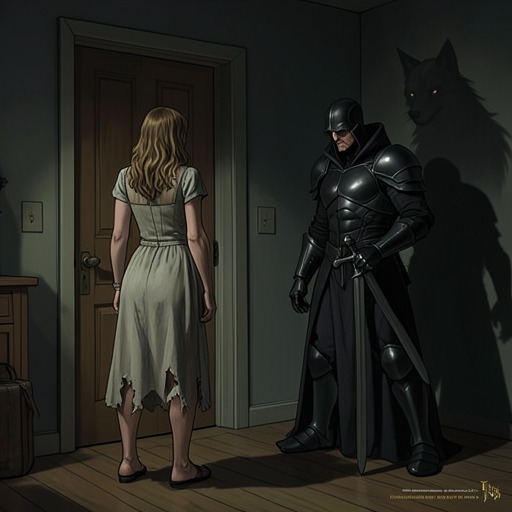
The pack’s attack on the Dumoulin Mansion follows the discovery that Esmeralda is missing. Judith reports that the werewolves destroyed everything while the servants tried to protect her. They took Esmeralda despite her screams and carried her away from the vampire household. The attack occurs in broad daylight and in the middle of a vampire city, making it an extraordinary assertion of pack power and commitment.
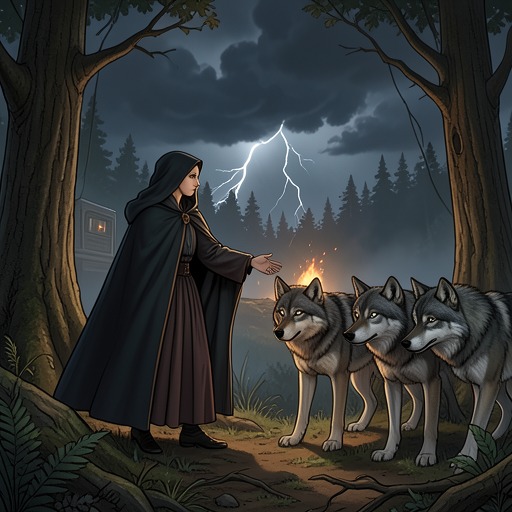
Aleksander follows the pack by tracking Esmeralda’s lilac scent. The trail leads west out of Ichoryllia and into the forest, where he hears wolves panting, branches cracking, and someone struggling. A dozen wolves emerge from dense forestry and surround him, while a much larger man approaches as their leader. The pack does not conceal its purpose: its spokesman declares that there will be no mercy for a vampire who has taken one of theirs and made her a pet.
Thomas then transforms before Aleksander. He drops to all fours; his face lengthens into a snout, his muscles swell until his clothes tear, a tail extends down his back, and hair covers his body. Within seconds, a huge wolf stands in his place. The physical transformation makes the pack’s threat unmistakable, while the difference between Thomas’s size and that of the other wolves identifies him as the Alpha. At his signal, the entire pack attacks.
The confrontation is a collective assault rather than a duel. Wolves bite and claw Aleksander from every side, and he answers with vampiric powers, sharp nails, and fangs. Even when one attacker appears to revert to human form and lies naked on the ground, Aleksander has no time to determine whether the wolf is dead. He continues fighting because Esmeralda is nearby and the need to recover her has become, in his description, a compulsion. The pack’s protective ethic is thus rendered through coordinated violence, while Aleksander’s pursuit mirrors it with an equally possessive determination.
Authority, Choice, and Supernatural Law
The conflict changes when Alyson intervenes. She carries Esmeralda and confronts Thomas, who objects that their daughter’s life is at stake. Alyson answers that Esmeralda has said Aleksander saved her and treated her well. This testimony does not erase the pack’s fear, but it prevents the pack from treating Esmeralda as a voiceless possession whose fate can be decided entirely by her parents.
The decisive dispute concerns the fated-mate bond. Thomas rejects the possibility that the Moon Goddess could mate a werewolf-witch pack member with a vampire, insisting that the divine order cannot sanction such a union. Alyson counters that the Moon Goddess disregards racial boundaries and that no bond is purer or more important than that of fated mates. Her position places sacred supernatural law above species custom and above the immediate authority of the Alpha.
Alyson ultimately releases Esmeralda, allowing her to return to Aleksander. She later accepts that if he is Esmeralda’s fated mate, he is the one with whom Esmeralda should be. The pack’s authority therefore shifts from compulsory recovery to conditional recognition. Its leaders do not simply approve of the relationship; they yield because Esmeralda’s own account and the Moon Goddess’s bond together outweigh the pack’s initial interpretation of vampire captivity.
Consequences and Significance
The pack’s intervention reveals that Esmeralda’s apparent marginality is deceptive. She lacks a wolf and magic, and Aleksander first treats her as prey and a purchasable pet, but her birth gives her a central place in the pack’s succession. Her value is measured simultaneously through family, leadership, and the bond that crosses species lines. The pack’s rescue makes those dimensions visible to Aleksander and forces him to understand that the woman he has claimed belongs to a larger political and emotional community.
Esmeralda’s decision ultimately limits what the pack can recover. Alyson warns that becoming a vampire would mean that Esmeralda could not lead the pack. Esmeralda accepts that consequence because her brother has always wanted to lead anyway, and she chooses Aleksander. Alyson is heartbroken but accepts the Moon Goddess’s decision; Thomas’s earlier protective certainty cannot overturn either Esmeralda’s will or the fated-mate bond.
The pack thus begins as a closed community defending its boundaries and ends as the community that recognizes a bond capable of crossing them. Its attack exposes the violence produced by the vampire pet system, but its leaders’ final response prevents the story from reducing werewolf protection to uncomplicated tribal revenge. The pack remains a source of kinship, succession, and obligation, yet its most important act is learning that protection can require accepting a member’s chosen departure and a future leadership arrangement changed by love.