Human Breeding Farms
The Vampire's Pet: Romantasy at its darkest (Blood and Kisses Chronicles : A Dark, Gothic Romance Series)Human Breeding Farms are the most explicit institutional expression of the Queen’s restored vampire-law regime: they turn human reproduction into a regulated resource for vampires and help return humans to a subordinate place in the kingdom’s social and predatory order. Their establishment does not merely alter the supply of blood; it transforms the city’s streets, markets, families, and moral vocabulary, presenting domination as law and biological production as administration.
Emergence Under the Restored Laws
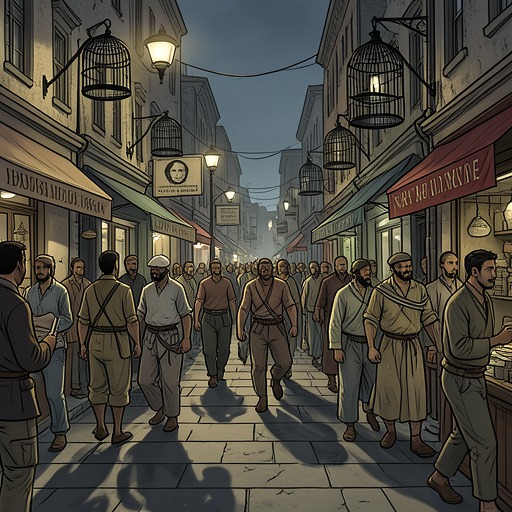
Human Breeding Farms opened on the same day that the Queen reinstated the old vampire laws. The timing made the farms appear less like an improvised response to a political change than one component of a prepared program. The city had previously been crowded with humans, many of whom worked in blood banks, but after the legal reversal the streets contained far fewer of them and the whole urban landscape had fallen into disarray. The farms therefore belonged to a wider reorganization of society, one that changed both where humans could live and what role their bodies would serve.
The speed of the farms’ creation also deepened suspicion about the Queen’s power. Aleksander Dumoulin recognized that an establishment could not be opened so quickly without prior warning or preparation, and he suspected that corruption at the highest level had helped produce the apparent political transformation. He concealed those doubts while continuing his work for the castle, because opposition to the Queen’s regime could bring violence or death. The farms thus emerged within a system in which public compliance was enforced alongside institutional expansion.
Production, Age, and Supply
The farms were designed to produce humans rather than acquire already mature captives. At the Human Pet Store, the proprietor explained that humans produced on a farm were still only babies, while the adults displayed for sale had been caught in the city. The distinction establishes a production cycle with a lengthy delay: the farms would not supply mature humans for another twenty years. Their existence consequently points to long-term population management rather than an immediate solution to the kingdom’s demand.
This delay also shaped the market for human pets. When Aleksander considered acquiring a human, he reasoned that the mature people in the store could not have come from the newly opened farms. The store therefore functioned as the short-term, capture-based complement to the farms’ slower reproductive system. Together, the two institutions divided human supply between manufactured future stock and adults seized from public space, making the boundary between agriculture, commerce, and imprisonment deliberately indistinct.
Social and Economic Consequences
The farms accompanied the disappearance of humans from ordinary urban employment. Before the legal change, many humans had worked in blood banks; afterward, humans were increasingly treated as prey and commodities rather than as social equals. The new system did not simply regulate feeding. It relocated human value into controlled reproduction, sale, and bodily use, while vampires reclaimed the authority to define the proper place of another species.
The farms also exposed the contradiction between claims of natural order and the elaborate infrastructure required to enforce that order. Aleksander accepted the restoration because it awakened his predatory instinct and made him feel alive, while his mother had taught him that the family’s preference for Blood Wine represented civilization’s progress beyond the old dark times, when the human population had nearly been exterminated. The farms therefore revived the very logic that earlier history had made catastrophic, even as the regime presented it as a return to a supposedly proper food chain.
Relation to Capture and Pet Ownership
The existence of Human Breeding Farms made the Human Pet Store possible without making it self-sufficient. The store held adult humans in cages containing straw, water, and food scraps; some slept, while others clung to the bars in panic. Its owner emphasized that these adults had been caught in the city, distinguishing them from the immature population on the farms. The commercial setting converted captivity into a retail transaction, with collars, leashes, clothing, toys, and other accessories displayed beside the human merchandise.
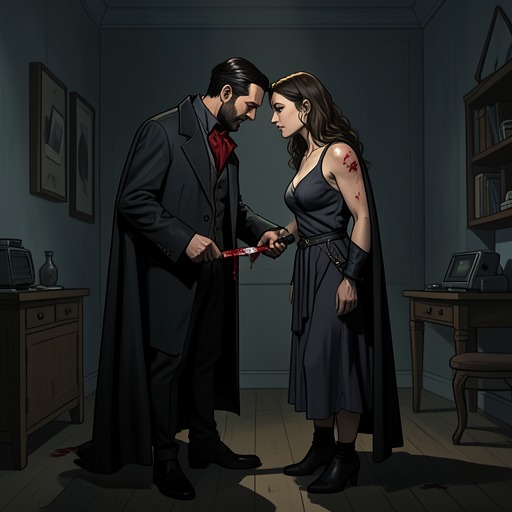
Aleksander’s purchase of Esmeralda reveals how the farm system and the pet system reinforced one another. He selected a black collar decorated with pearls and lace and bearing a large black gemstone, then paired it with a long black leather leash. When Esmeralda hesitated, he ordered her to wear the collar and declared, “Whether you like it or not, you’re mine! Now obey and put this collar on.” His language made ownership unmistakable, while the accessory turned legal and economic subordination into a visible mark on the body.
Yet Esmeralda’s origins expose the limits of the regime’s categories. She had been raised in a pack of werewolf witches despite being born without a wolf or magic, and she had been captured while traveling toward an elven city on pack business. Her body entered the vampire market not through the farms but through interspecies capture, and her status could not be fully explained by the kingdom’s human classification system. Later, her mother Alyson argued that the Moon Goddess disregarded racial boundaries and could join different races as fated mates, directly challenging the assumption that the regime’s divisions reflected an unquestionable natural law.
Political and Thematic Significance
Human Breeding Farms reveal the Queen’s government as a regime that manufactures scarcity, hierarchy, and obedience through coordinated law, commerce, religion, and violence. The official replacement of the portraits of Hecate, mother of vampires, with images of Alastor, demon and spirit of vengeance, occurred alongside the legal restoration and the farms’ opening. This religious change helped mark the same political turn: older moral restraints were displaced by an ideology of vengeance and predation, while dissenting vampires were suppressed through violence or death.
The farms also make human bodies into a contested boundary between person and property, food and family, reproduction and production. Aleksander’s certainty that humans belonged lower on the food chain coexists with his mother’s memory of the near-extinction of the human population, showing that the institution is supported by both instinctive appetite and historical denial. Its apparent order depends on cages, capture, controlled maturation, and the silencing of those who object.
That structure is later unsettled by the conflict over Esmeralda. Thomas, her father and the Alpha of her pack, regarded her life as a matter demanding recovery, while Alyson identified the fated-mate bond between Esmeralda and Aleksander as more important than racial separation. Esmeralda’s eventual choice to return to Aleksander does not erase the coercive conditions under which he first bought her; indeed, Aleksander himself remembered that she had initially been a prisoner and recognized that her later decision to remain represented a change. Against the farms’ logic of assigned bodies and predetermined use, the fated-mate relationship introduces a competing claim: that identity and belonging may arise from personal choice and a supernatural bond rather than from the state’s reproductive classifications.