Ichoryllia Royal Castle
The Vampire's Pet: Romantasy at its darkest (Blood and Kisses Chronicles : A Dark, Gothic Romance Series)Ichoryllia Royal Castle is the commanding royal palace of the kingdom, built above the town on a mountain and marked by white stucco, black brick, and an atmosphere in which magnificence coexists with political violence. It is not merely a residence for the Queen: the castle concentrates the kingdom’s altered laws, changing religion, courtly rituals, and newly normalized ownership of Humans. Its corridors also carry Aleksander Dumoulin’s personal history, linking the public transformation of the realm to the private memory of family, craftsmanship, and loss.
Setting and Architectural Presence
Ichoryllia Royal Castle dominates the town from its mountain position. Its white-stucco and black-brick walls contrast with the gray brick of the outer walls, giving the building an exotic appearance that Aleksander Dumoulin has considered magnificent since childhood. The castle’s elevation and visual authority make its political function apparent before any policy is discussed: it stands above the town as both an imposing landmark and the physical center of royal power.
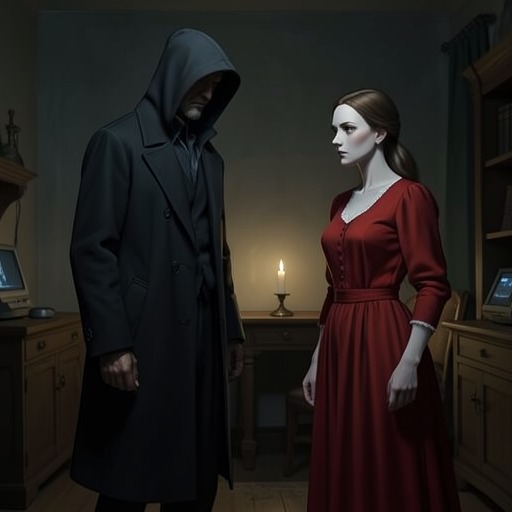
The interior preserves a refined elegance even while the regime is remaking it. The music room contains a grand piano with a polished ebony surface that gleams in soft lighting, and Aleksander Dumoulin regards it as one of the most beautiful instruments he has encountered in his career. Yet elsewhere servants are repainting rooms and replacing curtains and chandeliers. The juxtaposition is revealing. The palace retains the aesthetic of continuity while its furnishings, symbols, and governing order are being systematically altered.
Family Memory and Royal Service
The castle is bound to Aleksander Dumoulin’s childhood and professional inheritance. His family had served royalty for generations, and the court was accustomed to addressing him by his first name rather than by his title of Lord. As a child, he accompanied his father through the castle’s corridors while his father fulfilled piano-related contracts and explained the work to him. Returning after his parents’ deaths, Aleksander Dumoulin experiences a wave of sadness because the same passageways now recall the instruction and companionship he can no longer recover.
That memory is inseparable from the practical role he continues to perform there. His family’s long connection to the royal household helps explain why the Queen summons him to repair her instrument, while his training as a piano maker and repairer makes him the appropriate craftsman. Lysander, an elderly servant who must lean on a cane, greets him at the entrance. Having served the previous king and the king’s parents, Lysander now serves the Queen, embodying the palace’s institutional continuity across a change in rulers.
The Queen’s Altered Court
The castle reflects the Queen’s restoration of the Old Vampire Law and the political reordering that follows it. Since the Queen reinstated the old vampire laws, the city outside has fallen into disarray: Human breeding farms opened on the same day, and the once-visible Human population, including workers in blood banks, largely disappeared from the streets. Some Vampires opposed the laws and protested, but the Queen answered upright resistance with violence or death. The castle therefore functions as the protected source of policies whose consequences are imposed throughout the city.
The regime’s transformation is also visible in the palace’s religious imagery. Portraits of Hecate, the goddess described as the mother of Vampires, have been replaced by portraits of Alastor, a demon and spirit of vengeance. Aleksander Dumoulin is not religious, but he recognizes the replacement as wrong. He also understands that opposition to the Queen’s change in the kingdom’s official religion is punishable by death, making silence a condition of survival. The altered portraits turn the palace into a record of ideological enforcement: even its walls must testify to the Queen’s authority.
The Music Room and the Human Pet
The music room provides the castle’s most concentrated meeting of artistry and predation. The Queen asks for the piano to be played daily, and its broken condition brings Aleksander Dumoulin to the palace. He finds rusted strings, worn hammer felts, and a damaged soundboard, but he has the necessary materials with him. Repairing the instrument absorbs him so completely that he loses track of time, alone with the old wood and the strings until the work is finished and Lysander remains waiting nearby.
When Aleksander Dumoulin leaves, the room’s cultivated atmosphere is interrupted by the scent of prey. He notices a Human staring at the guitars in the corner and is surprised to find one inside the castle. Lysander identifies him as Jason, the Queen’s new pet. The scene exposes the palace’s contradiction more starkly than the altered decorations do: the court preserves music, polish, and refined ceremony while displaying a Human body as royal property.
Jason’s presence also has a direct consequence beyond the castle walls. Seeing the Queen’s pet awakens in Aleksander Dumoulin a persistent craving for fresh blood and leads him to decide that he should obtain a pet himself. He initially tries to reject the impulse, remembering that his family preferred Blood Wine and that his mother had warned against returning to the Dark Times, when the Human population had nearly been destroyed. The desire nevertheless becomes an obsession. Two days after visiting the castle, he goes to the Ichoryllia Human Pet Store, where the owner explains that the adults on display were captured in the city while Humans produced on the farms are still only babies.
Narrative and Political Significance
Ichoryllia Royal Castle transforms private recollection into political evidence. For Aleksander Dumoulin, it is the place where his father taught him a trade, where royal familiarity confirms his inherited status, and where grief interrupts his return. For the kingdom, it is the architectural face of the Queen’s restored vampire-law regime, a site from which legal hierarchy, religious replacement, and the Human pet system acquire ceremonial legitimacy.
The castle’s significance lies in this convergence of beauty and domination. Its mountain walls, polished piano, and elegant music room suggest order and permanence, while repainting, replaced religious portraits, royal pets, and the disappearance of Humans from public streets reveal a society being forcibly remade. The palace does not simply shelter the new order; it aestheticizes it, making coercive institutions appear compatible with tradition, refinement, and inherited royal service.