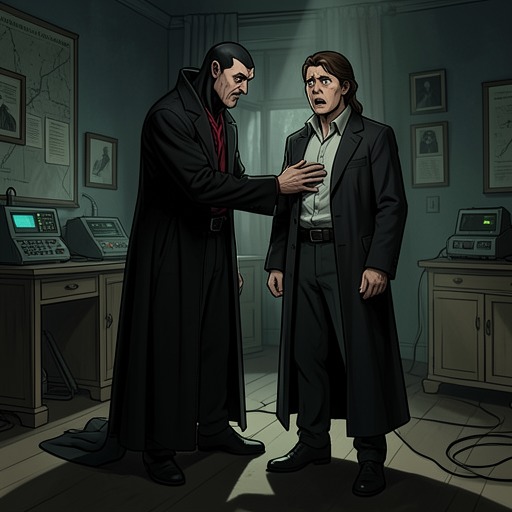
Vampire Pet Management Rules
The Vampire's Pet: Romantasy at its darkest (Blood and Kisses Chronicles : A Dark, Gothic Romance Series)Vampire Pet Management Rules govern the practical status of a human held as a vampire pet: where the pet may go, how the pet must appear, who may touch the pet, and what kind of treatment the pet receives. Aleksander Dumoulin applies the rules to Esmeralda after taking her from the Ichoryllia Human Pet Store, making the regulations a direct instrument of household authority and a visible expression of the broader order that places Humans beneath Vampires.
Definition and Political Background
The rules emerge within the transformed social order created after the Queen reinstates the Old Vampire Law. Human Breeding Farms open on the same day, the city’s former human workers disappear from the streets, and Humans are increasingly treated as a managed source of blood rather than as social equals. Vampires who protest the new laws face violent repression or death, while the official religion of the kingdom is changed and opposition to the Queen’s regime becomes punishable by death. Vampire Pet Management Rules therefore operate within a larger legal and political system that presents hierarchy as natural while manufacturing it through law, markets, confinement, and force.
Aleksander’s own response exposes the rules’ ideological contradiction. His family traditionally drinks Blood Wine, and his mother taught him that Vampires had advanced beyond the Dark Times, when the human population was nearly destroyed. Yet the sight of Humans being captured and the return of predatory customs awaken in him an instinct he enjoys. His desire for a pet grows into an obsession with fresh blood, leading him to the human pet store. The rules are thus not merely private preferences: they are enabled by the Queen’s restored regime and by a commercial system in which captured Humans and farm-produced infants are sold as commodities.
Purchase, Selection, and Visible Ownership
The pet store presents the material basis of the system. Humans are confined in wall-lined cages containing straw, water, and food scraps; some sleep, while others cling to the bars in panic. The owner explains that the adults were caught in the city and that Humans produced on the farm are still babies. The distinction shows how the system joins capture with controlled reproduction, supplying different kinds of human bodies to the vampire market.
Aleksander chooses Esmeralda because her presence awakens an immediate fascination and because the scent of her blood enthralls him. He reads her widened eyes as evidence that she may not be from Ichoryllia, but instead of treating that uncertainty as a reason to release her, he incorporates it into his control of her. He selects a black collar decorated with pearls and lace and marked by a large black gemstone, together with a long black leather leash. These accessories turn ownership into a public and bodily sign: the collar identifies Esmeralda as a pet, while the leash extends the keeper’s power beyond direct physical contact.
When Esmeralda hesitates to put on the collar, Aleksander orders her to obey and declares, "Whether you like it or not, you’re mine! Now obey and put this collar on." She complies under his sustained gaze, and he praises her as a good girl. The exchange establishes the central operation of the rules: consent is replaced by command, resistance is answered by coercion, and obedience is rewarded with approval. The collar is not decorative alone; it is the first enforcement mechanism through which a captured Human is made to occupy the social identity of a vampire’s possession.
Household Restrictions and Controlled Care
Once Aleksander brings Esmeralda to Dumoulin Mansion, he presents her to the servants and gives explicit instructions. She must not be beaten or bitten by anyone, must wear her collar at all times, and is forbidden to go outside. She may choose a book from the library, but only within the limits of the mansion’s controlled interior, and Judith is ordered to take her to the baths and provide proper clothing. The rules therefore combine protection with confinement. Esmeralda is shielded from unauthorized physical harm while simultaneously denied freedom of movement and required to display the collar continuously.
The same pattern appears after Aleksander returns injured with Esmeralda. Judith and the other servants are told to tend to Esmeralda, change her clothes, and ensure that she does not leave her room. Aleksander then adds that her collar must be put back on. Care is permitted, even demanded, but it remains subordinate to ownership and surveillance. Clean clothing, bathing, medical attention, and shelter do not undo the captive status; they help maintain a controlled and presentable possession within the household.
The rule against beating or biting also defines the limits of authorized violence rather than eliminating violence from the system. Esmeralda has already been taken from a cage, threatened with consumption by other Vampires, collared against her will, and confined. Aleksander’s prohibition means that harm must not be inflicted by servants or unauthorized Vampires, not that Esmeralda possesses equal standing. Protection is structured as the prerogative of the owner, and the owner retains the power to decide which forms of contact are legitimate.
Enforcement and the Language of Possession
Aleksander enforces the rules through commands, spatial restrictions, and personal violence. His warning that an uncollared and unleaded Human would be devoured by other Vampires presents the collar and leash as instruments of safety, but the logic also makes the pet dependent on the owner’s control. The same object that marks Esmeralda as property is represented as the barrier separating her from predation by strangers. Within this structure, captivity and protection become inseparable.
That possessive logic becomes most explicit when another vampire threatens Esmeralda. Aleksander attacks him after the vampire steps over her and later states, "Nobody touches what’s mine." The declaration protects Esmeralda from unauthorized contact, but its grammar places her within the category of an owned object. His intervention therefore reinforces rather than overturns the management rules: the owner alone claims the right to determine who may approach, injure, or possess the pet.
Esmeralda’s treatment also exposes a wider boundary system. The pet shop’s urine-smelling cages classify Humans as filthy merchandise, while the collar, clothing, bathing, and confinement attempt to reorganize one selected Human into a domesticated household presence. Blood is simultaneously food, temptation, danger, and the basis of social hierarchy. Aleksander is drawn to Esmeralda’s blood even as he imposes rules intended to prevent other Vampires from consuming or touching her, showing how the regulations manage desire rather than abolish it.
Limits, Contradictions, and Later Reinterpretation
The rules initially appear absolute: Esmeralda must remain in the mansion, remain collared, and submit to the owner’s instructions. Yet their authority is challenged by the disclosure that she and Aleksander are fated mates. During the confrontation involving Thomas and Alyson, Alyson insists that the Moon Goddess does not limit fated bonds by race and that no bond is purer or more important than that of fated mates. Esmeralda then returns to Aleksander’s arms, while he embraces her despite his injuries and promises that he would have gone to the ends of the world to find her.
This revelation does not erase the earlier coercion, but it changes the interpretive pressure surrounding the rules. The household code was created to define Esmeralda as a pet and possession; the fated-mate bond introduces a supernatural and emotional relation that cannot be fully contained by that classification. The collision between ownership language and mutual attachment becomes the rules’ central contradiction. A system designed to keep a Human in a subordinate category is confronted by a bond that the narrative presents as transcending racial divisions and competing authorities.
Narrative Significance
Vampire Pet Management Rules make the political order tangible inside the home. The Queen’s laws, Human Breeding Farms, the pet store, cages, collars, leashes, and household commands form a continuous chain from state policy to intimate bodily control. The rules show how hierarchy is normalized through ordinary procedures: selecting a body, purchasing accessories, restricting movement, assigning servants, regulating touch, and defining what counts as protection.
At the same time, the rules give the story a concrete vocabulary for its conflict between domination and attachment. Aleksander’s care for Esmeralda is real within the evidence—he forbids others to beat or bite her, arranges bathing and clothing, protects her from an attacking vampire, and reacts intensely when she is endangered—but it is expressed through the authority of an owner. The later fated-mate revelation places that authority under strain, making the collar both a sign of captivity and an emblem of the unequal relationship from which a different form of bond must emerge.