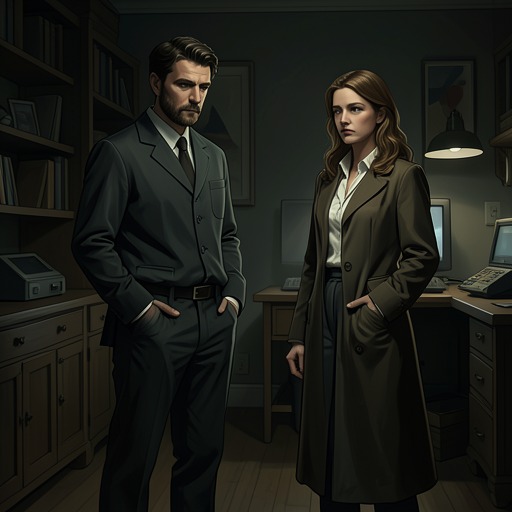
“I don't care. I haven't cared for a long time.”
The War of the Roses“I don't care. I haven't cared for a long time.” Barbara Rose’s blunt declaration gives language to a feeling she says had been smouldering for years. Spoken in the library to Oliver Rose, it makes the marriage’s emotional break explicit; repeated later in Oliver’s conversation with Harry Thurmont, it becomes a fact he still struggles to believe.
The Declaration in the Library
Barbara’s statement comes after she walks into the library while Oliver is reading The Washington Star. She explains that she did not rush to New York City to visit him in the hospital because she did not care. When Oliver asks whether she means it would not have mattered if he lived or died, she answers that she is serious and that the indifference has lasted a long time. The line is not a measured explanation of how the marriage reached this point; its force lies in making the emotional outcome plain.
The words follow Barbara’s recollection of a shared life organized around projects: supporting Oliver through law school, playing the traditional wife to an upwardly mobile public servant, raising children, and building toward the house they had jointly invested with energy and fantasy. She had considered life without him before, but could not identify a single moment when that possibility began. Against that long history of planning together, her terse declaration marks a decisive change: the future they built as a couple no longer binds her to the relationship.
Oliver’s response makes the difference between them visible. He removes his glasses, balances them on the Chesterfield’s leather arm, and asks whether she is serious. His fingers tap his crossed thigh as he tries to understand how she can dismiss a life, a relationship, and a family. When he snaps his fingers to stress the apparent suddenness of her decision, Barbara echoes the gesture. Her inward recognition that it was not “just like that” counters his impression of an abrupt dismissal: for her, the sentence condenses a feeling formed over time.
Repetition and Consequence
The declaration returns when Oliver speaks with Harry Thurmont. He repeats Barbara’s words and says it is still impossible to believe. He asks whether she might change her mind; Harry answers that she will not. Oliver’s difficulty accepting the statement thus persists beyond the library confrontation, while Harry treats it as a firm decision rather than a passing threat.
That exchange shifts the phrase from personal disclosure toward practical consequence. Harry warns Oliver that the divorce will be fiercely contested and advises him to protect himself. Barbara’s words are not a legal argument in themselves, but their repetition establishes the resolve behind the separation and helps explain why Oliver is being urged to prepare for a difficult dispute.
Narrative Significance
The line’s plainness is part of its impact. Barbara does not soften the declaration or offer Oliver a reassurance that could preserve the marriage’s old terms. The repeated phrase also links two scenes from different perspectives: first, the moment when she states her indifference directly to Oliver; later, Oliver’s attempt to process what she has said with Harry. What is a clear boundary for Barbara remains, for Oliver, an almost unbelievable rupture.