Ann
The War of the RosesAnn is the Roses’ twenty-two-year-old au pair, a history master’s student at Georgetown University, and an increasingly intimate witness to a marriage coming apart. She enters the family’s crisis as a dependent outsider who hopes to belong; she leaves its central catastrophe as the person who keeps Eve Rose and Josh Rose from rushing into the wreckage. Her attachment to Oliver Rose complicates that protective role, binding her to the household even as she recognizes the damage taking place inside it.
Identity and Position
Ann’s place in the household rests on an informal exchange: room and board for loosely defined services. She knows that calling herself a glorified au pair understates how warmly the Roses have tried to include her, but the arrangement gives her the means to pursue her history master’s degree. She first found the offer in the classified pages of The Washington Post, and the good fortune of the position has a practical edge: losing it would be a personal and financial disaster.
At twenty-two, Ann thinks of her growing attraction to Oliver as an adolescent crush, an emotional aberration that seems out of keeping with her age and position. She is amused by the neighborhood snobbery she has acquired in Kalorama, but alert to the limits of her standing there: she is still dependent on the people whose marriage she is watching. The gap between the family’s welcome and her insecurity helps explain why belonging, employment, and affection become difficult for her to separate.
Ann’s relationship with Eve Rose develops through confidence rather than authority alone. When Eve fails math at Sidwell Friends School and is too frightened to tell her parents, she confides in Ann. Ann agrees to act as a go-between, helping contain the immediate crisis while taking on the risk of intervening between a daughter and her parents. Eve’s trust matters to Ann not only personally but practically; she understands that winning the girl’s favor helps secure her place in the household.
Watching the Marriage Unravel
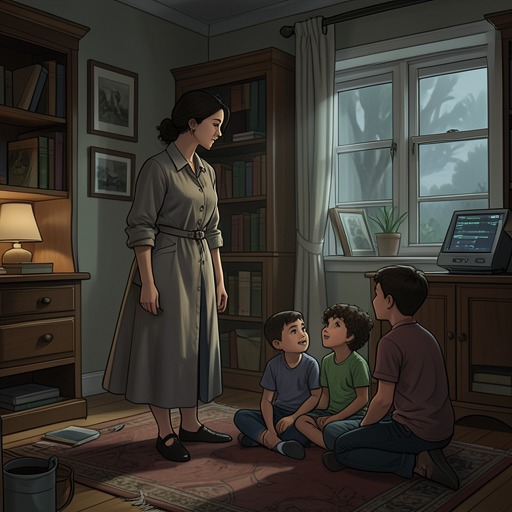
Ann initially encounters the Roses’ separation through Eve. While Ann is working on a thesis bibliography, Eve embraces her and sobs that her parents have split. Ann already knows what has happened, but the news has not fully registered; she continues to deny its reality and feels the weight of her own guilt. Because she has never seen the couple raise their voices to one another, she first tries to reassure Eve that the decision may be temporary. Eve corrects her: Barbara Rose called it a declaration of independence and said she wanted freedom to fulfill her own aspirations rather than remain an appendage.
Eve cannot reconcile that explanation with the family life she thought she knew. She remembers her parents doing things together around the house and says that she and her friends believed them to have the best relationship of any married couple. Ann offers tentative explanations, then recognizes that she is not privy to the marriage’s private reality. Her position is therefore both close and limited: the family confides in her, but she cannot make the separation intelligible to the children—or to herself.
As hostility spreads through the household, Ann turns into an observer, studying movements, looks, and stray words for signs of what the Roses might do next. She replays these details at night and privately calculates advances and retreats. At first, Eve and Josh try to bring their parents back together. When their efforts meet the couple’s continued hostility, they give up and settle into grudging acceptance. Eve spends more time with friends; Josh finds steadiness in sports and maintains contact with his father. Ann knows that her own interest in Oliver makes her supposedly detached inspection less innocent. Barbara notices her quietness, while Ann struggles to conceal both her curiosity and the hope that Oliver might see her as an alternative.
Intimacy, Guilt, and the Children
Ann’s feelings become harder to contain when Oliver confides in her. He describes the impersonal routine of eating alone at a hotel and looks around the library at the objects he and Barbara made or found together, including a rent table from an antique barn outside Frederick. He calls the house a fortress against life’s terrors and remembers the labor that went into its shelves. Ann listens as his account of the separation takes shape through the rooms and possessions he cannot bear to lose.
When Oliver speaks angrily of Barbara, his advisers, and even his children for not taking his side, Ann comforts him. He says that his ego has died; she embraces his head and kisses his hair, feeling at once motherly and uneasy about the intimacy. Their sexual relationship follows. Later, when Oliver says he can no longer trust what a woman tells him or shows him, Ann answers that women are a clandestine gender, conditioned to suppress secrets; he replies that men are too. They make love slowly and tenderly. Yet their closeness does not resolve the material and emotional conflict driving the divorce. When Ann asks why the house matters so much, Oliver answers that it is his whole world and that he will not let Barbara take it with her.
Eve also gives Ann a private view of how the conflict has reached the children. She refuses to go to camp, explaining that she is afraid to leave her parents alone together. She wants either a reconciliation or for one side of the family to move out, and wishes they would sell the house. She asks Ann to persuade Oliver not to send the children away, suggesting that Ann tell him she has fallen in with a bad crowd or needs supervision, but not to disclose the real reason: Eve fears that the Roses will tear each other apart. Ann accepts the confidence, becoming a keeper of the child’s fear as well as a participant in Oliver’s private life.
Leaving and Remaining Entangled
Ann eventually decides that she cannot stay in the household. She tells Oliver she would rather leave before Barbara forces the break, and worries that the detective will reveal their relationship. Oliver is still Barbara’s husband in law, and Ann cannot imagine facing the children under those circumstances. She tells him that she loves him but cannot bear the relationship in its present conditions; she also feels that she has somehow wished the family’s crisis into being. Her departure is not a clean emotional break. She leaves because intimacy with Oliver has made her more deeply implicated in a family whose unraveling she cannot stop.
Even away from the house, Ann remains preoccupied with Oliver and the Roses. She registers for summer school partly as a way to stay in town, though her dwindling finances and guilt keep her attending classes. Brief calls to Oliver’s office give her an excuse to hear his voice and assess his attitude; she resists further contact while hoping that, once the divorce is settled, he might choose devotion over indifference. She misses the children and writes to them, but her hopes remain one-sided and uncertain.
When Eve later asks why neither parent calls or writes, Ann promises to find out where they are and tell them that their children are worried. She has no plan, debates calling the police, and decides that she will never enter the house again. Even so, she goes to its door and knocks, first with the clapper and then with her fists, crying out that the matter concerns the children. She keeps knocking for twenty minutes without an answer. The quiet street and the house’s apparently innocent white facade offer no help; its occupants and neighbors remain sealed off from one another.
The Collapse and Ann’s Narrative Role
A cab is pulling away from the curb when Ann hears the crash. Dust pours from the open entrance. She sees Eve and Josh standing in it, then watches them turn toward the house, crying and looking terrified. When Josh says their parents are inside, Ann runs to stop them and holds them back as falling objects continue to clatter within. Once the sounds subside, she leads the way through the doorway, despite having just resolved never to enter again.
Inside, the roof has collapsed and the walls have buckled. The long clock lies on its side with its Roman-numeral face smashed, and shards from the chandelier cover the surfaces. Searching among the debris, Ann finds Oliver and Barbara dead beneath the rubble, their bodies appearing to embrace and their eyes fixed on one another. Eve asks why they did this; Ann has no answer. Her role is not to explain the couple’s final destruction but to witness it and keep the children from entering while the house is still falling.
In the aftermath, Josh and Eve find the intact Molineaux figure and fight over it alongside its companion Cribb. The figures break between them. Ann turns toward the entrance, her steps stirring the dust around her ankles. Her final movement carries her away from the ruins after she has done what she could for the children. Throughout the story, she occupies the unstable space between observer and participant: she watches the marriage, becomes Oliver’s lover, receives Eve’s confidences, and finally acts as the children’s immediate protection. Her care cannot restore the family or prevent its destruction, but it gives the catastrophe a witness who sees both the parents’ deaths and the children left behind.