Ann breaks into the Roses' home and escapes its traps
The War of the RosesAnn breaks into the Rose family home and escapes its traps in a scene that turns an act of concern into a desperate struggle for survival. Moving through a house she believes occupied, she encounters a familiar domestic space made perilous by its altered arrangements, slippery floors, falling objects, and blocked exits. Her escape ends with a glimpse of Oliver: gaunt, bearded, and still inside. The scene makes the house itself the immediate obstacle between Ann and the people she has come to reach, while leaving her unable to resolve whether compassion or fear should govern her response to Oliver.
The decision to enter
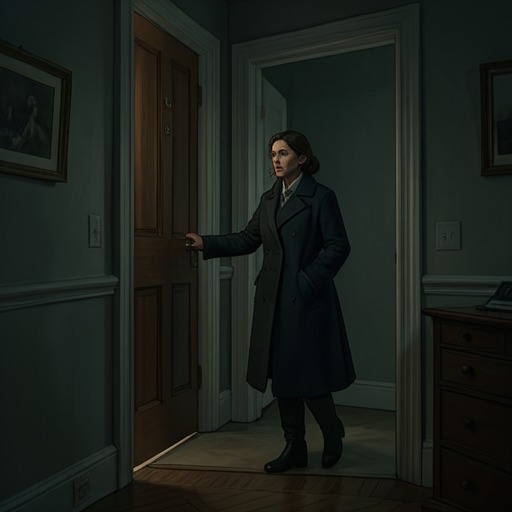
Ann does not accept the appearance of an empty house. After knocking and calling for Oliver and Barbara, she hears no response, and a neighbor tells her that they may have gone on vacation. Yet the closed shutters persuade Ann that someone is inside. The neighborhood’s prevailing privacy makes it difficult to seek help or expect intervention; she waits until nearly dark because she wants to avoid being mistaken for a burglar. Her entry is therefore deliberate, but shaped by uncertainty: she is convinced the house is occupied without knowing who is there or what awaits her.
The ground-floor windows are protected by iron bars, and the rear door to the basement and Oliver’s workshop is locked from within. Ann then remembers that Oliver keeps a ladder under the garage eaves. She opens the garage, carries it to the rear wall, and climbs to the sun-room. The route is improvised from her knowledge of the property, and initially the view offers little warning: the room appears familiar and normal, with empty flowerpots lined along the wall. To get inside, she breaks the window with her shoe and carefully removes the shards. A piece of glass scrapes her knee; as she tries to avoid further injury, she accidentally knocks the ladder to the ground, cutting off the route by which she entered.
A familiar interior made dangerous
Inside, darkness forces Ann to navigate by memory and by touch. The kitchen’s arrangement is wrong: apart from the work island, objects are no longer where she expects them. A rope stretches across her path. When she tugs it, pots crash down in a sudden, ear-splitting clatter. She screams, tries to run, and falls. The danger is not simply that she cannot see clearly; the room’s altered layout has made her knowledge of it unreliable. A place she should be able to cross by habit now turns each remembered route into a possible hazard.
The corridor offers no safer passage. On reaching the marble floor, Ann loses her footing and slides, unable to rise because the surfaces she touches are too slippery to grip. She struggles backward toward the kitchen. There, the refrigerator bears down on her, and she jumps aside just before it hits the floor. The sequence makes ordinary household objects feel newly threatening: a pot, a floor, and a refrigerator cease to be background furnishings and become immediate physical dangers. Ann wonders whether she is losing her mind, a response that registers how completely the house’s familiar order has collapsed for her.
Escape through the workshop
Searching for the basement door, Ann opens it and reaches for the banister, expecting stairs. Instead, her legs swing into empty space: the steps are gone. She catches the wooden rail with both arms and, using her legs against the walls of the narrow stairwell, wedges herself in place. Carefully lowering herself, she reaches the basement floor just as the effort is exhausting her back and leg muscles. The passage is a physical descent without a usable staircase, and survival depends on grip, balance, and improvisation rather than on the house’s ordinary means of access.
Bruised and hysterical, Ann crawls across the cement floor to find the door, only to discover it wedged shut. She locates the wedge by touch but cannot move it. The sounds of footsteps above make escape urgent. In the wreckage of Oliver’s workshop, she searches for a tool and finds a sledgehammer in a nearby corner. Fear gives her the strength to lift it over her head and strike the door. The blow loosens the wedge, and the door flies open. Ann runs into the garden and reaches the gate, having forced her way out of the basement rather than retraced her route through the house.
Oliver behind the broken window
Even in flight, Ann turns back. Through the shattered sun-room window, she sees Oliver in the shadows: gaunt, bearded, and staring out. The glimpse confirms that her conviction someone was in the house was not mistaken, but it does not explain why he is there or what has happened to him. Ann pauses, caught between compassion and fear, and wonders whether this is the Oliver she loved or the figure from her imagined other life. She does not remain long enough to find out.
That unfinished recognition gives the escape its emotional force. Ann gets out, but the sight of Oliver prevents the scene from resolving into a simple story of a trespasser escaping a dangerous building. The house has become an obstacle to contact, and Oliver’s appearance raises a question Ann cannot safely answer. Her brief hesitation is the last reversal: after fighting through an unfamiliar and apparently hostile interior, she must choose whether to approach the person she came seeking or protect herself. She leaves without resolving that conflict.