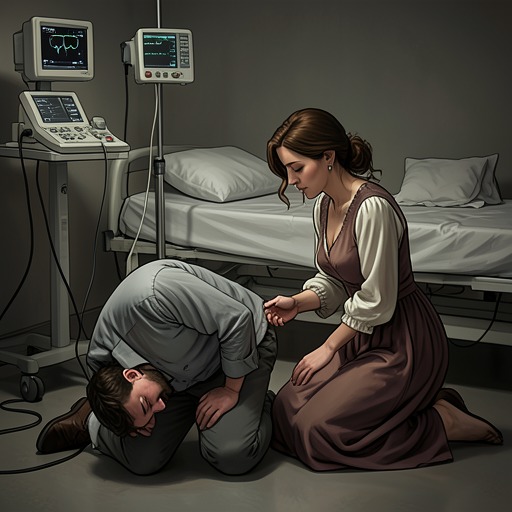
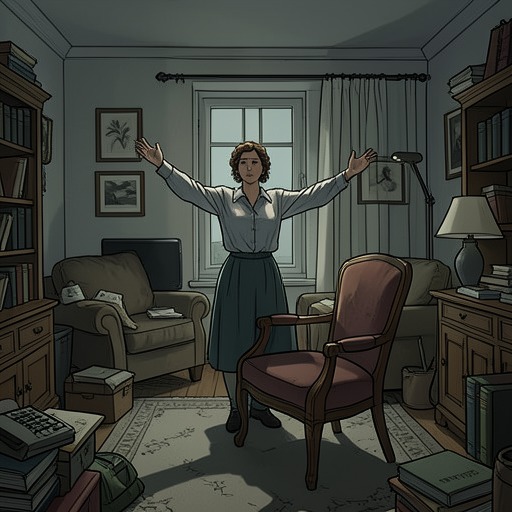
Barbara tells Oliver she wants a divorce
The War of the RosesBarbara Rose’s announcement that she wants a divorce is the decisive break in the Roses’ marriage: a private conviction becomes a spoken decision, and the shared life she once built with Oliver Rose becomes a source of grievance rather than proof of enduring love. She presents the separation as her own choice, not a judgment that Oliver is solely to blame. The declaration also sets the household’s emotional terms: the children are not asked to decide the marriage, but they cannot remain untouched by its collapse.
Background and decision
At nineteen, Barbara Rose believed that loving Oliver Rose was sufficient reason to organize her life around his. When her mother urged her to find something of her own, Barbara answered by invoking the depth of her love. Remembering that exchange years later, she reproaches her younger self for trusting an emotion she now regards as deceptive. The recollection gives the announcement a long history: she is not describing a sudden quarrel but reconsidering the premise on which she entered the marriage.
For years, the couple’s life had been organized around projects. Barbara supported Oliver through law school, performed the role of the accommodating wife to an upwardly mobile public servant, and cultivated a comfortable home for him. Their family moved from a small apartment to a suburban split-level, then managed car pools, dance classes, orthodontists, and the demands of raising children. Their latest and largest undertaking was the house, into which both had invested energy and imagination. Once that shared project was finished, Barbara confronted the question of what their life together was for. She understood her dissatisfaction as older than the house itself, perhaps even older than she could identify, but the completed project made it impossible for her to keep postponing an answer.
The immediate circumstance sharpened that reckoning. Oliver had been seriously ill, and Barbara remembered feeling that the possibility of a life without him had become thinkable. She explicitly distinguished this thought from wishing for the death of a healthy husband; she considered such a wish cruel and unthinkable. The disturbing fact for her was that his grave illness had made a future without him imaginable at all. Her question was no longer simply what she wanted from the marriage, but how she could continue living with Oliver after recognizing that possibility.
The announcement
Barbara told Oliver that she had not hurried to New York to visit him in the hospital because she did not care. When he asked whether she meant that his living or dying made no difference to her, she answered that she had not cared for a long time. Her calm insistence turned the conversation away from an argument over one act or omission and toward the accumulated absence of feeling she said had preceded it.
Oliver tried to locate a specific cause. Barbara told him that the decision was not really about something he had done, nor about a conscious injury for which he could be blamed. She said she could not bear the thought of living with him another moment. When he named the sacrifices she had made—giving up school and serving his ambitions—she acknowledged that he had benefited from them, but did not make his culpability the condition of her decision. She also rejected the implication that leaving meant abandoning the children: she intended to continue her responsibilities toward them, while insisting they had no authority to decide whether their parents stayed married.
The distinction between an explanation and an accusation left Oliver without the specific offense he wanted to contest. Barbara did refer to injuries he might have caused unconsciously, but she did not claim that he understood or admitted them. When he insisted that she was no longer the woman he had married, she affirmed that change rather than offering to restore the earlier version of herself. Her apology registered the pain of the scene, but did not qualify the decision. She wanted the separation and did not propose a trial period before divorce.
Reactions and family consequences
Oliver’s first response moved between hope and disbelief. He asked whether something he had done—or failed to do—had caused the rupture, and initially appeared to search for some remaining possibility of repair. As Barbara made clear that the decision was settled, his confusion gave way to anger and sarcasm. He described her choice as dismissing a life, a relationship, and a family in an instant, while she maintained that it was not sudden for her. He had believed he was succeeding at marriage; her answer was that his understanding of success did not match her experience.
The announcement also revealed the gulf between the couple’s public appearance and their private condition. Their daughter Eve Rose told Ann that her mother had presented the decision as a declaration of independence, explaining that she wanted to pursue her own aspirations and no longer be an appendage. Barbara had assured Eve that the separation would not end her relationship with her father and would be civilized and understanding. Eve, however, was most shaken by the possibility that her mother had been unhappy with Oliver. Friends and family had regarded the Roses as an unusually successful couple, in part because they did so many things together and had poured so much into their house. Eve could repeat her mother’s explanation without understanding what freedom from that life meant.
Ann knew what had happened, but initially struggled to accept its reality; she felt guilty because the separation resembled a fantasy she had not expected to see realized. Her assumptions about the marriage had been formed from its outward calm: she had never seen the Roses raise their voices to each other. As their hostility became unmistakable, the children’s early efforts to bring their parents back together faded. Eve spent more time with friends, while Josh Rose found an outlet in basketball and other sports and maintained contact with his father. Ann, who was also privately aware of her feelings for Oliver, watched the household from a position that mixed caregiving, observation, and concealed personal interest.
The strain made the children’s position more than a matter of hearing the news. Eve later refused to go to camp because she feared leaving her parents alone together. She asked Ann to keep that fear secret, explaining that the children were being sent away to escape the atmosphere at home and that she worried about what might happen in their absence. She wished that her parents would reconcile, that her father would move out, or that she and her mother would leave. When Eve later asked why neither parent had called or written, Ann promised to find them and urge them to contact their children, while privately trying to keep Eve and Josh away from the house.
From separation to domestic conflict
The declaration did not produce the orderly, understanding separation Barbara had hoped for. The Roses continued to inhabit the same household, where hostility altered ordinary movements and objects into signs of possible retaliation. Ann found herself interpreting gestures and stray words for what they might signal. The children’s initial hope of reconciliation gave way to grudging acceptance, while the house that had embodied years of joint effort became the setting in which the spouses’ conflict intensified.
Retaliation made that transformation concrete. After Barbara destroyed Oliver’s orchids, he retaliated against her catering work by altering seven meat loaves in the refrigerator with heavy quantities of spices, including ginger and curry powder, and by substituting sugar for salt in one preparation. He anticipated that the customers would argue over what had spoiled the food. The exchange marked a shift from marital grievances to deliberate attacks on each other’s work and attachments.
The conflict next entered the Basement sauna. After Oliver taunted Barbara and went inside, she wedged a chisel into the heavy redwood door with a wooden mallet, trapping him. Once he escaped, he carried a chisel through the sunroom, cut up Barbara’s African violets and Boston ferns, and boiled them in a stockpot. The successive acts followed the logic of reprisal: an attack on a treasured possession answered with the destruction of another, while the shared home offered both the instruments and the space for escalation.
The danger spread beyond plants and food. A series of kitchen appliances became hazards while Barbara prepared for a dinner, with the Cuisinart continuing to run, the electric stove’s burners glowing red, and a loose slicing blade flying into the range hood before falling into a sink. As she tried to avoid the blade, knives spilled from their box, she cut her thighs, and hot water scalded her hand. Later, she used the garage-door mechanism against Oliver’s Ferrari, repeatedly lowering the heavy door onto the car until its steering column bent, a wheel broke off, and the dashboard crumpled. The wrecking of a prized possession made the house’s machinery part of the spouses’ contest.
In turn, Oliver methodically loosened hinges, furniture supports, and kitchen fittings so that doors, furnishings, and overhead objects would fall with the slightest movement. After finding a broken Staffordshire figure and reading Barbara’s lipstick warning that she would break more, he continued preparing the house to betray whoever touched it. These acts do not resolve the question Barbara raised when she announced the divorce; they show how far the household has moved from the civilized separation she promised her daughter. A decision intended to free Barbara from a marriage becomes the starting point for a conflict that draws in the children, makes the home dangerous, and steadily replaces shared projects with weapons and traps.