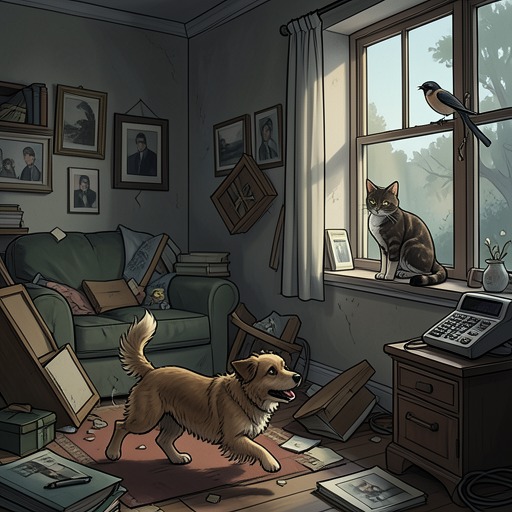
Benny
The War of the RosesBenny is the Roses’ overgrown Standard Schnauzer, a noisy neighborhood wanderer whose loyalties become especially visible during Oliver and Barbara’s separation. He follows his own routines, but his return to Oliver’s bedside and his attentive companionship make him more than a household pet: as the family’s human relationships fracture, Benny is one of the few sources of affection Oliver can still count on.
Identity and Introduction
Barbara introduces Benny to Ann as a large dog whose bark is more intimidating than his bite. She jokes that he spends his days pursuing local female dogs and usually obeys only Oliver, who sees a shared drive in their behavior. The joke eases Ann into the new household arrangement and helps establish a sisterly rapport between the women. Eve later supplies the connection between Benny’s name and that of Mercedes, the family’s Siamese cat: together, the two names suggest Mercedes-Benz. Ann realizes the pun and feels embarrassed that she did not catch it sooner.
Benny’s introduction places him within the household’s lively, sometimes irreverent pet culture. He is a specific, unruly presence rather than a decorative animal: Barbara anticipates his bark, Eve explains the joke behind his name, and Oliver’s account of the dog’s roaming habits gives him an independent life beyond the family’s rooms.
Life in the Divided Household
As the Roses’ hostility grows, the house is divided by locked bedroom doors, separate telephone lines, and informal territories. Oliver gives up access to the kitchen and its food, keeping dry dog food in his room instead. Benny moves through the neighborhood during the day, following his interest in female dogs, then returns by instinct at night to sleep at the foot of Oliver’s bed. His repeated return contrasts with the family members’ increasingly separate lives: whatever changes inside the house, Benny still comes back to Oliver.
The dog’s movements also mark a small domestic exception to the household’s new boundaries. Barbara will not let Benny into the house except when Oliver comes home. On those occasions, his persistent barking and the clicking of his nails on the marble announce Oliver’s return. Benny is thus associated with Oliver’s presence even before Oliver appears; his arrival is one of the household sounds Ann listens for amid the tense quiet.
Benny remains a source of practical activity as well as company. On Christmas Day, Oliver stays in bed while the children visit and later leave to dine with Barbara and Ann. Benny jumps onto the bed and burrows his head into Oliver’s chest. His strong dog odor eventually prompts Oliver to push him away, but the encounter gives Oliver a task: he gets up, checks on his orchids, and takes Benny to the workroom to bathe him in a large cast-iron sink. Even a disagreeable chore helps structure a day Oliver might otherwise spend alone.
Oliver’s Companion
Benny’s importance to Oliver becomes clearest when Oliver returns to the house unexpectedly and cannot find him. Oliver had not meant to go home, but, once in the alley, he imagines taking Benny to Hains Point, where the dog could run after a Frisbee. Oliver had taught him only a few tricks, and the imagined outing gives shape to a familiar bond: time together means a ride, exercise, and the uncomplicated pleasure of the dog at play.
Oliver whistles in the garden and then drives around the neighborhood, calling for Benny. He knows the dog usually returns on his own, yet the search exposes how much Oliver relies on that return. Benny sleeps at his feet, snores, and sometimes forgets that he is indoors; Oliver still considers him better than no one. The thought that the only loving member of his family nearby is a scruffy Schnauzer strikes Oliver as ironic, but it also cheers him. During the difficult months, he has poured out his troubles to Benny. The dog responds with alert brown eyes, a tilted head, and rigidly upright ears. Oliver sometimes hugs him, accepting the animal’s pungent smell as part of the comfort.
That companionship does not make Benny a human confidant or a participant in the marital dispute. Its force lies in its simplicity. Oliver can speak aloud without having to negotiate, persuade, or defend himself; Benny listens, and the familiar routine of sleeping beside him gives Oliver a remaining sense of company in a divided home.
The LSD Incident
Benny’s closeness to Oliver also places him in danger during the couple’s escalating conflict. After Oliver drinks orange juice that has been tampered with, he undergoes a disorienting episode and eventually wakes injured in the bathtub. In the wrecked room, he hears Benny whimpering and finds him cowering in a corner, looking unwell and covered in a whitish sticky substance. Oliver brings him into the bathroom and recognizes the material as luminous paint; he also recalls the orange juice and understands that Benny may have been exposed to the same substance that affected him.
Oliver takes the dog to the veterinarian and asks for the orange juice to be analyzed. The veterinarian later tells him that Benny had an acid trip and suggests that the dog may have sprayed the paint on himself. The substance is removed, and Benny is reported to be fine. The episode turns Oliver’s private ordeal into a danger that reaches an animal who cannot understand or choose to enter the conflict. Oliver’s anger is directed at the tampering, but the incident also makes plain how the household’s retaliatory behavior can spill beyond the spouses themselves.
Significance
Benny’s role is built from recurring, concrete habits: he roams, returns, barks when Oliver arrives, sleeps at the foot of the bed, and answers Oliver’s attention with a watchful gaze. Those routines persist as the family’s arrangements change. During the separation, Oliver’s room becomes a refuge for both man and dog, while Benny’s dependable return offers a small counterpoint to the Roses’ growing estrangement.
The novel does not present Benny as a solution to Oliver’s isolation; he cannot repair the marriage or restore the household as it was. Instead, his presence makes the isolation legible. Oliver’s search for him, his relief when the dog scratches at the door, and his willingness to confide in an animal show how little dependable affection remains available to him. Benny’s exposure to the LSD-laced orange juice gives that companionship a darker edge: in a home turned into a field of retaliation, even the pet who offers comfort can become collateral to the conflict.