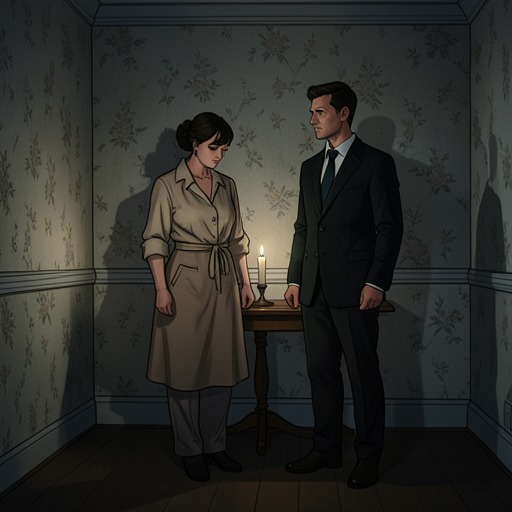
Blinded by love
The War of the Roses“Blinded by love” is a phrase in a fragmented recollection of Oliver Rose and Barbara Rose’s marriage. It first appears as an explanation for not knowing what love had done; Oliver then applies the same idea to himself, joining the phrase to his grief over the family and home he believes Barbara is taking from him.
The remembered exchange
The passage gives the exchange in short, interrupted fragments: “I didn't know,” followed by “Didn't know?” and then “I was blinded by love.” The reply, “Blinded? Does love blind?” turns the expression into a question about whether love obscures what a person might otherwise recognize. The passage does not clearly identify the speaker of each line, leaving the remembered conversation unsettled rather than presenting it as a complete, orderly account.
Oliver turns the phrase inward
The phrase is set against Oliver’s memories of the family he thought they had made. He recalls that he could not bear to let baby Eve Rose cry, that he and Barbara made room for her between them, and that the arrival of Josh Rose seemed to complete their family. He had thought of the house as a fort built to protect them. Against those memories, Barbara’s statement that he no longer mattered to her makes their shared past feel newly precarious.
Oliver’s inner response takes the remembered explanation and makes it his own: “Well, then, it blinded me as well.” He connects that claim to his sense that Barbara is taking away his whole life and his family, before insisting that the house is his. The phrase thus shifts from an explanation of not knowing into a way for Oliver to name his own past investment—and to frame the present conflict over the house.
Significance of the expression
The passage places the language of blindness beside two sharply different claims: Oliver remembers a home made for the family’s protection, while Barbara has told him that he no longer matters to her. The expression does not resolve which understanding of their marriage is right. Instead, its return shows how the same idea can be absorbed into Oliver’s private account of the loss: he recognizes that love may have blinded him, yet remains fixed on the house as the part of his life Barbara cannot take.