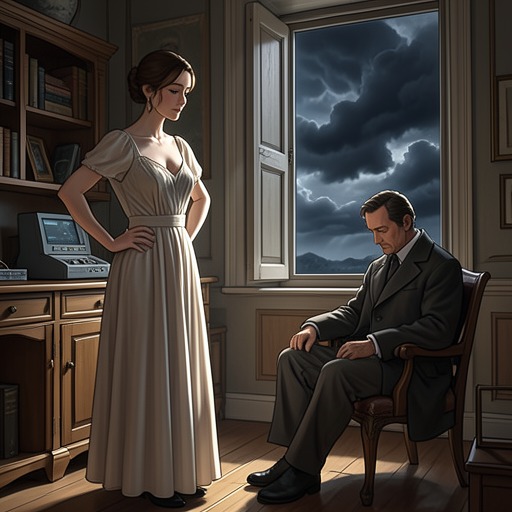
Christmas Eve
The War of the RosesChristmas Eve is the setting for a brief, consequential encounter between Ann and Oliver Rose, and a concentrated portrait of the Roses’ divided household. Beneath the decorated tree and wrapped gifts, Oliver’s isolation and Ann’s longing draw them together; Barbara’s return forces them apart. The night’s holiday customs continue around the marriage’s fracture, making the flickering tree lights and the unexchanged presents part of a scene shaped by absence, concealment, and interrupted intimacy.
A holiday under strain
By this point, the family’s separation has become visible to those around it, even when its causes remain difficult to understand. When Eve Rose tells Ann that her parents have decided to go their separate ways, Ann initially cannot absorb the news and feels the weight of her own guilt. She had not been privy to the conflict between them and had never seen them raise their voices. To Eve, however, the announcement is not a passing spat but a declaration of independence: Barbara Rose wants to fulfill her own aspirations and no longer be an appendage to her husband. Eve struggles to understand what that freedom means, especially because she had believed her parents shared an unusually good relationship and built their life together around the house.
The change spreads through the household. At first, the children try to bring their parents back together, but their efforts fade in the face of the Roses’ continuing hostility. Eve calls her parents crazy and spends more time with friends; Josh Rose finds an outlet in basketball and other sports while maintaining contact with his father. Ann, meanwhile, watches the family’s movements closely, reading looks and stray words for signs of what might happen next. She tries to remain an observer, but her feelings for Oliver Rose make that distance difficult to maintain. Christmas Eve places her in the same house as the couple whose conflict she has been monitoring, and beside the man toward whom her interest is no longer merely observational.
The night at the Christmas tree
Ann has stayed to help with the children rather than spend Christmas with her own parents, whose Christmas Eve drinking and next-day irritability make home an unappealing prospect. After washing up, she takes wine into the library, where the Christmas tree is decorated with tinsel and gifts are scattered beneath it. The Roses have again decided not to exchange presents with each other, though each has bought a gift for Ann. The lights flicker and lose their glow as she looks at Oliver’s present; she is about to unplug them when she hears Oliver’s familiar step in the foyer.
Oliver says it is a hell of a Christmas Eve, pours himself a heavy scotch, and raises a glass to better Christmases. Ann tells him everyone else is gone. He describes spending the evening at two Italian films, Down and Dirty and Bread and Chocolate. The theater had been nearly empty, and he had wanted to see the pictures again, but it closed so the projectionist could go home to his family. Oliver dwells on that ordinary domestic pleasure and asks Ann why she is not home with her own family. She answers that she is needed there. He replies that at least she is needed somewhere, while he feels needed nowhere—not even as an audience. His complaint gives the scene its emotional center: the holiday’s language of home and family sharpens his sense of exclusion.
As Oliver sits beside Ann among the presents, their nearness turns into a kiss. Ann gives in to a desire she has been carefully holding at a distance; the encounter is rendered through physical detail, including her hands reaching for Oliver’s wavy, salt-and-pepper hair. The intimacy is sudden, but it takes place within the very household whose strained marriage has made Ann an anxious observer. The scene does not resolve that tension. Instead, it makes her private longing collide with the family crisis she has been trying to watch from the margins.
Interruption and concealment
The front door opens, startling Oliver into disengaging. Ann straightens her clothes and busies herself with the gifts, while Oliver slips behind the armoire and out of her sight. Barbara comes into the library and asks whether Ann has finished the mixture for the pastry meat loaves. Ann says she has. Their exchange also establishes the immediate holiday setting: Christmas is the next day, and Barbara says she dreads it. Ann senses tension in the room and fears that Barbara may want to talk, but Barbara says she is exhausted and tells Ann to get some sleep.
Only after Barbara’s footsteps recede upstairs and her bedroom door closes does Oliver emerge from hiding. He apologizes in a whisper. Ann takes his hand and kisses its palm, but he quickly pulls it away, a gesture that can read as rejection or rebuke. He then tiptoes into the foyer and opens the front door, creating the impression that he has only just arrived, before hurrying upstairs and locking his own door. The lovers’ encounter is thus followed not by acknowledgment but by a small performance designed to preserve appearances. Ann remains kneeling before the tree for a long time, wondering whether Barbara saw them, then refuses to let that uncertainty intrude on her happiness. Looking up, she notices the weak, flickering lights and realizes she never reminded Oliver to fix them.
The holiday’s wider meaning
Christmas Eve gathers the story’s private and familial conflicts into a single room without making them speak openly. The presents show that the Roses still observe a custom of giving to Ann even as they have stopped exchanging gifts with each other. The tree remains decorated, but its lights fail; the meal for the following day is being prepared, though Barbara dreads the holiday. Oliver’s account of the theater projectionist going home to his family contrasts an ordinary image of belonging with his sense that he has no place where he is needed. Ann, who has stayed because she is needed in the house, is at once caretaker and participant in a secret that could further unsettle it.
The scene’s decisive turn is its interruption. For a moment, Ann and Oliver move from guarded observation into physical intimacy; Barbara’s arrival forces them back into secrecy before either can give the encounter a settled meaning. The Christmas tree, the gifts, and the preparations for Christmas Day do not restore the family unity they conventionally signify. Instead, they frame a household continuing its rituals while its members occupy increasingly separate emotional worlds. The final image of Ann looking up at the failing lights leaves that contradiction unresolved: the holiday’s visible decoration persists, but its brightness is already wavering.