Cribb and Molineaux Staffordshire ceramic boxing figures
The War of the RosesThe Cribb and Molineaux Staffordshire ceramic boxing figures are a matched pair of pearlware pugilists whose story runs from a rainy auction to the center of the Roses’ home. Their decisive significance is double: they commemorate how Oliver Rose and Barbara Rose met, and their fixed pose of combat gives visible form to a marriage whose history the household repeatedly retells.
Object and Auction
At the auction, the sale threatens the pair’s unity before either figure has a place in the Roses’ life together. The auctioneer identifies the piece before him as Staffordshire pearl ware depicting Cribb, champion of England in 1809. Oliver Rose recognizes that the figure is being separated from its counterpart: Molineaux, a Black former slave who fought Cribb twice and lost both times. The two pugilists had been memorialized together in drawings, pottery, and figures, always facing one another with fists raised.
Oliver Rose regards the figures as a pair, although he does not initially own either one. When bidding for Cribb begins, he has thirty-seven dollars, his entire weekend’s tips, and hopes to retain enough to buy Molineaux too. He wins Cribb for twenty dollars. The auction’s small financial stakes become a personal contest: his relief and exhilaration at winning are inseparable from his awareness that the pair may now be split.
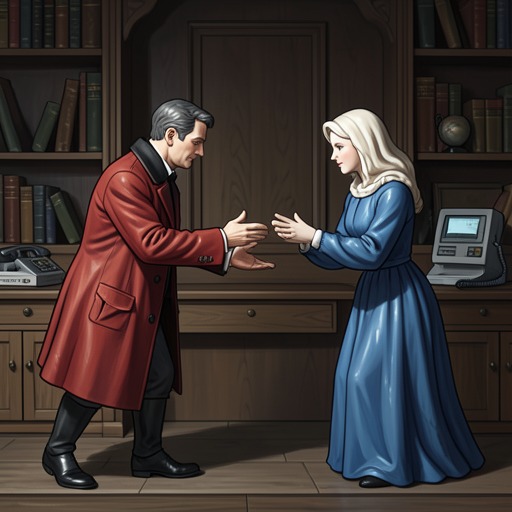
The second sale reverses the first. Barbara Rose, then Barbara Knowles, has only seventeen dollars and deliberately bids the price of Molineaux up against Oliver Rose. She ultimately lets the figure go, and he confronts her afterward, insisting that the two belong together. She points out that they were not sold as a pair. Her reason for wanting Molineaux changes the meaning of the contest: she had planned to give it to a maid at the Chatham Arms, whose brother boxed in the Golden Gloves, instead of giving her a tip. Oliver Rose is touched by the explanation and recognizes the kindness behind a purchase he had treated as competition.
From Contest to Courtship
The figures’ divided sale creates the first exchange between the couple that the novel later makes central to their shared history. After the auction, Oliver Rose and Barbara Rose continue talking as they leave the parlor and shelter from the gusty rain beneath her umbrella. Their disagreement over whether the figures should be together becomes part of an encounter that also includes their account of themselves: she is a student at Boston University, working as a summer baking assistant, while he has spent his weekend tips on the auction.
The object’s meaning expands beyond the auction because each figure carries a different strand of the meeting. Oliver Rose’s desire to preserve a matched pair confronts Barbara Rose’s wish to make a thoughtful gift to someone else. Neither motive cancels the other. The pair can therefore recall not simply that they met, but the early mixture of competition, generosity, embarrassment, and attraction that shaped the encounter.
Sometime near dawn, while tracing his life with Barbara Rose back to their first meeting in the parlor of the rickety Barker house in Chatham, Oliver Rose recalls that Cribb and Molineaux finally joined them on their wedding night. Barbara Rose had then proposed letting the figures do all their fighting for them. The line turns the display into a private emblem of the couple: the fighters can stage the opposition while the spouses share the house around them. In retrospect, the arrangement also carries an irony. The figures’ confrontation remains safely fixed in pottery; the couple’s conflict does not.
Display in the Rose Home
The reunited pair occupies a marble table in the foyer, poised in what the narration describes as their eternal pugilistic confrontation. The display stands amid the house’s dense material life: the foyer’s tall clock and three-story chandelier, and, nearby, Oliver Rose’s extensive Staffordshire collection. More than fifty figures, including sailors, milkmaids, Napoleons, Garibaldis, and Little Red Riding Hoods, are scattered through the house. The Cribb and Molineaux figures are distinguished among them not merely by their subject but by their place in the family’s remembered origin story.
Their story has been repeated in the household ad infinitum. That repetition makes the figures more than decoration: the object acts as a durable prompt for a family narrative, connecting the auction, the courtship, and the wedding across the years. Their prominence is also relational. Oliver Rose had recognized the pair’s significance from the moment he saw Cribb offered alone; the household’s eventual display preserves the unity he had argued for, while Barbara Rose’s role in the story remains inseparable from the rival bid that first challenged him.
Separation and Significance
When Oliver Rose begins packing to leave, he moves through the house touching familiar possessions: his Staffordshire figures, the carved armoire, and the long clock he has wound each morning for more than five years. At the sight of Cribb and Molineaux, his eyes mist. He decides that he cannot look at them that day and leaves his suitcase in the guest room. The figures’ presence thus gives his threatened departure a precise emotional focus: they belong both to the home he may have to leave and to the story by which that home became shared.
Their meaning changes without their pose changing. At the auction, two figures facing one another provoke a struggle over ownership; in the foyer, their pairing commemorates a marriage and becomes a familiar household legend; during Oliver Rose’s contemplated departure, the same display recalls what he fears losing. Their stillness makes the contrast legible. The fighters remain together, eternally poised, while the people who made them a symbol must confront separation. The figures do not resolve the Roses’ conflict, but they preserve its beginnings—and the tenderness, rivalry, and shared memory that the conflict cannot entirely erase.