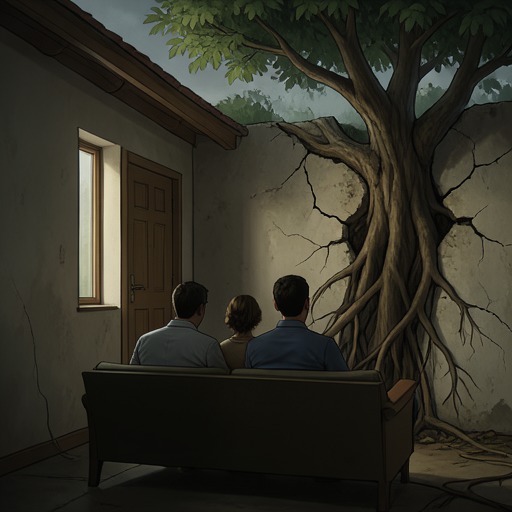
Family as a refuge
The War of the RosesThe family-as-refuge motif in The War of the Roses is embodied in the home Oliver Rose and Barbara Rose build as a shelter for their children and a material expression of their shared life. The house begins as a fort against the world, but their separation transforms it into the setting of a conflict that reaches their children and puts the household itself at risk. At the climax, the appeal to save Eve Rose and Josh Rose briefly recalls the protective family the house was meant to contain.
The House as a Shared Refuge
For Oliver, the family is bound to the house he created to protect it. In a late, disordered recollection, he remembers Eve as a baby: her cries troubled him, and he could not let her cry without comfort. He remembers telling Barbara that their daughter needed protection, shelter, and warmth; Barbara had objected to his spoiling Eve, but made room for the baby between them in their bed. The recollection presents refuge as an intimate, practical act of care, shared by both parents.
Josh’s arrival completes Oliver’s picture of family: husband, wife, son, and daughter together against the world. He thinks of the house as the fort he built for them. Its meaning therefore exceeds ownership or shelter from the weather. It stands for the family’s earlier sense of unity and for Oliver’s belief that he made a life whose security depended on the home they shared.
That sense of shared authorship had concrete foundations. Barbara had devoted years to the house and designed its kitchen with her catering ambitions in mind; Oliver helped construct it, bringing his knowledge of circuitry and craftsmanship to the work. When he discusses the separation with Murray Goldstein, he describes the house and its antiques as the things into which the couple put everything they had, and recalls how much love they lavished on the place. The refuge is thus also a record of common labor, accumulated possessions, and a life made together.
Separation Reaches the Children
The parents’ separation overturns the family’s reassuring appearance. Eve tells Ann that Barbara described the decision as a declaration of independence: Barbara wanted freedom to pursue her aspirations and no longer to be an appendage. She assured Eve that the separation would not damage her relationship with her father and would remain civilized, but Eve is shocked by the news and especially distressed that her mother had been unhappy. The children are asked to understand a rupture whose causes and consequences they cannot control.
At first, Eve and Josh try to bring their parents back together. When the hostility between Oliver and Barbara persists, that effort fades into grudging acceptance. Their response shows the household’s emotional change: the children who once belonged to an apparently united family increasingly accommodate a conflict that has become part of daily life. Ann, who watches the family from within the home, also recognizes how the parents’ hostility alters the household and the children’s place in it.
Eve later tells Ann she will not go to camp. Beneath her stated refusal is a more urgent fear: she does not want to leave Oliver and Barbara alone together, and asks Ann to keep that reason secret. She wishes that the parents would reconcile or that one of them would move out; failing that, she wishes they would sell the house and end the impasse. Her fear makes the family home a paradoxical refuge: it is still where the family lives, but its occupants no longer experience it as a secure shared world.
Home, Security, and Unequal Stakes
The separation also makes the house a disputed resource. Oliver initially tells Goldstein that half the value of the home and possessions would be acceptable because the couple made them together. Harry Thurmont explains to Barbara that this offer concerns the market value, not her right to keep the house or its contents. Barbara rejects money as an adequate substitute: she argues that she gave nearly twenty years to Oliver’s career and needs, gave up schooling, raised their children, and contributed extensively to the home. To her, keeping the house means preserving a way of life, not simply receiving an asset.
The economic disagreement exposes different kinds of security within the same family. Oliver says he wants the children to be comfortable and is willing to provide reasonable support. Barbara, meanwhile, is trying to establish a catering business while the separation agreement bars her from using household money for it. When customers pay slowly and suppliers demand payment, she borrows from household funds and encounters resistance from a meat supplier who tells her that women should not be in business. The pressures on her livelihood sharpen the stakes of the home: the refuge represents a life she helped build, while cash alone does not promise the same continuing place within it.
The Refuge Under Threat
As the parents’ hostility hardens, the house no longer merely represents their conflict; it becomes the terrain on which it is enacted. Oliver discovers surveillance equipment, follows its wire through Eve’s room and the corridor, and finds a man in the garage. Afterward, he dismantles the television equipment, removes the wire, smashes the camera, and disposes of its remains. The children’s rooms and familiar domestic spaces have become entangled with suspicion, while the house’s mechanisms and objects are drawn into the spouses’ struggle.
The change in the home’s meaning is especially stark against Oliver’s memory of its original purpose. He insists to himself that the children are not part of the conflict, even as he remembers the family he once believed the house protected. The contradiction shows how completely the refuge has fractured: his idea of the house as a fort persists, but the safety it was supposed to secure has given way to estrangement and danger.
A Moment of Reclaimed Protection
When Eve and Josh return, they enter a house in which movement and balance have become perilous. The broken figures lie in Oliver’s path; he falls, while the children struggle on the slick stairs. Objects tumble and the clock chimes violently. Barbara, on the landing, sees the children advancing and pleads with Oliver to save them. Her appeal, and his repetition of the words about their children, break through the immediate antagonism. For a moment, he sees the earlier softness in Barbara and remembers what passed between them when they met at Chatham.
That recognition does not restore the household to safety. Barbara loses her balance near the unprotected opening where the banister has fallen, and hangs above the floor below. Oliver tells the children to get out and says he will save her. The scene brings the motif to its sharpest point: the family bond reappears as a shared impulse to protect the children, but it does so inside the very home whose transformation from refuge into danger has made rescue necessary. The book thus binds the house’s promise and its failure together: it was built as shelter for a family, yet the family’s conflict leaves its members struggling to escape it.