House and possessions: identity, power, and confinement
The War of the RosesThe house and possessions in The War of the Roses are not a neutral backdrop to the Roses’ divorce. They hold the couple’s shared history and public identity, but also become the stakes and weapons of their conflict. The dispute over who may keep the house exposes an unequal balance between Barbara’s domestic and unpaid contributions and Oliver’s greater earning power; as the struggle hardens, the home that once expressed their partnership becomes a place neither can relinquish without feeling that a whole way of life is being taken away.
A home made into a shared identity
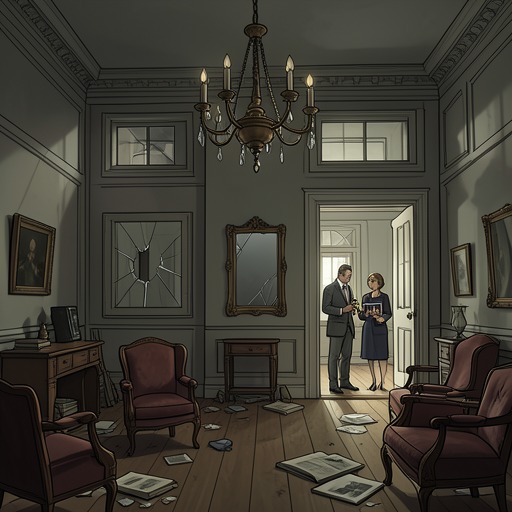
The Roses’ attachment begins in the house’s appearance and the life they built around it. Its high ground-floor windows, ornamental wrought iron, dormers, rusting slate roof, and repeated sixteen-light windows exceeded their expectations. They were so pleased with its looks that they had a copperplate engraving made and sent it out each Christmas. The house was not simply a possession they admired: it represented them. That identification had a material history. Oliver Rose and Barbara Rose collected antiques together, spending weekends at auctions and searching old Virginia and Maryland homesteads for bargains. European vacations also became part of the collection, as furnishings and accessories accumulated memories of their travels.
Their domestic world was made through work as well as acquisition. Barbara had learned cooking from her mother and from summer work with professional cooks and bakers; as the children needed less of her time, she began considering a catering business. Oliver supported the idea and devoted weekends to the kitchen’s construction, applying his knowledge of circuitry and craftsmanship. Barbara learned practical repairs herself, from changing washers and tightening faucets to cleaning grease traps and fixing the garbage disposal. Oliver gave her a tool chest, and she had helped him build the basement sauna and shower. They also refinished antique furniture together. The house and its contents thus recorded shared labor, even as the divorce forced that shared history into the language of individual claims.
Property, contribution, and competing definitions of fairness
When Oliver consults Goldstein, he describes the house and everything in it as joint property: they had put everything they had into the place. He estimates that the house might fetch at least half a million dollars, with antiques and other possessions worth another half-million or more. His initial offer is to divide the value equally. That proposal treats the home as a divisible financial asset, a settlement that might be reasonable in monetary terms but does not resolve what the house means to either spouse.
Thurmont explains to Barbara that Oliver’s offer concerns half the value, not ownership of the house or a particular half of its contents. An independent appraiser would establish market value, after which Oliver could borrow money to make a single settlement. Thurmont estimates that Barbara might receive four or five hundred thousand dollars after fees. Barbara rejects the idea that equal cash would make the outcome fair. She argues that she devoted nearly twenty years to Oliver’s career, needs, security, and desires, gave up her schooling, raised their children, and spent more time on the house than he did. Oliver’s earning power, she points out, would allow him to replace the house’s value within a few years, while she would be left with cash. To her, keeping the house preserves a life-style and a record of work that money alone cannot replace.
The argument becomes more complicated when Barbara’s catering business begins to trade. Her separation agreement bars her from using household money for the business, but slow-paying customers and suppliers demanding payment sooner leave her short of cash. She borrows from household funds to stay afloat. A meat supplier cuts her off, dismisses her bills, and tells her that women should not be in business; she throws chopped meat at him, and he drives his cleaver into the counter. Thurmont warns that her business is not relevant to the divorce case and that her success may hurt it. The episode makes the unequal stakes tangible: Barbara seeks a livelihood and independence through the very domestic skills and space that the marriage helped cultivate, while legal and financial arrangements constrain how she can use them.
Possessions as memory, status, and refuge
Oliver resists reducing the antiques to market prices. A sleigh bed found in Middleburg and dated to around 1810 prompts him to reflect on the people who slept in it and the lives they imagined. Refinishing such an antique, he observes, can diminish its value, yet the Roses liked the bed. For him, objects draw their force from the histories and fantasies they carry; thinking about them seems to prolong their lives. Ann answers that they are beautiful but not flesh and blood: people are what count. Their exchange states the central divide. Oliver experiences possessions as durable vessels of human history, while Ann sees the danger of valuing them above living relationships.
The house’s value is also social. At a dinner party, Barbara sees the neighborhood, the size of the house, and its possessions as signs by which people are known in Washington. The house gives her a head start in the effort to achieve personal fulfillment; hosting there makes her feel powerful and confirms why she fought to retain it. That confidence briefly opens the possibility of compromise, but Oliver’s continued presence crowds her, and the relief does not remove the conflict. The same rooms can therefore promise Barbara an independent public identity and remain, through Oliver’s presence, a source of daily irritation.
From sanctuary to contested territory
As the marriage deteriorates, the material things that once made a home also supply the means of retaliation. Oliver cherishes his Ferrari as a toy and a personal possession, caring for it and imagining that he might escape in it to a new life. After Mercedes dies, however, he puts the cat’s body in a plastic bag, drives to Memorial Bridge, and throws it into the Potomac River. The scene sets the fantasy of escape beside the consequences of the household war: even an object associated with freedom cannot take him out of the conflict that defines his thoughts.
Ann tries to interrupt that logic by reminding Oliver that a house can be replaced and possessions are only things. She tells him that his fixation is driving both him and Barbara to destructive acts, and that she has seen him with a knife. Oliver counters by describing the antiques as more than objects, but his defense of their meaning increasingly merges with a refusal to give them up. In this struggle, the house ceases to be shelter in any uncomplicated sense. Barbara has sabotaged the large library armoire, sawing its front legs and cementing its doors; Oliver, trapped and injured in the sauna, mentally inventories the house’s pipes, wires, and hidden spaces and resolves to use it as a weapon and ally. The knowledge and craftsmanship once spent building and maintaining their shared environment now serve the contest to control it.
What the house does to the family
The property dispute radiates beyond the spouses. At first, the children try to bring Oliver and Barbara back together, but their efforts fade as the hostility becomes unmistakable. Eve Rose tells Ann that her parents have gone crazy and spends more time with friends; Josh Rose finds solace in sports and continues seeing his father. Later, Eve confides that she is afraid to leave her parents alone, worries about what might happen in the house, and wishes either that they would reconcile or that one side would move out. She feels that the family has ceased to exist except as people living under one roof. When she and Josh are away, she remains worried because neither parent has called or written, and insists that the children still matter despite the parents’ differences.
By the dining-room confrontation, Oliver and Barbara can raise a division of the contents as a possible bargain: Barbara offers Oliver his choice of half the things, including books, paintings, and Staffordshire figures, while reserving the house and certain rooms and furniture for herself. Oliver does not accept the distinction between a house and its contents, or between financial value and attachment. He insists that things are loyal and people diminish; Barbara withdraws her offer. The line condenses the concept’s bitter reversal. Objects that once testified to a shared life seem safer than people precisely because the marriage has made trust impossible. Yet their apparent permanence does not free the Roses: attachment to the home and its contents binds them to the place where their relationship is breaking apart. The house is at once a monument to their partnership, a claim to status and independence, and the terrain of a conflict that confines the family it was meant to hold together.