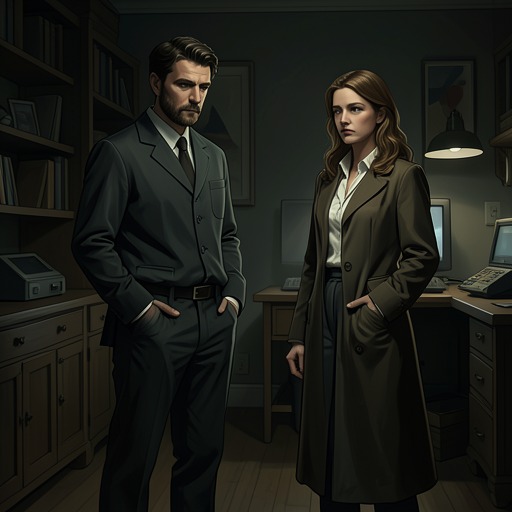
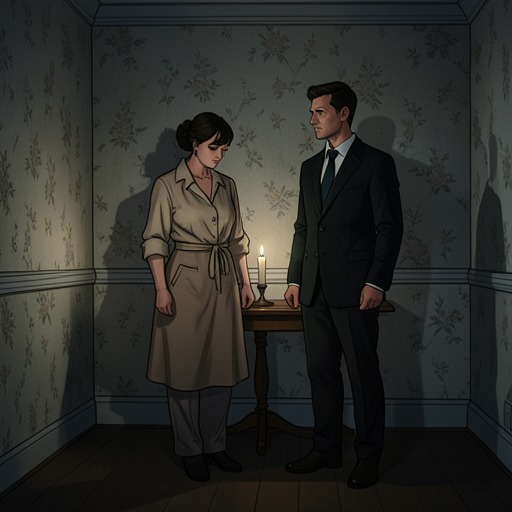
Oliver and Barbara meet at the Chatham auction
The War of the RosesOliver and Barbara meet at the Chatham auction over two Staffordshire boxing figures: an encounter shaped by a divided pair, competing bids, and the different purposes each assigns to the objects. Oliver leaves with Cribb and Barbara with Molineaux, but the exchange that follows turns an auction-room loss into a beginning. The figures endure as more than souvenirs: displayed together in the Roses’ home, they preserve the story of how the couple first met.
The pair and the bidding
Oliver recognizes the figures as a pair before the auctioneer treats them as separate lots. Cribb, the white English champion, had beaten Molineaux, a Black former slave, in both of their fights. Their likenesses had been made familiar through caricatures, pottery, and figures that showed them facing each other with fists raised. To Oliver, separating them is an act of ignorance: the two objects’ significance lies in their relationship as well as in their individual identities.
The auctioneer reads from the specification sheet and handles Cribb as an unexceptional souvenir rather than a work of art. Oliver knows the figure probably sold for very little when it was made by an anonymous potter, but its modest commercial value does not diminish what the pairing means to him. When a woman bids fifteen dollars, he raises his hand. Winning brings him a flush of victory, yet that success immediately becomes precarious: Molineaux is still to be sold, and Oliver has only seventeen dollars left after paying for Cribb.
Barbara enters the contest from several rows behind him. Oliver bids eleven dollars for Molineaux; Barbara answers with twelve, then raises her bid to twelve-fifty without hesitation. He reads her bidding as a threat to the pair and watches her for signs of wavering, while also suspecting the auctioneer of playing games. The contest draws Oliver into a struggle between his resolve to keep the figures together and his awareness that he is spending money he cannot spare. He continues bidding, but stops at twenty-one dollars. The auctioneer’s gavel awards Molineaux to Barbara.
From rivalry to conversation
Oliver sits through the rest of the auction in a funk, regretting that he did not borrow the money, though he also questions why he should have done so. Once calmer, he confronts Barbara while they collect their purchases. He insists that the figures belong together; she points out that they were not sold that way and says she liked the one she bought. The dispute is therefore not simply about whether the figures form a pair. Oliver values their shared history and composition, while Barbara has made her own choice about Molineaux.
When Oliver asks why she wanted the figure, Barbara explains that she works for the summer as a baking assistant at the Chatham Arms. She intends it as a gift for one of the maids, whose brother boxes in the Golden Gloves, rather than as a tip. Her purpose changes Oliver’s response: he feels touched and suddenly guilty, and concedes that separating the pair is a shame even for a good cause. What had seemed to him like a rival’s interference now has a generous explanation, although it does not undo the outcome of the bidding.
They leave the auction parlor into a crowded hall where people are opening umbrellas against gusty rain. Barbara steps beneath hers, and Oliver ducks under it too. As they walk toward the Chatham Arms, his hand covers hers where they hold the umbrella against the wind; the rain drives at them horizontally, and they finally take shelter in the doorway of a closed toy store. The shared shelter follows the contest without erasing it: they have not reached agreement about the figures, but the encounter has shifted from bidding and rebuke toward flirtation.
The lives behind the encounter
On the walk, Oliver and Barbara exchange personal details. Barbara is a student at Boston University. She had hoped to spend the summer volunteering for Jack Kennedy’s campaign against Nixon, but could not afford to do so; instead, she is earning money through baking, which she says she enjoys. Oliver teases her about spending her earnings, gesturing toward Cribb wrapped in soggy newspapers. The remark links their finances back to the auction, where his determination to secure the pair had already competed with his limited funds.
The figures also reveal how differently the two approach value. Oliver’s concern is the relation between the objects and the history embodied in their paired pose. Barbara’s purchase is attached to a particular recipient and a practical act of appreciation for a maid. Neither purpose makes the other disappear: Oliver still laments the separation, while learning why Barbara chose Molineaux makes him feel guilty rather than triumphant. The disagreement gives their first conversation its shape, with an argument over ownership opening into an exchange of motives and personal circumstances.
The encounter remembered at home
The auction becomes part of the Roses’ shared household history. In their home, Cribb and Molineaux are displayed together on a marble table in the foyer, posed in their enduring pugilistic confrontation. The story of the couple’s first meeting is repeated so often within the household that it becomes legendary. The later display is striking because the pair had been divided at the auction: their eventual presentation together preserves the image Oliver wanted, while their remembered story preserves the competition that prevented him from acquiring both figures that day.
The figures thus operate both as objects in the home and as a compact record of the couple’s origin story. Their raised fists keep the original contest visible; their shared place in the foyer makes the auction’s separation temporary in the household’s telling. What began with Oliver’s fear that the pair would be broken ends as a story the Roses repeatedly tell about themselves, joining a particular act of collecting to the memory of their first encounter.