Oliver and Barbara's home
The War of the RosesOliver and Barbara's home is at once the family shelter Oliver believes he created and the material focus of the Roses' bitter separation. As the couple's shared life breaks down, the home shifts in meaning: Oliver clings to it as the last possession he can claim, while Eve Rose sees it as the setting of a family that has ceased to exist. Its final collapse turns that conflict into physical destruction, burying Oliver Rose and Barbara Rose beneath the structure they fought over.
A Fort Built for the Family
In Oliver Rose's private account of the past, the house is a fort he built to protect his family. He remembers the children as helpless and owed protection, shelter, and warmth; with the arrival of Josh Rose, he recalls imagining the four of them—husband, wife, son, and daughter—together against the world. The house therefore stands not merely for property but for the family unity Oliver believed he had made possible.
That ideal is bound to a memory of mutual agreement. Oliver recalls Barbara Rose seeming to share his sense that their family was complete. Against that remembered picture, her decision to pursue her own aspirations and stop being an appendage to him makes the house feel like a life she no longer accepts. Oliver later frames the separation as the loss of his whole life and family, but insists that the house remains his. His claim to the building becomes a desperate defense of the identity he associates with it.
A Shared Home Under Separation
After Barbara announces that she wants to separate, the home holds the Roses together physically while their hostility permeates daily life. The children initially try, slyly, to bring their parents back together, but give up as the conflict persists. Eve Rose describes the separation as a shock precisely because the family had seemed to her and her friends to have an unusually good relationship, with the Roses doing things together and working on the house.
For Eve, the same building that once represented family life becomes evidence of its absence. She tells Ann that the family seems no longer to exist, except that everyone still lives in one house, and wishes the Roses would sell it and end the impasse. When she refuses to go to camp, she confides that she is afraid to leave her parents alone in the hostile atmosphere. She hopes they will reconcile or that one side will move away, revealing how the shared home has made the children witnesses to—and anxious participants in—their parents' conflict.
From Refuge to Threat
As the conflict continues, Ann watches the household with growing unease. The children have moved from attempted reconciliation to grudging acceptance, while Ann feels guilt and anxiety about her own position in the home. Later, Eve worries that her parents have not called or written and insists that, whatever their differences, they remain the children's parents. Ann promises to find them and ask them to call, while privately needing to keep the children away from the house she regards as monstrous. The language of refuge has reversed: the place once imagined as protection is now something from which the children may need protection.
Collapse and Aftermath
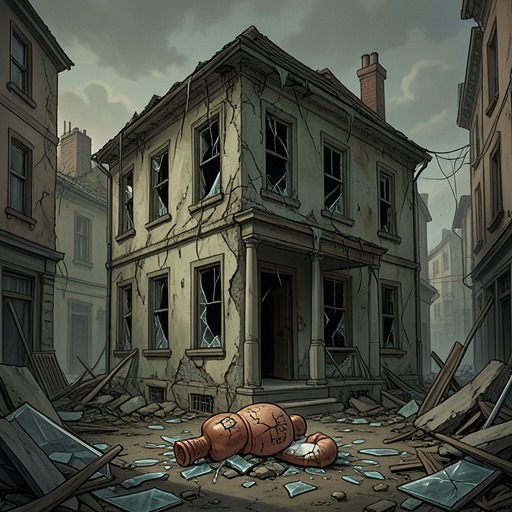
When Ann reaches the house with Eve Rose and Josh Rose, falling objects continue to clatter inside. The roof has collapsed and the interior walls have buckled. Near the entrance, the long clock lies on its side with its Roman-numeral face smashed; shards from the chandelier cover the surfaces, and dust fills the wreckage. These familiar furnishings no longer serve the household: broken and displaced, they make the collapse visible in the objects that once belonged to domestic life.
Ann searches through the debris and finds Oliver Rose and Barbara Rose dead beneath the rubble. They appear to be embracing, their lifeless eyes fixed on each other. The image is in sharp contrast with Oliver's earlier picture of the house as a fort against the world: the structure he meant to make a shelter has become a ruin around the couple. The home thus gives material form to the failure of their shared life, while its destruction makes the consequences of their domestic war irreversible.