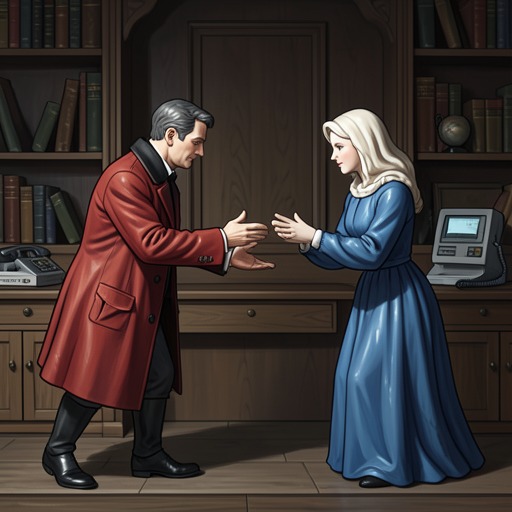
Oliver and Barbara's meeting at the Chatham auction
The War of the RosesOliver and Barbara Rose's meeting at the Chatham auction begins as a contest over two small Staffordshire figures and becomes the household origin story the Roses later repeat. In a crowded, rain-soaked auction room, Oliver's determination to keep the pugilists together collides with Barbara's independent purpose for bidding. Each leaves with one figure; the pair's eventual display gives lasting shape to the balance of rivalry and attraction established in their first exchange.
The auction and the divided pair
A cold rain lashes the clapboard house as Oliver sits a few rows from the podium, among fewer than thirty people and the scattered possessions of the Barker family. The auctioneer's dispirited handling of the sale sets its atmosphere: even a battered Windsor-style rocker, identified as a genuine Boston rocker, draws little response. When the Staffordshire pugilist Cribb comes up, Oliver recognizes that the auctioneer is separating a pair. Cribb, the white figure, represents the English champion who fought Molineaux, a Black former slave, twice; the two had been commemorated together, facing one another with fists raised. Oliver regards the figures as a pair worth preserving, although he knows they are souvenirs rather than fine art.
Oliver has only thirty-seven dollars, his total weekend tip income, and wants money left to bid for Molineaux after securing Cribb. He raises his bid against a woman in the first row, who pushes the price upward; at twenty dollars, Oliver wins. The gavel's fall gives him an immediate flush of victory, but the second half of the sale makes that success precarious. With only seventeen dollars remaining, he bids for Molineaux against the first bidder and then hears a new voice from behind him. Barbara, seated two rows back beneath a sailor cap, joins the contest. Her bids carry Molineaux beyond Oliver's reach. He believes the auctioneer is playing games and turns to rebuke Barbara with a scowl, but she continues bidding. When the figure sells for twenty-one dollars, Oliver sits through the rest of the auction in a funk, regretting that he did not borrow the money. He has won the first figure, but not the pair.
From competition to conversation
After the sale, Oliver confronts Barbara as they collect their purchases. He insists that the figures belong together and criticizes the auctioneer for not understanding what he was selling. Barbara answers that she liked Molineaux and draws the figure closer when Oliver looks at it possessively. Their first conversation preserves the terms of the auction: he argues for the pair, while she refuses to treat her purchase as merely the half he failed to win. She explains that she intends it as a gift for a maid at the Chatham Arms, whose brother boxes in the Golden Gloves. Barbara herself is working there as a baking assistant for the summer; she wants to offer the figure instead of a tip to someone who takes a lot of abuse.
The explanation unsettles Oliver's certainty that the two figures must remain together. He feels touched and guilty, and acknowledges that separating them is a shame even for a good cause. The shift does not settle their dispute so much as turn it into flirtation. Barbara has beaten him fairly, he concedes, while also admitting that he is a poor loser. They leave the auction parlor into the gusty rain and share an umbrella that offers little protection as they walk through town. Oliver covers Barbara's hand as they hold it against the wind; when the weather drives them into the doorway of a closed toy store, the practical shelter becomes a pause in which they exchange personal details.
The people behind the bids
Barbara tells Oliver she is a Boston University student. She had wanted to volunteer for Jack Kennedy's campaign against Nixon but could not afford to do so; she chose summer baking work instead, explaining that she enjoys it and that the pay is good. Oliver points to the figure wrapped in soggy newspapers and observes that money can be spent quickly. Barbara turns the joke back on him. The exchange connects their competing bids to their circumstances without making either figure a simple measure of its buyer: Oliver has spent most of his modest earnings to secure one half of the pair, while Barbara has paid more for a gift intended for someone else.
The rain continues to shape the encounter, from the auctioneer's windows to the shared umbrella and the refuge at the toy-store doorway. It also gives the scene a gradual change of pace. Inside, the figures provoke rivalry; outside, the same objects prompt explanation, teasing, and recognition. Oliver notices that Barbara's eyes, initially seeming green, look hazel and have turned brown in the late-afternoon light. The observation follows their conversation and the easing of his resentment: the woman who had seemed an adversary in the bidding becomes someone he is attending to closely.
The pair as a lasting emblem
Even after walking together, Oliver is reluctant to let Barbara give Molineaux away. He senses that the figure has become a symbol of their meeting and asks her not to part with it yet. Barbara insists that it is hers, mockingly holding it over his head like a club. Oliver returns to the argument that one figure is not much use without the other: they form a twosome. Barbara counters that she won hers fairly. His final insistence that the battle is not over, met by her agreement, leaves the encounter suspended between a joke and a promise of continued contest. Their attraction does not erase the disagreement; it gives the disagreement a playful, shared future.
Years later, the Cribb and Molineaux figures stand on a marble table in the foyer of the Rose household, poised in their eternal boxing confrontation. The story of the Roses' first meeting has by then been repeated in the household ad infinitum. That recurrence makes the auction more than an origin anecdote: the pair is a material reminder of how the relationship began, with each person attached to a different figure and neither willing to yield. Their later placement together preserves the very division Oliver first tried to prevent. The figures' enduring face-off turns a rain-soaked purchase into a compact image of the Roses' union—shared history held in place not by agreement, but by the continuing tension between two separate claims.