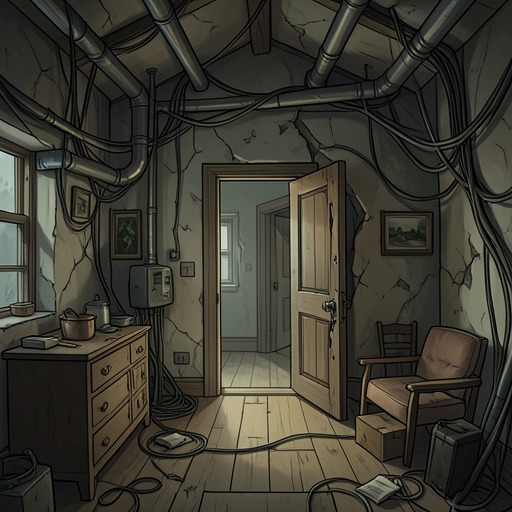
Oliver sabotages the kitchen to stop Barbara's dinner party
The War of the RosesOliver sabotages the kitchen to stop Barbara's dinner party, transforming a demanding professional undertaking into a physical struggle for safety and control. A hot faucet, a runaway food processor, and a cascade of activated appliances leave Barbara injured amid the wreckage. She cuts the power, disables the tampered equipment, and carries on without it; the dinner is ultimately served successfully, so the sabotage fails at its immediate aim even as it exposes how far the spouses' conflict has escalated.
Causes and Stakes
Barbara approaches the dinner as a project that belongs to her alone. She has decided to prove that she can provide a complete service, and the work gives her structure and purpose. She gathers china, silver, and crystal, draws up a detailed ingredients list, and shops for the best available produce. With the children away, she can follow her own pace and largely ignore Oliver's movements. Still, she anticipates interference: before beginning, she inspects the food and wine for signs of tampering and has already devised a plan in case Oliver tries to disrupt her work.
The day before the party, Barbara moves a cot into the kitchen so she can prepare the food overnight and remain there until the three people she has hired arrive. Her decision turns the kitchen into both workplace and refuge, but it also places her directly among the equipment that Oliver has tampered with. The stakes are not merely whether she can meet a demanding schedule. She is trying to complete a public-facing professional undertaking without allowing Oliver to force a confrontation or dictate what she is capable of doing.
The Kitchen Turns Against Her
The first warning is a faucet that will not run cold. When Barbara turns it toward hot, scalding water burns her hand. She improvises with ice cubes in a stock pot, making cold water for washing the ingredients, and continues. At first, she only vaguely connects the malfunction to Oliver. A mixing head then flies off the bowl on the kitchen island and narrowly misses her face. She checks its thread and refits it, still allowing that she may not have tightened it properly.
The danger becomes harder to dismiss when the Cuisinart keeps running after Barbara turns its cover to the off position. She switches the machine off, but it continues to whir; the plug will not come free. Meanwhile, every burner on the electric stove is red hot, and turning the knobs has little effect. When she finally tugs at the wire, the food processor falls to the floor. Its loosened slicing blade shoots across the room, strikes the range hood, ricochets off a cabinet, and clanks into a sink.
As Barbara tries to avoid the blade, the knife box topples and scatters knives over her body, cutting her thighs. She reaches for the faucet and scalds her hand again. Her movement sets off the disposal, which she cannot stop; the range-hood fan and two blenders start as well. The toaster is hot when she reaches toward the plugs, and the coffee maker, microwave, and dishwasher join the commotion. In sequence, the kitchen's appliances seem to come alive around her. The noise grows into a cacophony as she staggers among the pots and pans, scatters food, breaks plates, and brings down hanging copper pots while trying to keep her balance. Cuts bleed through her slacks; her burned hand aches, and the falling pots bruise her.
Escape and Countermeasures
Injured and helpless in the wreckage, Barbara crawls across the kitchen floor, reaches the downstairs door, and makes her way down the wooden stairs. She slips near the landing and hits her head, but reaches the fuse box and pulls the master switch. The house falls dark and quiet. On the basement floor, pain convinces her that she is still alive; she cannot tell whether the wetness on her cheeks is tears or blood. When she manages to climb back upstairs, she sees the kitchen in ruins and examines the damage in the bathroom: bruises on her head and arms, cuts across her thighs, and a stinging scald on her hand.
The injuries sharpen her anger into certainty. Barbara concludes that Oliver has booby-trapped the kitchen and made it into a weapon. She believes the tampering could have mortally injured her, and recognizes that she herself could kill without guilt or remorse. Rather than abandon the dinner, she turns that recognition into resolve. She cleans the kitchen as best she can, uses tools from Oliver's workshop to pry out plugs and disconnect the affected appliances, and leaves the electrical stove unusable. One sink still works. She does not call an electrician, because there is no time; instead, she buys a hand-operated meat grinder and tools for slicing and grating.
The Dinner Goes Ahead
Barbara checks that the gas stove and oven have not been tampered with and relies on them. Without the electric appliances, she finishes the work by hand: at dawn she adds the final touches to the foie gras and pounds dough for the pastry around the beef fillet. By midmorning, the crab imperial is prepared in its shells, the fillet is partly cooked before being covered with foie gras and pastry, and the vichyssoise is in the refrigerator. After keeping watch through the night, she has retained control of the work and its timetable.
When two white-gloved waiters and a maid arrive, Barbara feels the effort has paid off. She takes the head of the table in an old Galanos dress, with her hair done by a hairdresser, and converses with the Greek and Thai ambassadors. The Washington Post food editor asks detailed questions about the dishes and appears impressed by her answers. The guests admire the house and the silver and china on the table; the beef Wellington is perfect. The contrast is exact: the kitchen that had seemed to be Oliver's instrument of sabotage becomes the site of Barbara's successful improvisation.
Significance
The sabotage changes the value of Barbara's undertaking from professional challenge to immediate bodily danger, but it does not make her abandon the goal. Her response is practical as well as emotional: she cuts the power, disconnects the equipment, substitutes manual tools, and uses the surviving gas stove and oven. Each adaptation narrows Oliver's control over the outcome. What he has turned into a trap becomes a test of Barbara's resourcefulness, and the meal's success gives material proof that the sabotage has not stopped her.
The sequence also makes domestic technology part of the spouses' conflict rather than neutral background. Faucets, switches, knives, appliances, and the fuse box shape the action, first threatening Barbara and then offering means of escape or repair. Her eventual distrust of the machines is grounded in a specific experience of their failure and apparent manipulation. The dinner does not end the conflict, but it marks a reversal within it: Oliver's attack leaves Barbara injured and furious, yet she completes the event on her own terms and before the guests who came to judge her work.