Oliver's apparent heart attack and Barbara's absence
The War of the RosesOliver Rose’s apparent heart attack and Barbara Rose’s absence from the hospital turn a medical scare into a revelation about their marriage: Oliver discovers how urgently he wants his wife beside him, while Barbara privately recognizes that she had wished he would die. The crisis begins with pain mistaken for a mortal emergency and ends with a diagnosis that is medically reassuring but emotionally unsettling. Its consequences arrive not only in the hospital, but later, as each spouse confronts what the episode has exposed about their attachment and estrangement.
The Attack and Its Escalation
The episode begins in Manhattan, during a conference in the chairman’s office about a company’s special problem with the Federal Trade Commission. Oliver has already drunk more coffee than usual when pain strikes behind his breastbone. His pencil jitters across a yellow legal pad, his attempt to dismiss the sensation gives way to cold sweat and panic, and the chairman’s words become muffled and incoherent. Oliver tries to conceal his discomfort with a cough and humor, but the pain worsens. When others notice his poor color and cold skin, someone calls an ambulance.
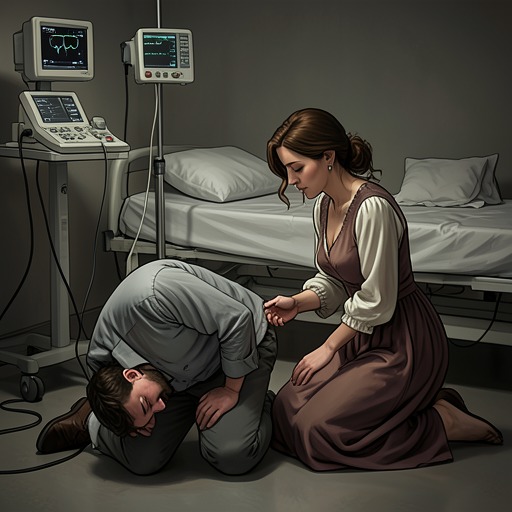
The possibility of death quickly commandeers Oliver’s thoughts. He worries about becoming an embarrassing burden in front of his colleagues, then finds himself imagining his family watching over him at the moment of his death. On the stretcher, he asks for his wife to be called. The request becomes a repeated plea: even after the oxygen mask is removed and he is connected to monitoring equipment, he insists that Barbara must come, believing that his life depends on her arrival. A burp briefly relieves the pain, but when it returns he again imagines himself dying and reproaches himself for having let his family down.
His panic also takes the form of a detailed inventory of the life he fears leaving behind. Oliver wonders who will feed Benny, care for the orchids, turn the wine, wind the tall mahogany clock, repair appliances, watch over the antiques and Staffordshire figures, and tune up his Ferrari. The list makes his attachment to home tangible: in the emergency, he thinks not only of people but of the routines, collections, plants, and possessions through which he maintains his place in the household. At the hospital, an X-ray and other precautions follow; after medication eases his pain, he drifts in and out of sleep beneath the fluorescent lights.
Diagnosis and Barbara’s Absence
The doctor eventually tells Oliver that he has a hiatus hernia, a common condition whose gas pain can imitate a heart attack. The alarming symptoms have prompted precautionary treatment, but Oliver was not dying. He reacts with relief mixed with embarrassment and irritation, imagining that he will be a laughingstock at his firm. The reversal resolves the immediate medical danger without answering the emotional question that has gathered around it: why did Barbara not come?
When Oliver is discharged, he receives his clothes, wallet, keys, money, and briefcase, then calls home from a phone booth in the hospital lobby. Ann answers and says that everyone is glad he is well. Oliver is surprised that she is on the telephone and asks where Barbara is. Ann explains that Barbara has just left and will be back in a little while, having been busy with the Pakistan Embassy order. The children are safe and have been told what happened; Ann says they were worried sick. Yet Barbara is not there when Oliver calls, and his expectation that she will meet him at the hospital has gone unmet. He goes on to see his client and tells the chairman that even the doctors felt foolish for making such a fuss, a claim the narration identifies as a lie that lets him close the subject in public.
The account does not make Barbara’s absence a simple scheduling detail. In a separate scene, while boning chickens for her catering work, Barbara asks herself why she did not go. She answers the question in anger, striking a cleaver into the cutting board and leaving an irrevocable scar. Her explanation is stark: when the first hospital call came, she had wanted Oliver to die, to be removed from her life like a rotten tooth. The thought frightens her, because she understands that wishing for his death implies hatred and feels inhuman; nevertheless, she cannot deny its clarity. Her absence therefore coincides with a wish she cannot comfortably accept, though the scene does not reduce the entire marriage to a single motive.
The Fear Returns After Discharge
The medical crisis does not end when Oliver leaves the hospital. On a plane, his attention returns to the ordeal, and he doodles on his yellow pad beneath the changing light of sunset. Instead of feeling grateful simply to have survived, he experiences desolation, loneliness, and a fear that seems to him beyond logic. The gap between the harmless diagnosis and his continuing distress gives the episode its emotional afterlife: his body is no longer in immediate danger, but the need that surfaced during the emergency remains unresolved.
In memory, Oliver hears himself pleading for his wife and imagines the roles reversed. He pictures himself abandoning everything to reach Barbara, swimming through rough seas, crossing dunes, and climbing rocks to be near her. The imagined acts of rescue collapse, leaving him feeling empty and betrayed. He takes her failure to appear at his deathbed as a measure of what she would not do for him, even though the supposed deathbed has proved to be a hospital stay for a hernia. The fantasy intensifies the meaning he assigns to her absence rather than establishing what she would have done in a genuine mortal emergency.
Significance in the Marriage
The episode places two incompatible truths beside each other. In the ambulance and hospital, Oliver’s fear makes Barbara seem indispensable: he repeatedly calls for her and imagines that her presence could secure his survival. Barbara, remembering the call while working in the kitchen, discovers that she had wanted the opposite outcome. The contrast is not softened by the diagnosis. Because the crisis is not fatal, the spouses must return to the marriage whose underlying conflict the emergency has briefly made visible.
The scene also establishes a recurring tension between people and possessions in Oliver’s sense of home. Faced with possible death, he names the dog, orchids, wine, clock, antiques, tools, and Ferrari alongside his family, revealing how closely domestic identity is bound to care and ownership in his imagination. The hospital’s intervention strips those routines from him temporarily; his mind circles back to them even as it calls for Barbara. The attack is thus both a false alarm about his heart and a genuine disturbance of his confidence in the marriage. Its decisive outcome is not a death, but the knowledge—felt differently by each spouse—that their bond no longer means the same thing to both.