Oliver's apparent heart attack
The War of the RosesOliver's apparent heart attack is a medical scare that becomes a revelation about the Roses' marriage: the crisis proves physically harmless, but Oliver's plea for Barbara Rose and Barbara's response to the possibility of his death expose how differently they experience their bond. What begins as pain at a conference table ends as evidence of a loneliness neither spouse can dismiss.
Onset at the Conference
The episode begins during a meeting in the chairman's Manhattan office. Mr. Larabee has just finished outlining the company's special problem with the Federal Trade Commission, while Oliver takes notes on a yellow legal pad. He has already had more coffee than usual before lunch when a stabbing pain begins. At first he tries to disregard it; then a cold sweat and mounting panic make that impossible. As the chairman addresses him directly, the words reach Oliver as muffled and incoherent. He attempts to disguise his distress with a cough and humor, but cannot swallow the water someone pours from a silver pitcher.
Oliver is moved to a leather couch, where he loosens his collar and tie. The episode is frightening not only because of the pain but because it interrupts a consequential work occasion: he imagines that he has ruined his first major interview with a new law client and anticipates the dismissive judgment of his colleagues. Two attendants carry him on a stretcher; he sees an oxygen mask approaching and asks for his wife. The ambulance's siren and the hurried medical attention confirm the seriousness with which others treat the symptoms, even as Oliver's own awareness becomes hazy.
Hospital Vigil and Diagnosis
As he is taken through the hospital, Oliver's thoughts repeatedly return to the possibility that Barbara must arrive for him to be safe. He imagines his life depending on her presence. Yet fear of death is interwoven with anxiety about the routines and possessions waiting at home: who will feed Benny, tend the wine and orchids, wind the mahogany clock, repair appliances, care for the antiques and Staffordshire figures, and tune up the Ferrari? The catalogue makes his household responsibilities feel inseparable from his identity; the thought of being separated from them intensifies an ordeal already made frightening by pain.
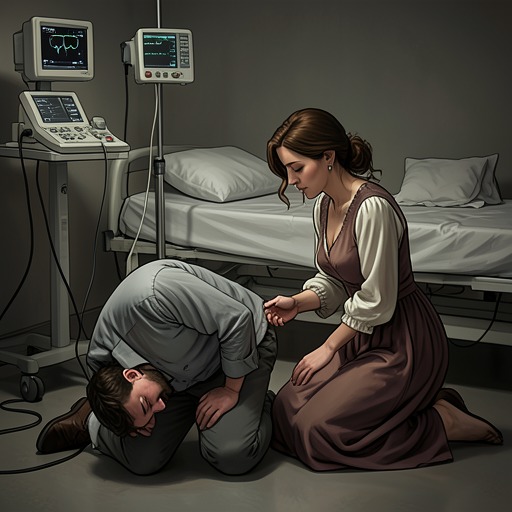
Medical staff initially treat the symptoms as a possible heart attack, taking precautions that include oxygen and further examinations. Oliver is X-rayed and kept under observation, but he is not connected to ongoing mechanical support. When a doctor wakes him, the explanation is a hiatus hernia, described as common: the severe sensation came from gas pain that can imitate a heart attack. Oliver reacts with renewed relief and bitter humor, imagining that the firm will make him a laughingstock. He wants to leave and asks for Barbara, but learns that she is not at the hospital. The crisis that seemed to place his survival in her hands has not brought her to his bedside.
Return and Delayed Fear
After dressing and collecting his belongings, Oliver calls home from a phone booth in the hospital lobby. Ann answers. She tells him that Barbara has just left and will return later, busy with the Pakistan Embassy order; she also reports that the children are worried, after being called at school. Oliver says he will be home that night. The exchange gives him news of the household, but not the encounter with Barbara he had urgently sought.
Oliver subsequently returns to the chairman's office and brushes off discussion of his indisposition, claiming that even the doctors felt foolish for making such a fuss. On the plane, however, the experience reopens in his mind. He doodles on the yellow pad as the sunset changes the light outside, while the relief of having escaped death gives way to desolation and a sense of being utterly alone. The fear arrives belatedly, after the immediate danger has passed: he cannot reconcile his survival with the depth of his isolation.
In memory, his request for Barbara becomes a plea for rescue. He imagines himself crossing rough seas, desert dunes, and jagged rocks to reach her if their positions were reversed. The fantasy ends in a sense of betrayal: he had called for her at what he believed was the edge of death, and she had not come. This imagined reversal does not establish what Barbara would have done in the same circumstances; it reveals the intensity of Oliver's own expectation that she should be there.
Barbara's Response and Marital Significance
The episode also shows the crisis from Barbara's side. While boning chickens for the Pakistan Embassy order, she turns over the question of why she had not gone to Oliver. Her hands continue the practiced work of separating skin and bone as her thoughts move toward an answer she resists naming. She admits to herself that, after the first hospital call, she wanted Oliver to die—to be removed from her life. The thought frightens her, and she tries to regard it as an aberration, but cannot deny its clarity.
Her anger has no settled explanation for her at that moment. She searches for reasons, then drives the point of a cleaver into the cutting board, leaving an irrevocable scar. The concrete damage registers the force of an emotion she has not yet made fully intelligible to herself. Set beside Oliver's belief that Barbara's arrival would save him, her response makes the same medical scare two sharply opposed experiences: he discovers how urgently he still depends on her, while she confronts a wish for his absence.
The diagnosis closes the medical emergency but not its consequences. Oliver's imagined rescue and Barbara's private admission disclose the estrangement beneath the ordinary arrangements of work and home. The apparent heart attack is therefore a turning point in perception rather than a fatal event: it exposes the marriage's unequal attachments without resolving them.