Rose family home
The War of the RosesThe Rose family home is more than the setting for the Roses’ separation: it is the shared territory through which their private conflict reaches their children and those who care for them. As the household’s routines and relationships break down, its rooms become places to hide, watch, flee, and survive. The contrast between the home’s composed exterior and the danger inside gives the house a central role in the novel’s portrayal of domestic conflict.
Setting and Domestic Life
The home is the center of a family life that once seemed, to Eve Rose and others around the household, unusually harmonious. After Barbara Rose tells Eve that she wants freedom to fulfill her own aspirations and no longer be an appendage, Eve struggles to reconcile that explanation with the parents and shared household she thought she knew. Her shock is sharpened by the apparent contrast between the announcement and the life the family had built together in the house. For Eve, the separation is not an abstract disagreement between adults: it threatens the meaning of the family’s common home.
That meaning erodes as the parents’ hostility permeates daily life. Ann observes the household closely, reading movements, looks, and stray words as possible signs of what might happen next. At first, the children try to bring their parents back together; faced with their parents’ continuing antagonism, they give up and settle into grudging acceptance. Eve spends more time with her friends, while Josh Rose finds an outlet in basketball and other sports. Their changing habits show how the conflict reorganizes life in the house even when no confrontation is taking place.
A Household Drawn into the Conflict
Eve understands the home as an increasingly unsafe place to leave unattended. She tells Ann that she does not want to go to camp, explaining privately that she is afraid to leave her parents alone together. She hopes they will either reconcile or that one side of the family will move out, and she wishes they would sell the house and end the impasse. Her fear reveals the cost of the Roses’ continued cohabitation: the house still contains the family, but no longer provides Eve with a sense that the family exists as a functioning whole.
The home also draws Ann into conflicting roles. She is both an observer of the Roses’ deterioration and a caregiver to their children, while privately aware of her unrequited feelings for Oliver Rose. She tries to preserve a pose of indifference, but interprets the family’s gestures and words and feels guilty about her interest in Oliver. The children’s efforts to influence their parents’ relationship, and Eve’s decision to confide her fear to Ann, make the home a setting where the adults’ conflict is repeatedly carried by other members of the household.
Rooms of Surveillance and Escape
The house’s internal spaces become part of a struggle over privacy. In Eve Rose’s room, Oliver discovers a wire running from a tiny hole near the floor, along the corridor, and toward a window overlooking the garden. He follows it outside toward the garage while Ann watches from the house, frightened by his concentration and the knife he has taken from the kitchen. Afterward, he dismantles the television equipment, removes the wire, smashes the camera with a sledgehammer, and disposes of the flattened pieces in the alley. A private home has become a place in which its occupants may be watched, and Oliver responds by destroying the means of surveillance.
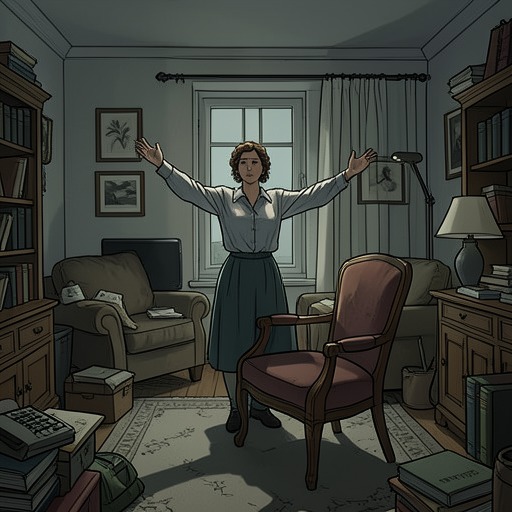
Later, the kitchen itself becomes a source of physical danger. Amid the sequence of appliances turning on, Barbara is cut and scalded, and the noise and wreckage leave her unable to remain there. She crawls to the downstairs door, reaches the basement fuse box, and pulls the master switch, plunging the house into darkness. Injured and disoriented, she lies on the basement floor before following daylight back upstairs. The episode makes the house’s ordinary infrastructure—appliances, stairs, and electrical supply—part of the immediate threat, and leaves the kitchen a wreck.
The workshop offers another passage between confinement and escape. Bruised and hysterical, Barbara finds herself unable to open a wedged door in what remains of Oliver’s workshop. Hearing footsteps above, she searches the surrounding wreckage for a tool and finds a sledgehammer. She uses it to break the wedge free, runs into the garden, and opens the gate. Yet even in flight she turns back toward the sunroom, where she sees Oliver gaunt and bearded through a shattered window. The house’s connected rooms and openings shape the moment: escape carries her outside, but the broken window keeps her gaze—and her unresolved attachment—drawn back to the home.
The Dining Room and the Public Face of Home
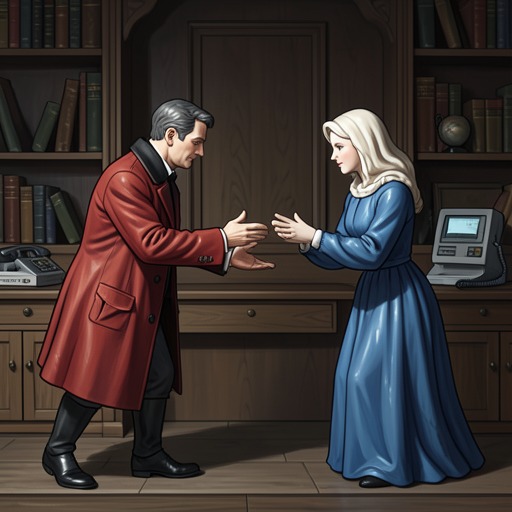
Barbara later prepares to meet Oliver in the dining room, a space she considers her domain. She fills all ten sockets of a silver rococo candelabrum with candles, setting silver goblets and plates at either end of the polished mahogany table. On Oliver’s plate she places pate and melba toast; beside her own foot, she keeps a shopping bag containing a cleaver. The careful table setting and concealed weapon bring hospitality and danger into the same room. Her choice of the dining room gives the encounter a domestic form, but her preparation makes clear that this is no ordinary shared meal.
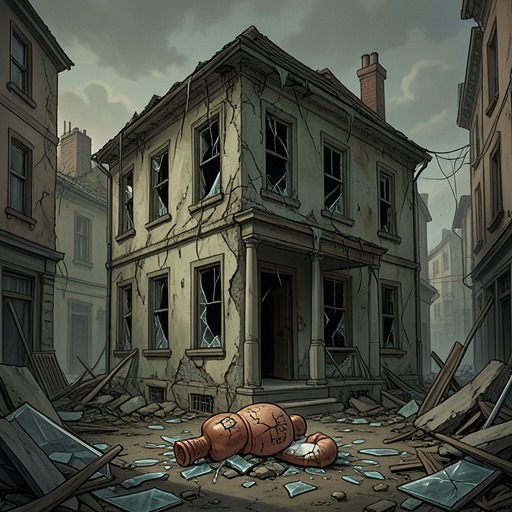
From the street, the home still appears composed. Its white facade and black shutters glitter in the sunlight when Ann comes to the door, seeking help because Eve is distressed that neither parent has called or written. Ann knocks repeatedly, then pounds with her fists and calls out that the matter concerns the children. The silence inside contrasts with the house’s innocent appearance and with Ann’s urgency outside. The surrounding neighborhood, described as quiet and shielded from the pain of its residents, reinforces the house’s double character: a private refuge from public scrutiny, but also an enclosure in which family suffering can remain unseen.
Narrative Significance
Across these episodes, the Rose family home changes in meaning without ceasing to be the family’s common address. It is at once the setting of shared memories, the place where the children absorb the separation, and a structure whose rooms and equipment become implicated in the adults’ conflict. The wire in the corridor, the disabled kitchen, the wedged workshop door, the shattered sunroom window, and the candlelit dining table give that conflict a physical geography.
The contrast between exterior and interior is especially consequential. Ann meets a bright, orderly-looking facade but receives no answer for twenty minutes; within the home, Barbara has struggled through injury and escape, and Oliver remains visible only as a gaunt figure behind broken glass. The house can conceal distress from neighbors even as it exposes its occupants to one another. Its apparent privacy no longer guarantees security, and its domestic spaces become the means through which the family’s separation is experienced, feared, and endured.