Kelly Shaw
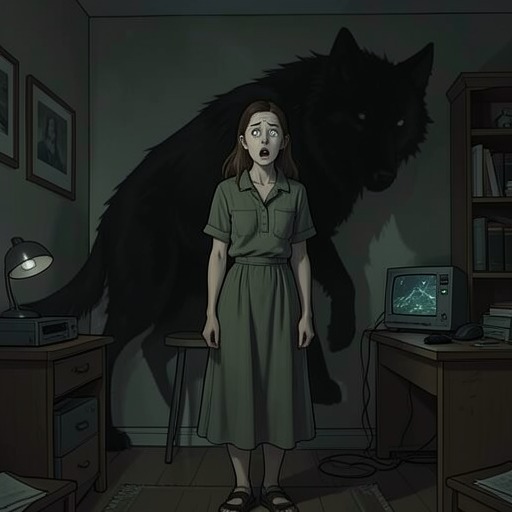
The Werewolf Mates Anthology (Erotic Romance)Kelly Shaw is introduced as a twenty-nine-year-old scientist beginning a new life in Boise, Idaho, but her first decisive act in the story is not performed in a laboratory or a wilderness field site. It occurs at Cafe Merge, where an apparently ordinary restaurant conceals a dark, crowded, club-like interior. There she sees Max, follows an instinct she cannot explain, and enters the supernatural and relational world that will redefine her understanding of herself. Her transformation makes her both a victim of the werewolf curse and an active interpreter of the institutions and relationships that attempt to classify her.
Identity and Background
Kelly arrives in Boise with a clear professional purpose. Having recently completed her PhD at the University of Oregon, she has been selected for post-doctoral work at Silver Sky Research, an animal research project studying wolf migration and assessing whether expanded wolf reintroduction would benefit modern life. Her attraction to the American West is connected to its mountains, lakes, wilderness, and remaining wild wolf populations; she hopes to study wolves in the field, and the position appears to make that ambition possible.
Her first evening in the city exposes a contrast between the life she planned and the forces already waiting for her. She chooses Cafe Merge because its unassuming exterior resembles an ordinary restaurant, only to discover a loud interior with dark red curtains, weak metal lighting, a massive bar, and a dance floor crowded with moving bodies. Kelly stays long enough to eat because she cannot afford two dinners, an economical decision that places her in the room where she meets Max. The scene therefore links her practical independence and scientific ambitions to a chance encounter that is anything but ordinary.
Encounter with Max and the Infection
Kelly’s attention is arrested by Max before she understands why. He sits beside the bar, surrounded by people who keep their distance from him, and presents himself as a powerful natural leader through his appearance and bearing: a black leather jacket, gray shirt, tight jeans, brown hair around his shoulders, and upward-tilting brown eyes. Kelly does not cautiously approach him. She cuts directly across the dance floor, while Max rises and meets her halfway.
Max takes her hand, pulls her close, breathes her in, and identifies himself simply as Max. Kelly responds by giving her own name and wrapping an arm around him. The immediate physical and emotional intensity of the meeting makes ordinary introductions seem almost irrelevant. Their bodies move together despite the music’s separate rhythm, creating an enclosed world that isolates them from the crowded bar. The encounter establishes the attraction that later becomes a mate bond, but it also precedes the event Kelly initially misreads as an ordinary sexual aftermath.
The next morning, Kelly treats the mark on her neck as a severe hickey. She is excited about beginning work and covers the several-inch mark with concealer, foundation, and a fully buttoned high-collared shirt so that she will look professional. Her attempt to restore the episode to normality shows how strongly she initially relies on familiar explanations. When the mark disappears entirely, she attributes the rapid healing to antibodies overcoming what she assumes was the flu.
That explanation collapses when Kelly discovers that she has been unconscious for nearly two days. Max’s first message says that she left her license at the bar and asks her to call so he can return it; his later message is more urgent, saying that he needs to speak with her because the matter is important. The lost license is a mundane trace of the encounter, while the unexplained coma is the bodily evidence that something far more consequential occurred.
Revelation of Werewolf Identity
Max eventually explains that Kelly’s illness was an infection transmitted through a bite. The bitten person develops a fever and enters a coma-like sleep before awakening apparently recovered. The condition often remains unknown until the full moon, when the infected person discovers that they are no longer an ordinary human. Kelly’s recovery and missing time thus become part of a recognizable pattern rather than an isolated medical anomaly.
Max’s revelation is direct: he is a werewolf, and Kelly is one as well. Kelly rejects the claim because she has never knowingly turned into a wolf. Max explains that the full moon dominates werewolf existence, that it is the one night when werewolves cannot choose to change, and that the condition originated in a curse whose victims were forced to behave as beasts. Later generations learned to assume actual animal form and to pass the curse to others. Kelly’s new identity is consequently described through several competing vocabularies at once: infection, curse, transformation, and membership in a hidden social group.
Her resistance is not merely disbelief about the supernatural. It is also a refusal to accept the social consequences Max places before her. She must protect herself during the full moon and assimilate into the pack, including paying a small tribute to the alpha. When Kelly sarcastically imagines bowing before an alpha who has manufactured his own authority, Max admits that tribute exists while insisting that few people literally bow. She then realizes that Max himself is the alpha. The discovery converts the man who attracted her into the leader whose rules will structure her new life, making intimacy and hierarchy inseparable.
Relationships and Pack Belonging
Kelly’s connection with Max develops from immediate desire into a werewolf mate bond. Later explanation describes accepting a mate as a mixture of emotional and physical intimacy in which everything simply clicks, rather than as a spectacular supernatural display. Kelly admits that she would not know how to avoid such a bond, and her embarrassment when she looks toward Max reveals that the relationship is not only biological or institutional. It is also an attraction she experiences as intimate, difficult to control, and increasingly consequential.
Max’s role toward Kelly combines authority with protection. He tells her that her life does not have to change completely, promises that the pack will keep her safe, and begins preparing her for the approaching full moon. Kelly does not surrender passively to his leadership. Her objection to alpha authority and her insistence on understanding what has happened place her in a negotiating position: she accepts information and protection while questioning the hierarchy that offers them. The relationship therefore does not erase her independence, even though the mate bond and pack structure sharply constrain the choices available to her.
Andy Olson becomes part of Kelly’s introduction to pack life when Max summons him to return her license and take her back to her car. Kelly recognizes Andy as one of the men who helped her that night, and she later stays at Max’s house often enough that the house becomes a practical meeting place for the pack’s affairs. Kelly’s presence there also confirms that her relationship with Max has moved beyond the original bar encounter into an established domestic and social arrangement.
Work, Silver Sky, and the Wider Conflict
Kelly’s professional position at Silver Sky Research gives her an important connection to the institution at the center of the larger conflict. She begins with the expectation that the organization is conducting legitimate ecological research on wolf migration and reintroduction. That expectation is later overturned when Max and Kelly reveal to Abigail McKinney that Silver Sky is doing more than studying wolf migration and has conducted unauthorized, unvetted experiments on humans.
Kelly participates in Abigail’s rescue aftermath rather than remaining a distant observer. When she arrives with Max at the place where Abigail has been found with Jacob Pitman, she recognizes Abigail’s absence from work as suspicious. Silver Sky has announced that Abigail went on vacation, although Abigail had made no such plan. Kelly helps identify the deception and states the central finding: the organization selected Abigail as one of its human subjects.
The revelation extends beyond Abigail. Kelly later tells Jacob that the testing performed by Silver Sky on Abigail, Jacob, and Jaz Pitman turned all three of them into werewolves, while Max and Kelly were also werewolves. Jacob initially laughs because he believes the claim must be a joke, but the seriousness of the others confirms that Kelly is speaking about a hidden reality rather than making a provocation. Her scientific employment has thus become an ethical and existential trap: the institution whose research initially promised access to wolves is connected to human experimentation that produces the very condition she is learning to inhabit.
Kelly also helps maintain the secrecy protecting the werewolf community. After the Griffith case is dropped, Max and Andy recognize that Parker Griffith must be kept quiet because an ordinary person talking about real werewolves at a research facility in Idaho could threaten the group’s safety. Kelly’s involvement in the pack places her on the side of controlled disclosure, even as her own experience demonstrates the violence of secrets when they are imposed on an uninformed person.
Change and Narrative Significance
Kelly’s trajectory crosses several boundaries that the story initially treats as stable: scientist and subject, human and wolf, individual and pack member, professional colleague and mate. Her scientific interest in wolves begins as a conscious career choice, but her bite makes the animal-human boundary bodily and unavoidable. She does not merely study a nonhuman species; she becomes part of a hidden condition that reorganizes her health, perception, social obligations, and intimate life.
Her early explanations repeatedly fail in concrete ways. The mark on her neck disappears instead of healing like an ordinary injury, her supposed flu leaves her unconscious for almost two days, and the full moon threatens a transformation she has never experienced consciously. Each failed explanation forces Kelly to revise the category in which she has placed herself. Yet she remains recognizably analytical: she asks how the infection works, challenges the logic of alpha authority, and helps investigate Silver Sky rather than accepting Max’s account without resistance.
Kelly’s significance lies in the tension between imposed identity and active self-definition. Max names her a werewolf; the pack offers her a place; Silver Sky’s experiments make her a subject; the mate bond connects her to an alpha. None of these labels is neutral. Each carries practical consequences, from full-moon safety to social tribute and secrecy. Kelly’s response is neither a simple return to humanity nor a complete submission to the pack. She learns the terms of her altered existence while continuing to question who has the right to define it, making her transformation a central example of how bodily change becomes social belonging and, eventually, a basis for resistance.