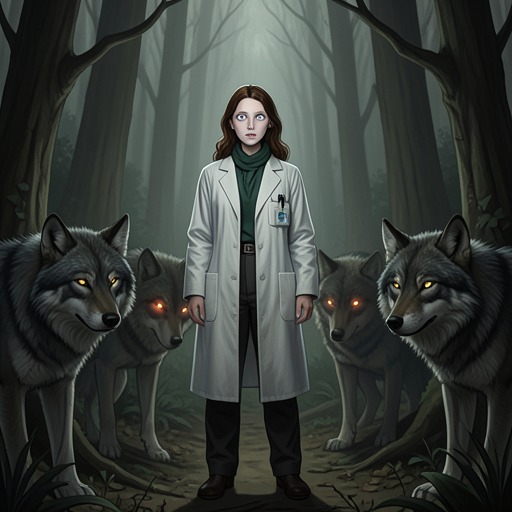
Abigail McKinney
The Werewolf Mates Anthology (Erotic Romance)Abigail McKinney begins as a scientist whose professional interest in wolves makes her especially well placed to recognize the difference between legitimate animal research and institutional abuse. Her arrival at Silver Sky Research turns that expertise into vulnerability: the laboratory presents itself as a center for wolf and predator studies while secretly selecting human beings as experimental subjects. Abigail’s abduction and subsequent transformation therefore make her both a victim of the research system and one of the characters through whom its scientific claims are exposed.
Identity and Professional Background
Abigail is introduced as Kelly Shaw’s new supervisor at Silver Sky Research. She is addressed as Abigail, Abby, and Dr. Abigail McKinney, and her authority initially appears ordinary and professional. When Kelly arrives at the large reception area, Abigail comes to give her a tour, welcomes her through the facility, and introduces her to the workplace before handing her a new-hire packet containing an office map. The setting reinforces the laboratory’s public identity: stark white corridors are decorated with portraits of benefactors and images of wild wolves and other predators studied by Silver Sky Research.
Her manner toward Kelly combines institutional competence with personal attentiveness. After noticing that Kelly does not look well, Abigail takes a small bottle of water from the mini-fridge beside her desk and asks whether she is all right. Later, when Kelly can barely keep her eyes open, Abigail crouches in front of her and arranges for an intern named Alysa to take her home. These moments establish Abigail as a supervisor who notices physical distress and responds practically, even before the hidden dangers of the laboratory become visible.
Abigail’s scientific position is not incidental to the plot. Silver Sky Research is publicly associated with wolf migration and predator studies, but Max reveals that the institution is doing more than studying migration patterns. Kelly then explains that Silver Sky has conducted unauthorized, unvetted human testing and that Abigail appears to have been chosen as one of its subjects. The irony is precise: Abigail’s knowledge of wolves does not protect her from the institution; it makes her placement within its research apparatus more consequential.
Abduction and Captivity
Abigail’s disappearance begins in her own office. She had been sick throughout the morning and had tried remedies without relief when her supervisor, Damien Greggs, entered to discuss her latest report. Before that conversation could last more than a few minutes, she collapsed to the floor. The episode converts a workplace encounter into the concealed mechanism of her capture, linking professional hierarchy, illness, and institutional control.
Three days later, Abigail is being held in a cage. She paces inside it like a captured but untamed animal, a description that reverses Silver Sky’s usual division between observing researchers and observed creatures. She knows that another girl is confined in a different cage, but their captors prevent them from speaking. Armed men dressed entirely in black later remove Abigail from the cell, while she remains unaware of who is holding her or where the other prisoner has gone. The isolation is therefore both physical and informational: the captors control movement, communication, and identity.
Jacob Pitman’s rescue depends on the weaknesses of that security system. He calculates that at 12:37 the guards will change positions, giving him three minutes to enter the facility, disable the camera feed, loop dummy video at the temporarily unmanned guard station, disable the holding-cell sensors, unlock doors along his route, and trigger a false alarm elsewhere. He then enters through the front door with a stolen identification card; although the cameras record him, his black clothing and hood obscure his face. His operation turns surveillance, access control, and the false alarm into tools against the institution that relies on them.
During the hurried escape, Jacob notices the wristband Abigail is wearing. It identifies her as Abigail McKinney and includes the numbers 24593 and 060614, though those numbers have no meaning for him. The band gives him the name the facility has reduced to an indexed body, while his reassurance that she is safe marks the beginning of a personal connection beyond the laboratory’s classification system. He takes her to his room after paying cash and using an untraceable getaway truck, trying to sever the logistical trail of her captivity.
Rescue, Transformation, and Intimate Disorientation
Abigail wakes the next morning sore and confused, but immediately understands that she is no longer in the cell. She also discovers Jacob lying beside her with an arm across her naked back and realizes that they have had vigorous sex, probably more than once. Her response is radically disorienting: fear and anger might ordinarily follow captivity and an unfamiliar rescue, yet she instead wants to move closer to Jacob, pursue him sexually, and have him again. The scene presents desire not as a simple reward for rescue but as another force Abigail cannot yet explain or control.
Jacob identifies himself as Jacob Pitman, and Abigail’s first sustained contact with him follows the contradictory pattern already established by her awakening: she has been removed from institutional violence but remains unable to separate bodily compulsion from conscious choice. The later understanding of the event places that confusion within the larger werewolf plot. Her response suggests that rescue has not restored her former autonomy; it has delivered her into a new bodily and relational condition whose rules are initially opaque.
At Max Shaw’s home, Kelly brings Abigail into the living room and offers her the large brown couch, while Max asks whether she would like to sleep before discussing what has happened. Abigail’s vulnerability is met by care rather than interrogation, but the domestic setting soon becomes a site of revelation. Max stretches, hunches over, falls onto all fours, and disappears; less than a blink later, a giant wolf stands where he had been. The transformation gives Abigail direct visual evidence that the animal identity she once approached scientifically is also embodied by the people now trying to help her.
After she has had time to calm down and think, Abigail gradually accepts the possibility that she is a werewolf. The adjustment takes several days. She wakes at night wondering why she is not in her own home, and Max and Kelly help her adapt after an abrupt first-day experience that throws her off a cliff. They wait for her questions, explain why they can turn into wolves, and clarify why they cannot transform on the night of the full moon. Their approach contrasts with Silver Sky’s coercive experimentation: knowledge is offered in response to Abigail’s needs rather than imposed through confinement.
Her first attempt to shift is governed by concentration rather than laboratory procedure. Abigail shakes out her arms, rotates her neck, breathes deeply, and pictures a wolf. Her scientific familiarity gives her a vocabulary for the imagined body: sleek gray fur, thick enough to withstand long winters, though the gray she first pictures is too dark for the wolves she knows. When she tries to correct the color, the image dissolves. The failure is significant because it shows her expertise has not yet become bodily mastery. She can analyze wolves as a researcher, but she cannot simply reason herself into becoming one.
Relationships and Conflicting Systems of Trust
Abigail’s relationship with Kelly begins in a professional hierarchy, but the crisis reverses that arrangement. Abigail first appears as the supervisor giving Kelly a tour and later acts as the person who notices Kelly’s illness and sends her home. Once Abigail becomes a captive and an experimental subject, Kelly becomes one of the people helping her understand the truth about Silver Sky. The relationship consequently shifts from workplace supervision to mutual exposure and practical care.
Max and Kelly provide Abigail with a temporary protective household. Max tells her that Silver Sky has been studying more than wolf migration, and Kelly states that the research center has conducted unauthorized human testing and selected Abigail as a subject. At the same time, their protection does not erase the unsettling power of the new world they introduce. Max’s wolf form and the rules surrounding transformation force Abigail to reconsider the categories on which her professional identity was built.
Jacob is the person most directly connected to Abigail’s escape. He identifies her from the wristband, carries her out of the facility, and tells her that she is safe. Yet the immediate sexual bond between them makes safety difficult to interpret in purely psychological terms. Abigail’s powerful attraction to him begins before she has any clear account of what has happened to her, so their connection is experienced as both rescue and compulsion. The later arrival of Jacob’s sister, Jaz Pitman, broadens Abigail’s relationship network: Jaz recognizes Abigail through her resemblance to Jacob, explains that Jacob made a deal and was being kept, says that she had been dumped in the forest, and urgently demands that Abigail help get Jacob out.
Jaz’s appeal places Abigail between two forms of captivity and obligation. Abigail has been rescued from a cage, but Jacob remains in Silver Sky’s custody after making a deal. The request also makes kinship a force that reaches beyond the laboratory: Jaz does not treat Abigail merely as a recovered subject, but as someone capable of acting on Jacob’s behalf. Abigail’s emerging ties therefore connect scientific complicity, intimate attraction, and the practical demands of family loyalty.
Development and Narrative Significance
Abigail’s arc is a movement from institutional legitimacy to bodily uncertainty and then toward chosen understanding. At Silver Sky Research, research language, maps, offices, benefactors, and predator photographs make the facility appear orderly and benevolent. Behind that appearance, the same institution confines people in cages and subjects them to unauthorized human testing. Abigail’s professional role exposes the contradiction because she knows the public field from within, yet her own body becomes evidence of what the institution conceals.
Her transformation also unsettles the boundary between human subject and animal object. Abigail once approached wolves through research, including the practical details of fur, coloration, and adaptation to winter. After Silver Sky’s intervention, she must learn the wolf not as a specimen but as a possible self. Her failed visualization of gray fur captures the distance between intellectual knowledge and embodied identity, while Max and Kelly’s explanations offer a social framework in which transformation can be learned rather than merely endured.
The character’s significance lies in the collision of these systems. Silver Sky defines bodies through cages, records, security procedures, and experimental selection; Jacob counters it through planning, stolen access, and rescue; Max and Kelly counter it through explanation and care; Jaz adds the pressure of sibling loyalty and unfinished captivity. Abigail stands at the intersection of all four. She begins as a scientist arriving to work at the laboratory, becomes one of its hidden subjects, survives its confinement, and is then required to interpret a body that makes the laboratory’s public subject matter personally real.