Olson and Breyer, Attorneys at Law
The Werewolf Mates Anthology (Erotic Romance)Olson and Breyer, Attorneys at Law is a relatively small Boise firm whose legal work becomes an unlikely crossing point between ordinary criminal procedure, professional obligations, and the hidden world of werewolves and illegal human experimentation. Through Andy Olson’s defense of Parker Griffith and Wren Longwood’s assignment to the same case, the office shifts from a workplace into an investigative threshold: its files, meetings, conference rooms, and conversations expose how official law encounters secrets that the pack must contain by its own rules.
Identity and Working Environment
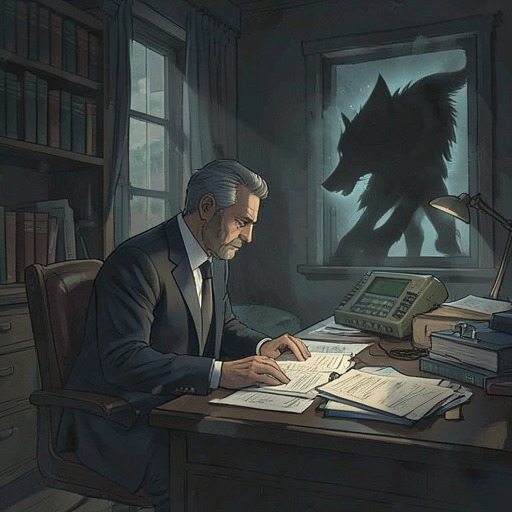
Olson and Breyer, Attorneys at Law is described as a small practice carrying a larger caseload than its number of attorneys should comfortably allow. Andy Olson has experience in the firm and is expected to handle a difficult burglary case partly because Parker Griffith’s father is a family friend and Andy’s father believes the assignment will give him useful experience. The firm’s workload is demanding but not as punishing as Andy’s earlier period as a prosecutor in New York. Even so, Andy has been arriving early and staying late for weeks, searching for a defensible argument in a case whose evidence appears overwhelmingly strong.
The office contains several distinct spaces that reflect its professional hierarchy. A smaller conference room, once a closet and still the only meeting room without windows, is normally reserved for internal meetings; clients receive the better rooms. Later, Andy and Wren meet Marina Trent, an assistant prosecutor, in a more prestigious conference room overlooking the foothills. The contrast makes the firm’s architecture part of its institutional character: privacy, status, and access are distributed through rooms before anyone speaks.
The Griffith Case and the Silver Sky Clues
The firm becomes involved in the Parker Griffith case after Griffith is accused of burglarizing Silver Sky Research. Andy initially sees the matter as a nearly hopeless defense. He considers persuading Griffith to plead guilty simply to end the proceeding, yet his dislike of losing drives him to investigate the evidence more intensely. The case therefore begins as routine professional labor: a lawyer studies crime-scene material, prepares for a prison visit, and looks for a weakness that might prevent conviction.
Wren Longwood is assigned to work with Andy on the Griffith case, apparently at the direction of Andy’s father, Sam, without Andy having expected the arrangement. In their first substantive meeting at the firm, Wren lays out redacted documents and crime-scene photographs from the Silver Sky break-in and proposes that they compare their progress rather than duplicate each other’s research. Their collaboration has an immediate personal complication. Andy is powerfully attracted to Wren, while her presence and background make her seem both sophisticated and perfectly controlled. The office thus holds two investigations at once: the explicit legal inquiry into Griffith and the private struggle of two people trying not to surrender control to their attraction.
The firm also supplies the setting in which a seemingly minor administrative anomaly becomes a meaningful clue. Kelly Shaw tells Andy that the Olson and Breyer servers crashed on the same day as the Silver Sky break-in, even though the police report treats the failure as unrelated and investigators have accepted Griffith’s denial of knowledge. Because the crash occurred near the time of the intrusion, the firm’s own technical disruption becomes part of the chain connecting the burglary to concealed information. Wren’s documents, the crime-scene photographs, and the overlooked server failure gradually transform the case from an uncomplicated burglary prosecution into a question about what Silver Sky is hiding.
Professional Law and Hidden Authority
The firm operates according to the formal rules of legal practice. Andy reminds Griffith that their conversation is private and privileged before asking why he entered Silver Sky Research. The language of privilege creates a protected space in which Griffith can disclose information that might otherwise remain inaccessible. Yet the firm’s legal safeguards prove limited when the underlying conflict extends beyond the ordinary criminal courts. Griffith’s account points toward Silver Sky’s secret experiments, while the werewolf pack’s need for secrecy imposes another, unofficial system of enforcement.
The case ends before a trial can test the evidence. Marina Trent arrives at the office unannounced and privately informs Andy and Wren that the prosecutor’s office has decided to drop the charges against Griffith. Andy immediately suspects that the decision is connected to what Griffith told them. When Andy calls Max Shaw, Max says that people will examine Silver Sky more closely and refuses to confirm whether that investigation has anything to do with the dropped prosecution. Andy objects that prosecutors cannot simply be bribed and insists that the town is governed by law rather than personal power. Max denies bribery, but declares that Andy’s problem has been taken care of.
The office therefore marks the boundary between public justice and private authority. A prosecutor’s decision formally resolves the Griffith case, but the conversation suggests that forces outside the firm have influenced the practical outcome. Andy and Wren must also keep Griffith quiet because an ordinary person speaking publicly about real werewolves at an Idaho research facility would threaten the pack’s security, whether or not anyone would believe him. Legal confidentiality and supernatural secrecy overlap, but they are not identical: one is a professional obligation, while the other is a survival rule.
Wren Longwood’s Place in the Firm
For Wren Longwood, Olson and Breyer, Attorneys at Law is both a workplace and a temporary refuge from her Manhattan family. She has come from New York, where the Longwood family has lived for more than two centuries, and she works in Boise after being expelled when her family learned that she had become a werewolf. At the firm, her background remains visible in her manner and expectations, but she does not treat Boise as inferior or behave as though she is out of place. Her professional competence allows her to enter the office’s legal culture without abandoning the identity that her family rejected.
Her assignment to the Griffith case gives her a concrete role beside Andy. She researches documents, summarizes the case, and continues working on other matters because the firm’s caseload prevents her from dedicating all her time to one investigation. Even private research can be conducted under the cover of office work: while preparing material on sunrise and sunset times for another case, she also looks for a roofing specialist for personal reasons. The firm is consequently a space where Wren’s human profession and werewolf circumstances coexist without either being fully visible to her colleagues.
Narrative Significance
Olson and Breyer, Attorneys at Law functions as a threshold location rather than a mere backdrop. Its conference rooms turn attraction into a problem of professional self-control; its files and server failure convert a burglary defense into an inquiry into Silver Sky Research; and its private meetings show formal institutions struggling to contain facts that belong to a concealed supernatural order. The firm’s legal language—privilege, evidence, prosecution, conviction, and dismissal—continually encounters other forms of authority, including pack secrecy, alpha power, family control, and the coercion exercised by Silver Sky over its human subjects.
The location’s significance also lies in its ordinary appearance. Nothing about a law office announces the existence of werewolves, yet the Griffith case brings that hidden reality into its rooms through testimony, documents, and professional investigation. By the time the charges are dropped, the firm has not solved Silver Sky’s crimes in court, but it has helped expose the first usable connection between the burglary, the research facility, and the wider danger. In that sense, Olson and Breyer is where conventional law first becomes aware that the case is larger than the legal system prepared to recognize.