
The Chase and Its Changing Stakes
The WhaleThis flow traces the open-boat whale hunt from dangerous face-to-face confrontation to technologically unequal industrial slaughter and modern rescue.
increasing Bearing strength in each event
 decreasing
Bearing strength in each eventdecreasingThe Search from the Masthead
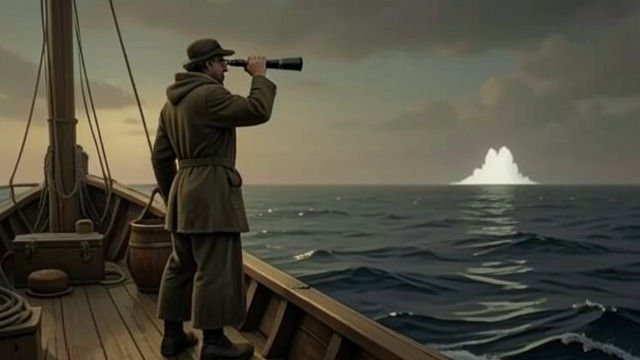
Waiting for the Blow
Days of uncertainty
Lookouts scan the horizon while ships move across vast grounds in search of whales. Long stretches of inaction give way to a sudden command when an animal appears.
An economy of suspense
The entire voyage depends on a few encounters. Crew, ship, and investment converge on the possibility of a single kill.
The Boat Goes Down
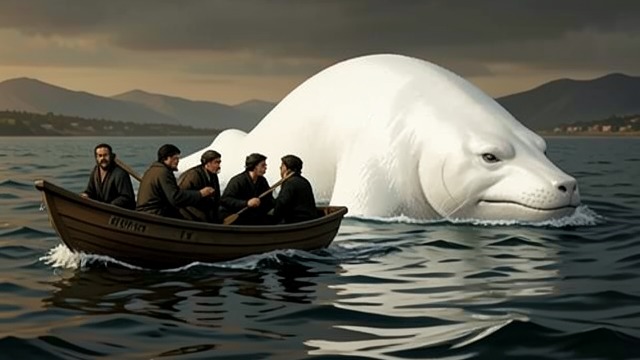
A Small Craft at Risk
The lowering
A crew climbs into an American-style whaleboat and rows quietly toward the whale. The hunter’s proximity exposes the men to the animal’s size and sudden movement.
Courage and coercion
The chase is remembered as heroic sport, but it is also dangerous labour performed for the ship’s profits. The whale is treated as an opponent and a commodity at once.
The Harpoon Finds Flesh
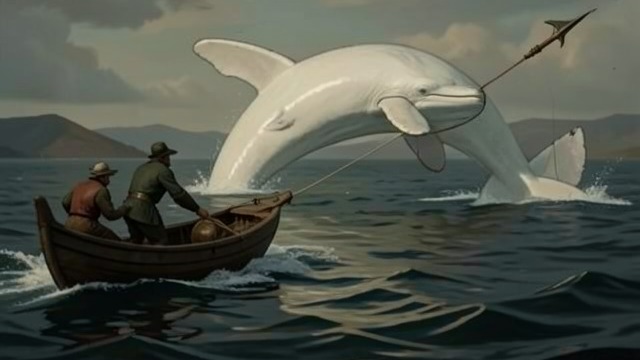
A Line Between Species
The strike
A harpoon enters the whale and the line runs out at dangerous speed. Men may be dragged overboard as the wounded animal dives or tows their boat away.
A precarious reversal
The whale can break boats and kill its hunters, making the confrontation genuinely uncertain. Human control is not secured until the animal is exhausted and killed.
Factory-Ship Efficiency
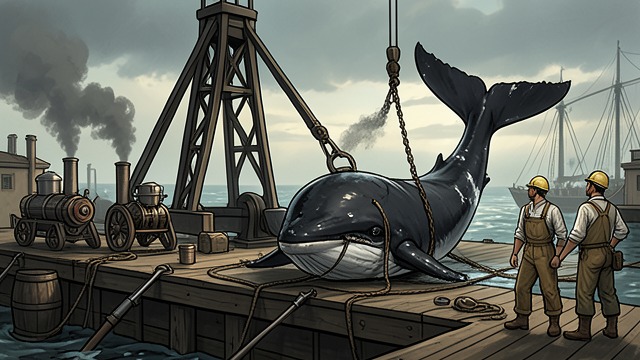
The Unequal Hunt
A technological shift
Harpoon guns, steam-powered catchers, and factory ships enable fleets to kill at a far greater rate. Hunters no longer have to face the whale in a small boat.
A lost balance
The animal’s capacity to fight back is greatly reduced. Industrial efficiency converts the old risky chase into a rapid, large-scale process of slaughter.
The Rescue Reversal
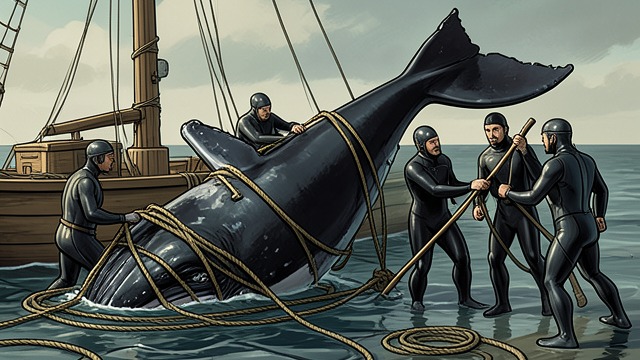
Cutting a Whale Free
Familiar equipment, new aim
Rescuers approach an entangled whale with boats, lines, and long-handled tools that recall whaling methods. Their purpose is to release rather than kill the animal.
A dangerous ethical reversal
The whale remains physically powerful, and rescuers risk injury in close contact. Human skill now attempts to repair one of the hazards human industry has created.
During nineteenth-century whaling voyages
At the start of an open-boat pursuit
During the climax of a nineteenth-century chase
During the twentieth-century industrial whaling era
During Charles Mayo’s modern rescue work
