
Whaling and Slavery
The WhaleThis flow traces the book’s comparison between two exploitative Atlantic industries and the unequal labour and ideologies supporting them.
increasing Bearing strength in each event
 decreasing
Bearing strength in each eventdecreasingA Port of Enslaved Labour
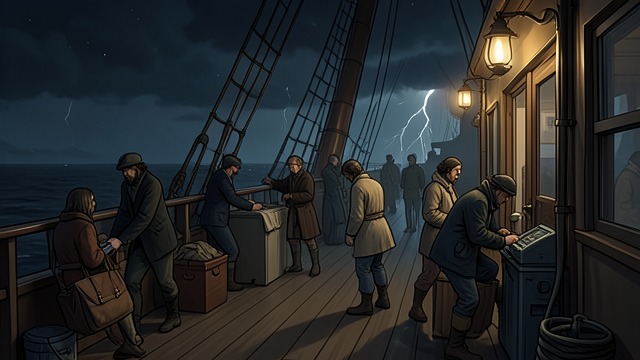
Whaling’s Human Workforce
Crews from many origins
Whaling ships employ people from across the world, including Black sailors and men from the Azores and Cape Verde. Their labour supports a trade celebrated through the image of white New England enterprise.
Unequal conditions
Crew members face dangerous work, harsh discipline, and unequal treatment. The ship’s apparent community does not erase the social hierarchy carried aboard.
Douglass in New Bedford
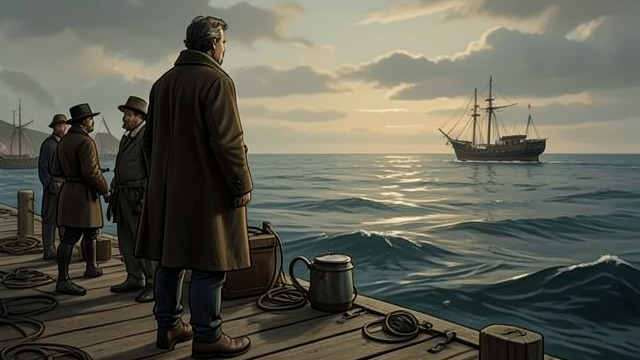
Freedom in a Whaling City
A place of refuge
Frederick Douglass escapes slavery and finds work in New Bedford. Its port and abolitionist networks offer a meaningful, though incomplete, form of safety.
A revealing contrast
The city’s whaling economy binds sailors to exploitative labour even as it shelters people escaping human bondage. The parallel exposes different forms of coercion without making them identical.
The Fugitive Slave Law

A Nation’s Moral Crisis
Legal capture
The Fugitive Slave Act empowers slaveholders to pursue people who have escaped across state lines. Abolitionists recognize the law as a direct attack on freedom.
Melville’s symbolic language
Moby-Dick’s divisions and images of whiteness and blackness take on added political resonance. The novel’s whale hunt unfolds against a nation arguing over who may claim another body.
Douglass Under Attack

Violence Against a Public Voice
An assault on the street
Douglass and the Griffiths sisters are attacked in New York by hostile men. The assault makes clear that public abolitionist speech can carry immediate physical risk.
A demand for justice
Douglass writes against racial violence and continues speaking. His response challenges a society that claims freedom while policing Black presence.
Two Industries Exposed
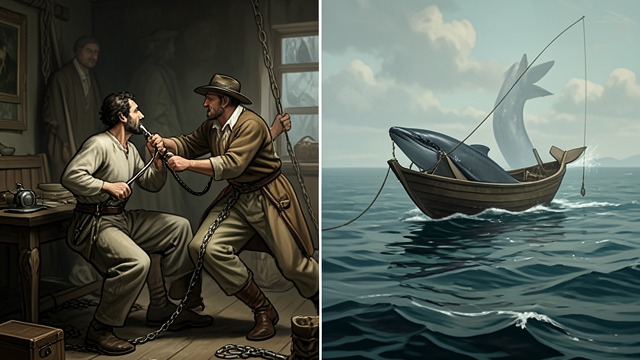
Extraction and Responsibility
Human and animal claims
The book places slavery and whaling beside one another as exploitative, transoceanic economies. One trades in human beings and the other in whale bodies, while both depend on systems that normalize profit from vulnerability.
A difficult comparison
The analogy does not collapse their distinct histories. It instead asks how economic success can be built on lives treated as resources.
During the nineteenth-century whaling boom
From 1838
In 1850
During Douglass’s public work in New York
As Hoare reflects on the history of whaling
