1712
The Whale1712 is presented as a pivotal year in the expansion of Nantucket whaling: the reported discovery of the sperm whale in deep water opened a new fishery and helped set the island on a course toward global commercial prominence. The year’s importance lies not in isolation but in the long chain it begins, linking a change in quarry to fortunes on shore, labor at sea, technological escalation, and the depletion of whale populations.
A New Quarry
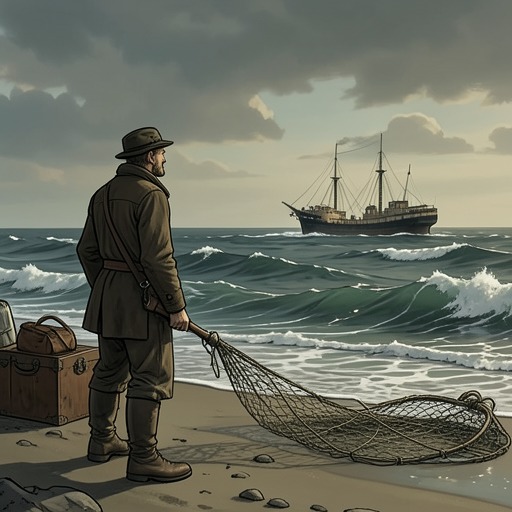
Before 1712, Nantucket whalers had learned from Nattick Indians to pursue migrating right whales. Lookouts watched from land masts; crews harpooned whales and towed them to the beach, where the thick blubber yielded abundant oil and the baleen supplied useful material. The fishery thus already depended on Indigenous knowledge and on transforming a whale’s body into products for human use.
According to the account’s legend, Christopher Hussey was hunting in a sloop when wind carried him beyond the usual limits of Nantucket’s fishing grounds. In deep water he encountered the sperm whale, previously considered fabulous or unknown. The new prey displaced the right whale as the more prestigious target in the island’s whaling culture. The distinction was framed in terms of status and sport: pursuit of the sperm whale was cast as a more spirited and gentlemanly hunt. As right whales grew scarcer, the sperm whale became increasingly important to the island’s economy.
From Island Fishery to Industry
The change registered quickly in the growth of the fleet. By 1730 Nantucket had twenty-five whaling vessels, and by the end of the century the island led the world in whaling. In 1748, Jacob Rodriques Rivera introduced to New England the method for producing candles from sperm-whale headmatter. The process involved heating the material, separating and pressing it in stages, and refining the residue into white wax. Each step turned the catch into saleable goods; the candles and other whale products brought substantial wealth to the island.
That wealth was neither evenly made nor confined to Nantucket. Whaling fortunes helped build the first industrial fortunes in America, while New Bedford emerged as another major port. By the second quarter of the nineteenth century, one in twenty residents of New Bedford was black, and its streets reflected a population shaped by migration from the Azores and Cape Verde as well as from elsewhere. Black sailors found work with whaling owners, some rising to become captains or mates; Lewis Temple, a New Bedford inventor, developed the toggle-iron harpoon. Yet racial divisions persisted aboard ship, including segregated bunks, and the industry’s labor depended on men of color as well as on workers from many national backgrounds.
The limits of that freedom are visible in the experience of Frederick Douglass. After escaping slavery in 1838, he lived and worked in New Bedford for four years, doing a range of manual jobs. The whaling ship and shipyard could offer knowledge and work, but they remained part of a society marked by racial inequality. The city’s maritime prosperity joined opportunity to hardship rather than resolving the contradiction between them.
Decline and New Forms of Extraction
From the 1840s, Nantucket’s position weakened. Larger ships needed for distant sperm-whale grounds could not easily cross the island’s silting harbor bar, while New Bedford offered easier access to the Pacific. A fire in 1846 destroyed a third of Nantucket’s businesses. The 1849 departure of the ship Aurora for San Francisco reflected another pull on the island’s young people: the search for gold during the California Gold Rush.
Petroleum further altered the market. Kerosene and coal gas had already entered use when, in 1859, Edwin L. Drake drilled for oil at Titusville, Pennsylvania. The new petroleum supply helped end the commercial basis of the sperm-whale fishery, even as demand for bright illumination had initially encouraged consumption of whale oil. During the American Civil War, ships were captured or burned, and forty whaling vessels were deliberately sunk as the Stone Fleet to obstruct southern harbors. The Nantucket industry continued for a few more years; its last whaling ship departed in 1869.
The shift from sperm whales to other species did not end the pressure. On Christmas Eve 1868, Sven Foyn recorded thanks for his newly patented grenade harpoon, a technological advance that allowed whalers to pursue large, fast rorquals, including blue whales and fin whales. As American whaling declined, European operations expanded into Antarctic waters from 1904, supplying whale products for new industrial uses, including the manufacture of nitroglycerine. By 1918, the entire South Atlantic humpback population had been driven to extinction. The history that begins with the opening of a new fishery thus broadens into a recurring pattern: when one source of whales became depleted or unprofitable, technology and markets redirected the hunt toward another.
Historical and Ecological Afterlife
Whaling’s changing fortunes continued into the twentieth century. The New Bedford fishery was already in long decline when its last whaler sailed in 1924; the industry had shifted toward textiles, while the town’s old wharves and derelict ships remained reminders of its earlier dependence on whale oil. Meanwhile, factory ships enabled industrial-scale Antarctic whaling, and the resulting loss of rorquals made clear that the expanding catch could not continue indefinitely.
The retrospective account places 1712 within a much longer history of human use and ecological consequence. Scientific attention to whale societies arrived alongside signs of their disappearance: hunting could remove matriarchs and the knowledge passed between generations, while slow-breeding species remained vulnerable to the accumulated effects of commercial killing. During the writing of the book, the Yangtze River dolphin was declared extinct, and the future of sperm whales was described as uncertain. The year 1712 therefore serves as a historical hinge: the moment a new quarry expanded Nantucket’s fishery also begins a chronology in which economic success repeatedly depended on finding, exploiting, and eventually exhausting new populations.