Age of Whaling
The WhaleThe Age of Whaling was a period of commercial extraction that made whales a source of wealth, energy, food, and industrial materials, while bringing hunters into a perilous closeness with animals they scarcely understood. Its history joined technological change to ecological loss: a century that began with active pursuit ended, in the book’s account, with people watching whales instead. The transition did not erase the costs of the hunt, either to whale populations or to the human societies built around it.
An economy made from whales
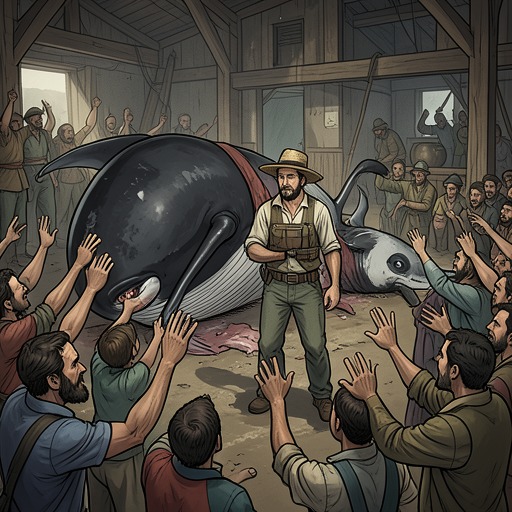
The whale fishery generated fortunes and helped build the modern world. Whale bodies were converted into commodities for distant markets, and wealth made at sea took visible form ashore. In New Bedford, houses and gardens on County Street represented an exchange in which whales from the Atlantic, Pacific, and Indian oceans were killed to pay for urban grandeur. Whale oil supplied light and industrial uses; Baleen, flexible and workable, served as a material for objects including umbrellas, corset stays, blinds, and brushes. The consequences reached far beyond the waterfront: the value of the whale connected ocean hunting to manufacturing, trade, domestic consumption, and the fortunes of port communities.
On Nantucket, processing Whale oil into candles illustrates how many stages separated the captured animal from a finished product. The technique reached New England in 1748. Headmatter from Sperm whales was heated in large kettles to remove water and impurities, then cooled in casks over winter. Workers placed the coagulated material in woollen bags and pressed it in wooden equipment; the first, purest pressing was known as winter-strained sperm. The residue became black cakes, stored until spring and pressed again as spring-strained oil. A third pressing left a brownish substance that was clarified with wood shavings and potash into white wax. Each stage extracted further value from the same material, and the resulting candles helped make the whale fishery profitable.
The whale’s body also became a provision for a later, larger-scale industry. When the factory ship Balaena returned to Southampton in 1948 after an Antarctic season, its cargo included 4,500 tons of meat, 163,000 barrels of edible oil intended for margarine, 10,000 barrels of sperm oil, 170 tons of meat extract, and another 3,000 tons of meat for cattle fodder. The ship itself carried laboratories, a blacksmith’s shop, and a hospital. Its cargo showed how completely industrial processing could turn a single expedition’s catch into food and materials for a post-war economy.
Expanding the hunt
The history of the hunt was shaped by changing prey, markets, and technology. Sperm whales became central to modern whaling in the early eighteenth century, when commercial pursuit first brought people toward an understanding of the animals. Their deep-water habits and long-ranging lives meant that for a long time whalers, rather than other observers, were the people most likely to see them alive. The species’ apparent vulnerability to hunting was bound up with its physiology and behaviour: it had valuable blubber, spent time at the surface, and was considered shy. Right whales, similarly buoyant and inclined to remain near shore, had been hunted for centuries; their Baleen could be made into a range of useful goods. Fewer than four hundred North Atlantic right whales remained in the account given by the book.
As familiar hunting grounds and target species were depleted, new methods widened the range of the fishery. On Christmas Eve 1868, Sven Foyn recorded his thanks after patenting a grenade harpoon designed to explode in a whale’s head. Harpoon guns had already been used, but Foyn’s weapon, mounted on steam-powered vessels, made the fast rorquals—including Blue whales and Fin whales—accessible to commercial hunters. The new method turned a sighting into a near-certain death sentence; Scandinavian fleets soon killed a thousand Fin whales a year, and Humpback whales also came under heavy pressure. The technology did not simply make hunting more efficient: it shifted exploitation toward species that earlier whalers had struggled to catch.
The search for new uses and grounds continued as markets changed. From 1904, Norwegian and British steamships opened Antarctic waters to large-scale hunting, in part to produce nitroglycerine. During the two world wars, about 50,000 whales were killed, supplying material for a world at war; by 1918 the entire South Atlantic population of Humpback whales had been driven to extinction. In 1925, Norway launched the first factory ship, the Lancing. The factory-ship system brought processing into the hunting grounds and enabled the killing of one and a half million rorqual whales over the ensuing period described in the book. A practice that had once depended on ships bringing their catch back to port had become a mobile industrial operation in remote waters.
Energy shifts and the decline of older ports
Whaling’s fortunes were tied to demand for illumination and other products. Kerosene and coal gas began lighting streets and houses from the 1840s, initially accompanying rather than immediately ending demand for Whale oil. In 1859, Edwin L. Drake drilled for oil at Titusville, Pennsylvania. Petroleum offered a new source of fuel, while the first electric light was switched on in 1879. With the price of Whale oil falling and major whale populations depleted, older fisheries lost their commercial footing. A vessel sailing from Peterhead in 1880 returned after six months with only two whales and had to rely on seals for profit.
The decline was uneven rather than immediate. Whaling in the western Arctic briefly revived in America as hunters pursued Bowhead whales for their Baleen, then used in corsets and hoops. But Baleen was increasingly displaced by steel and plastic, just as the whale-oil market had lost ground to other sources of light. The last whaler sailed from New Bedford in 1924. In 1869, the last whaling ship had already left Nantucket, following the combined blows of an obstructed harbour, a devastating fire, the California Gold Rush, petroleum, and wartime losses. The change was also social: as the fishery contracted, New Bedford’s waterfront turned toward textile production and tourism, while Nantucket’s former whaling centre became a quieter place marked by empty quays and the buildings left by its prosperous era.
Ecological consequences and a changed relationship
The reduction in hunting did not mean that whale populations recovered quickly, or that their dangers had ended. The North Atlantic right whale had been protected from hunting in 1935, yet its numbers remained static. Its coastal habits brought it into busy shipping routes, where collisions and fishing-line entanglement continued to kill whales. Rules moving shipping lanes north and directing vessels to stay five hundred yards away had not removed the threat. With only a small number of breeding whales and eight matrilineal lines remaining in the northern population described by the book, the accumulated effects of past hunting and present hazards placed its future in doubt.
Whaling also altered the social knowledge on which whale communities depend. Research into Sperm whale societies suggested that groups learn foraging practices and distinctive patterns of communication across generations. Hunting may have undermined those communities by removing matriarchs and the knowledge they carried, as well as large males that mated with females. Because Sperm whales breed slowly, population losses can continue to shape their prospects long after the period of intensive hunting has passed. The book sets this delayed ecological damage beside a broader warning: while people learn more about whales, the animals and the worlds they inhabit may be disappearing.
The change from hunting to watching was therefore real but incomplete. Modern science and the circulation of photographs, film, and television brought whales into public view in new ways, helping recast them from quarry and feared adversary as vulnerable, remarkable animals. Yet that changed public image followed centuries in which the whale had been treated as money, food, livelihood, and raw material. The declaration that the Yangtze River dolphin was extinct during the period of the book’s composition makes the larger consequence plain: the end of commercial pursuit in some places cannot by itself undo the losses of the Age of Whaling, or guarantee the survival of the species that remain.